
Desktop AI agent for macOS and Windows
Lapu AI is a desktop-native AI agent that operates files, shell, and desktop applications on your machine. Built-in frontier AI, permission-based execution, and a free tier with no credit card.
- 1-click uninstall
- Cancel anytime
- Files never leave your computer
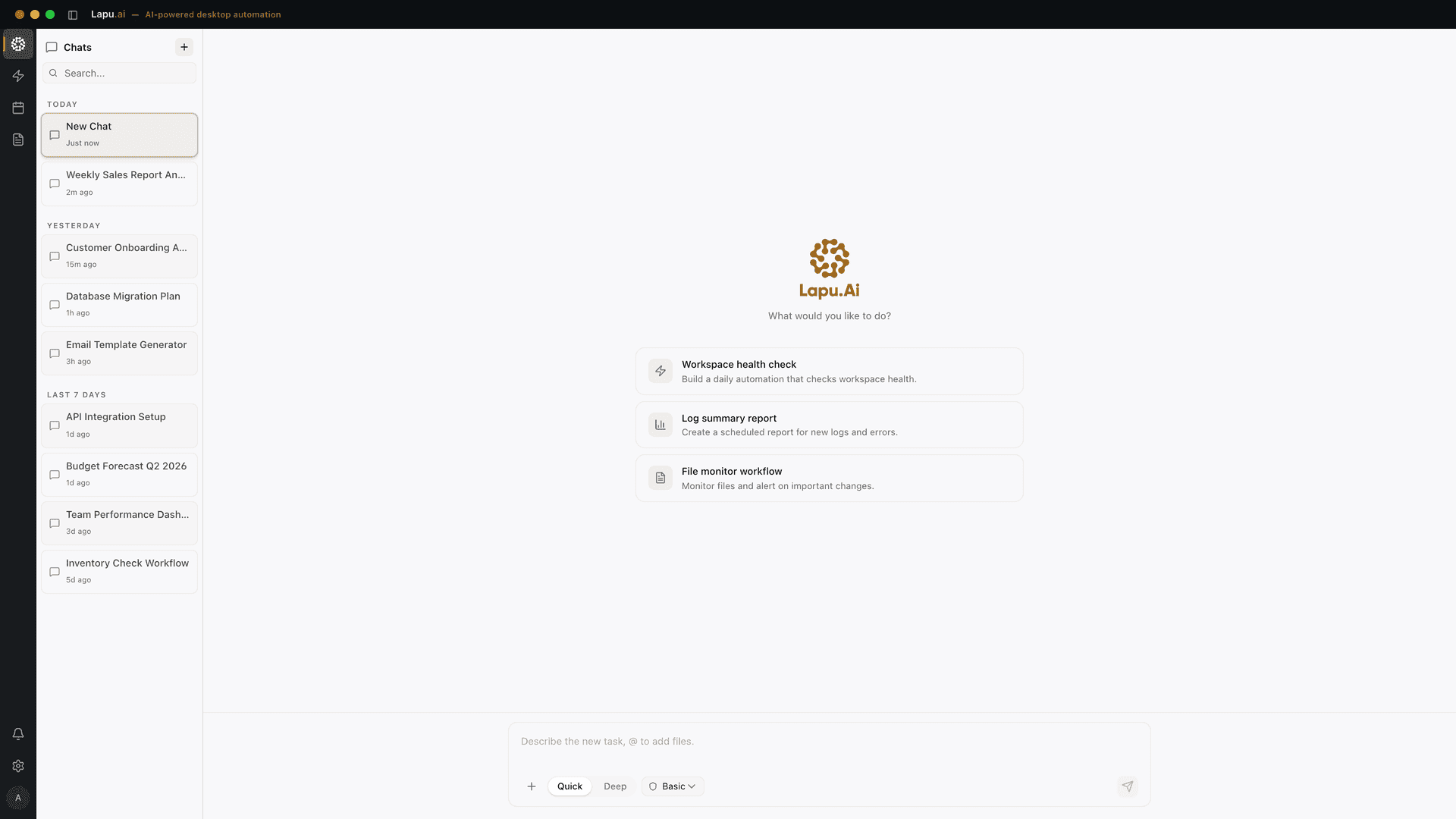

Why a desktop AI agent
Most AI tools live in a chat box or a browser tab. They give you answers and ask you to copy results back into the work. A desktop AI agent closes that loop: it reads the file, runs the command, drives the other application, and returns finished work. Lapu AI is built for that loop, with safety gates so the agent never acts beyond its granted scope.
What Lapu AI is, and what it is not
Lapu AI is an installed macOS and Windows agent for bounded work on the user's own machine. It reads local files, operates desktop and web applications, runs approved commands, and records the actions it takes. It is designed for non-technical people who want the work completed without building the automation themselves.
Not a chat-only assistant
The output can be an edited file, a completed form, or an updated application, not only an answer in a conversation.
Not a coding IDE replacement
Lapu can run commands and edit files, but it is built for everyday desktop work rather than heads-down software development.
Not a remote cloud workspace
Files and tool execution stay on the machine. Only the context needed for a reasoning step is sent to the model endpoint.
Not uncontrolled autonomy
Consequential actions stop for permission, and the audit trail keeps the completed workflow reviewable.
What Lapu AI gives you
Built-in frontier AI
No model API keys to manage. Reasoning calls go through Lapu AI infrastructure to the integrated model endpoint.
Local tools
File read, write, edit, grep, and shell execution: all running on your hardware with output captured and reasoned about.
Desktop automation
Native accessibility APIs on macOS (Swift) and Windows (C#) drive other applications: screenshot, click, type, navigate.
Permission gating
Risky actions surface a per-action approval prompt. The agent shows what it plans before any file write or shell command.
Reusable skills
Package workflows into skills you can rerun and schedule. Operational repeatability without rewriting a prompt each time.
Local-first data story
Files stay on your machine. Only the immediate reasoning context for a single step is sent to the model endpoint.
| What the agent does | Where it runs | Before it runs |
|---|---|---|
| Reasons about the next step | Lapu AI infrastructure → the integrated model endpoint | Only the immediate context for that step is sent |
| Reads, writes, edits and greps files | Your hardware | A per-action approval prompt before any file write |
| Runs shell commands | Your hardware | A per-action approval prompt before any shell command |
| Drives other applications | Native accessibility APIs: Swift on macOS, C# on Windows | Risky steps pause for your approval |
Lapu AI is the desktop AI agent described here. Free tier, no credit card, on macOS 12 Monterey or later and Windows 10 or 11.
Try it freeHow does a desktop AI agent control other applications?
Through the accessibility interfaces the operating system already publishes. Microsoft documents UI Automation as providing programmatic access to most user interface elements on the desktop, so assistive technology can read the UI and manipulate it by means other than standard input. Apple documents its Accessibility API as an abstraction layer that lets one application manipulate the UI of another, reading an AXUIElement and performing the actions it exposes. A screen reader uses those interfaces to announce the Save button. An agent uses the same interfaces to press it.
The alternative approach is to work from pixels. IEEE Spectrum’s February 2025 survey of computer-use agents describes Claude navigating by viewing screenshots and counting the pixels needed to move the cursor to a spot for a click. Anthropic’s own computer use documentation describes the same primitives (screenshot capture, mouse control, keyboard input), and notes that computer use is a client-side tool, so screenshots, inputs and session files are captured and stored in your environment rather than by Anthropic.
Neither approach is finished work. Reporting the OSWorld desktop benchmark at the January 2025 launch of OpenAI’s Operator, MIT Technology Review put the Computer-Using Agent model at 38.1% and Anthropic’s Computer Use at 22.0%, against 72.4% for humans. On the web-only WebVoyager benchmark the same report put CUA at 87%. The gap between those two numbers is the honest shape of the category: agents are markedly better inside a browser than across a real desktop, which is why a permission prompt before each risky step is a design requirement rather than a courtesy. IEEE Spectrum notes the practical corollary: these agents hand control back to the person to log in, accept terms of service, solve CAPTCHAs and enter payment details.
A separate question is how an agent reaches services rather than applications. That is what the Model Context Protocol covers: an open-source standard, published at modelcontextprotocol.io, for connecting AI applications to external data sources, tools and workflows. MCP and the accessibility layer solve different problems: MCP reaches systems that expose a server, and the accessibility layer reaches the software already open on your screen that never will.
By type
Free Desktop AI Agent
A free desktop AI agent for macOS and Windows. Lapu AI ships frontier models, file and shell tools, and permission gates, no credit card required.
How to Choose the Best Desktop AI Agent
How to choose the best desktop AI agent in 2026. A decision framework covering local execution, permissions, model access, platform support, and pricing.
By role
Founders, operators, office workers, analysts, and researchers use the same desktop agent. The difference is the workflow: reconcile a spreadsheet, prepare a report, organize source material, or move information between applications.
Browse workflows by roleExplore further
Frequently asked questions
| Dimension | Cloud or browser agent | Desktop AI agent (Lapu AI)Recommended |
|---|---|---|
| Where it runs | A server you do not control. Containerized agents spin up a remote Linux desktop. | Natively on your own macOS or Windows machine. |
| What it acts on | Data it has to be handed first. | The real files, shell, and applications already there. |
| Where execution and files stay | On the server, once your data is handed over. | Local. There is no Lapu AI cloud workspace. |
- What is a desktop AI agent?
- A desktop AI agent is a native application that combines a frontier AI model with direct access to local tools (files, shell, and desktop automation), so it can execute multi-step work on your machine rather than only answering questions.
- How is a desktop AI agent different from a chat assistant?
- Chat assistants give you answers. A desktop AI agent acts. It reads files, runs commands, drives other applications, and completes multi-step tasks on your computer, pausing for your approval before risky steps.
- Which platforms does Lapu AI support?
- Lapu AI runs natively on macOS 12 Monterey or later (Apple Silicon) and Windows 10 or 11 (64-bit). Both builds share the same agent loop, tool set, and permission model.
- Is my data sent to the cloud?
- Files and workspace data stay on your machine. There is no Lapu AI cloud workspace. When the agent needs to reason about a step, only the immediate context is sent to the integrated model endpoint via Lapu AI infrastructure.
- Is there a free tier?
- Yes. Lapu AI's Free tier is available without a credit card and includes the desktop application, built-in frontier AI within a monthly usage allowance, local tools, and reusable skills.
- How is a desktop AI agent different from a cloud or browser agent?
- A desktop AI agent runs natively on your own macOS or Windows machine and acts on the real files, shell, and applications already there. Cloud and browser agents, and containerized agents that spin up a remote Linux desktop, run on a server you do not control and have to be handed your data first. The native-desktop model keeps execution and files local and gates risky actions behind your approval. That is the model Lapu AI uses.
Sources
- Microsoft Learn. UI Automation Overview. Accessed July 2026.
- Apple Developer. UIElementInspector: Accessibility API and AXUIElement. Accessed July 2026.
- Anthropic. Computer use tool documentation. Accessed July 2026.
- IEEE Spectrum. Are You Ready to Let an AI Agent Use Your Computer?. Eliza Strickland. February 13, 2025.
- MIT Technology Review. OpenAI launches Operator: an agent that can use a computer for you. Will Douglas Heaven. January 23, 2025.
- Model Context Protocol. What is the Model Context Protocol (MCP)?. Accessed July 2026.
Automate the work between you and outcomes
Lapu AI handles the repetitive work between you and outcomes. One desktop agent, zero tab-switching. Available now on macOS and Windows.
- 1-click uninstall
- Cancel anytime
- Files never leave your computer
Free to start. Cancel in 1 click. Files stay on your machine.