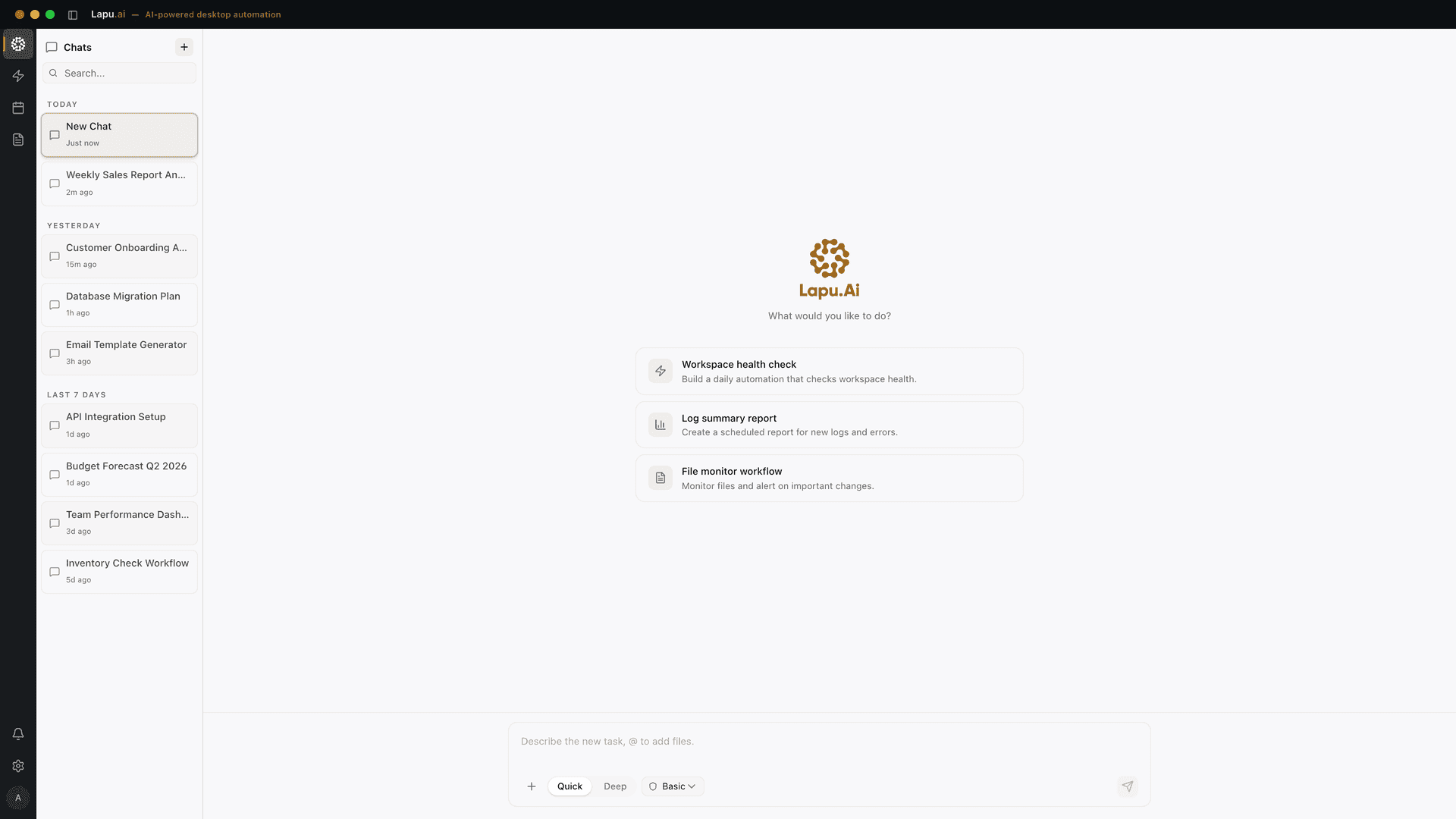
What is the best desktop for AI computing tasks in 2026? Short answer: the workload picks the machine. A desktop AI agent like Lapu AI that calls a frontier model in the cloud runs well on almost any modern PC or Mac. A local-LLM rig that has to hold a 70-billion-parameter model in memory is a different machine entirely. This guide breaks the three real workloads apart, lists the components that matter for each, and gives four reference builds you can copy.
What is the best desktop for AI computing tasks?
The honest answer is that "AI computing tasks" is not one workload: it is at least three, and the right desktop depends on which of them you actually do.
- Cloud-API desktop AI agents (Lapu AI, Claude Desktop, ChatGPT, Microsoft Copilot, Perplexity Desktop). The model lives on a provider's servers. Your machine sends prompts and runs the resulting tool calls. Opening files, driving apps, executing shell commands. Hardware demand is light.
- Local LLM inference (Llama 3, Qwen, DeepSeek, GPT-OSS run through Ollama, LM Studio, llama.cpp). The model lives in your GPU's VRAM or in unified memory. Hardware demand is heavy and scales with parameter count.
- AI training and fine-tuning (LoRA, full fine-tunes, diffusion training). VRAM, FLOPS, and sustained cooling matter most. This is workstation territory.
Most desktop AI users are in the first bucket. A growing minority sit in the second bucket because they want privacy, latency, or freedom from per-token billing. The third bucket is the smallest and the most expensive, for most readers, renting cloud GPUs is cheaper than buying them.
The rest of this post is a hardware shortlist organized around those three workloads, plus where the desktop-native agent layer (the software that actually does work on your behalf) sits on top.
Best computer and PC for AI agents
People searching for the best computer to run AI agents, or the best PC for AI agents, are usually asking the wrong question first. An AI agent is software that reasons in a model and acts on your machine. If that model is hosted in the cloud (the default for Lapu AI, Claude, ChatGPT, and Copilot), the agent itself is cheap to run: the heavy reasoning happens on a provider's servers, and your machine only needs to open files, drive apps, and run short tool calls. The hardware question only gets expensive when you want the model to run locally too.
So split the question in two.
Best desktop PC for AI agents (cloud model)
If your AI work is "an agent that drives my real apps using a frontier model," almost any 2024-or-later machine is the best desktop PC for AI of this kind. The practical shortlist:
- Mac: a refurbished or new Mac mini with the base M-series chip and 16 GB of unified memory. Quiet, low-power, leaves the GPU idle because the agent never touches it.
- Windows: any Copilot+ PC or a mini PC with a recent Ryzen or Core Ultra chip, 16-32 GB of RAM, and an NVMe SSD. The NPU is a bonus you will rarely use for the agent itself.
- What to spend on: RAM (32 GB removes friction when a browser, an IDE, chat, and the agent are all open) and a fast SSD, not the GPU.
A desktop AI agent of this class will run comfortably on a machine that costs a fifth of a serious local-inference rig. This is the bucket most people are actually in.
Best unified memory PC for AI (local model)
If you want the agent to reason on a model running on your own hardware, the question becomes the best unified memory PC for AI, and here Apple Silicon leads. Unified memory is shared between the CPU and GPU, so the whole pool is available to hold model weights:
- Mac Studio M4 Max: up to 128 GB unified memory at 546 GB/s. Comfortable for 30B-class models.
- Mac Studio M3 Ultra: up to 512 GB unified memory at over 800 GB/s, enough to hold a 600-billion-parameter model in memory (Apple, 2025).
- PC alternative: an NVIDIA RTX 5090 (32 GB GDDR7) wins on raw throughput and CUDA tooling, but VRAM, not unified memory, is the cap; very large models need quantization or a second card.
The takeaway: the best computer for AI agents is whatever comfortably hosts your model layer. Pick the machine for the model tier you actually need, then put the agent on top. If your model lives in the cloud, the cheapest machine on this page is the right one, and the agent is just as capable on it. Spreadsheet-heavy work is a good example: Excel automation with a desktop AI agent is bottlenecked by the cloud model's reasoning, not by your local silicon, so a modest Mac mini runs it exactly as well as a $7,000 workstation.
Three classes of desktop AI work and the hardware each needs
| Workload | Minimum useful desktop | Recommended | Where the bottleneck is |
|---|---|---|---|
| Cloud-API desktop AI agent | 8 GB RAM, dual-core CPU, modern SSD | 16-32 GB RAM, any 2024+ CPU, fast SSD | Network latency, not local compute |
| Local LLM up to 13B parameters | 16 GB unified memory or 12 GB VRAM | 32 GB RAM + 16 GB VRAM (RTX 5080) | Memory bandwidth |
| Local LLM 30-70B parameters | 64 GB unified memory or 24 GB VRAM | 128 GB unified (M4 Max) or 32 GB VRAM (RTX 5090) | VRAM/memory capacity |
| Local LLM 100B+ parameters | 128 GB unified memory | 256-512 GB unified (M3 Ultra) | Capacity, then bandwidth |
| Stable Diffusion / video gen | 12 GB VRAM | 24-32 GB VRAM, fast NVMe | VRAM, then GPU TFLOPs |
| AI training / fine-tuning | 24 GB VRAM | Multi-GPU, NVLink, 256 GB+ RAM | FLOPs, VRAM, cooling |
The big shift in 2026 is that the gap between "casual AI desktop" and "serious local-LLM workstation" is now a hardware-budget difference of about 10x, not 2x. A $700 mini PC can run a desktop agent that orchestrates Claude or GPT-4 in the cloud. A $7,000 Mac Studio with M3 Ultra can run a 600-billion-parameter model entirely in memory (Apple, 2025). The two machines do very different things; the cheaper one is enough for most people.
The 2026 component shortlist
CPU
For cloud-API desktop AI agents, any modern multi-core CPU is fine. Agents spend most of their time waiting on network I/O or running short tool-call subprocesses. An 8-core Ryzen 7, Core i7, Snapdragon X Elite, or Apple M4 base chip all leave headroom.
For local inference, the CPU only matters when the model spills out of GPU memory and you fall back to CPU. In that case, more cores and higher memory bandwidth on the motherboard help, but the right answer is usually "buy more VRAM" rather than "buy a bigger CPU."
GPU and VRAM
This is the single component that most determines local-AI ability. The current consumer ceiling on Windows/Linux is NVIDIA's GeForce RTX 5090, which ships with 32 GB of GDDR7 on a 512-bit memory bus, 21,760 CUDA cores, and 3,352 AI TOPS per NVIDIA's official spec (NVIDIA, 2025). The step down is the RTX 5080 at 16 GB GDDR7, enough for 7-13B-parameter models at full speed but not for 30B-plus without aggressive quantization.
Apple Silicon takes a different approach. The M4 Max in the Mac Studio offers up to 128 GB of unified memory shared between CPU and GPU at 546 GB/s of bandwidth; the M3 Ultra option pushes up to 512 GB at over 800 GB/s. The trade-off versus NVIDIA: bigger capacity, less raw FLOPS, no CUDA ecosystem. For people who care about running the largest possible model locally and care less about training speed, M3 Ultra is the only consumer-tier path.
NPU
Microsoft's Copilot+ PC class requires an NPU rated at 40 trillion operations per second (40 TOPS) (Microsoft, 2025). Qualifying chips in 2026 include Qualcomm Snapdragon X Elite (45 TOPS), Intel Core Ultra 200V "Lunar Lake" (48 TOPS), and AMD Ryzen AI 300 (50-55 TOPS).
The NPU is not where local LLMs run. It exists to run small, always-on AI features (Microsoft's Recall, live captions, background blur, on-device translation), without draining the battery or pulling power from the GPU. For an active desktop AI agent that calls a cloud model and executes on your machine, the NPU is mostly irrelevant today. That may change as more frameworks ship NPU-targeted small models, but in 2026 the GPU is still where serious local work happens.
RAM
For cloud-API agents: 16 GB is the working minimum, 32 GB removes friction when you have a browser, an IDE, Slack, and an agent all open. For local inference on Apple Silicon, RAM = VRAM (unified memory), so the numbers in the table above are also your RAM target. For PC builds, 64 GB DDR5 is the new sensible default and 128 GB is where heavy local work lives.
Storage
Buy NVMe SSDs. Local model files are big: a quantized Llama 3 70B is ~40 GB, a full-precision 70B is ~140 GB, and people who collect models can fill 4 TB in a weekend. Get at least 2 TB if you plan to run local models; 4 TB if you plan to keep more than two of them on disk.
Cooling and PSU
For consumer-grade work the stock builds are fine. For sustained training or multi-GPU rigs, undersize the cooling at your own peril: Puget Systems and other workstation builders consistently report that thermal headroom is the difference between holding boost clocks for an hour and dropping them after 90 seconds. The same logic applies to PSU sizing: a single RTX 5090 wants a 1000 W unit; dual GPUs want 1500 W.
Four real builds by budget
These are reference builds, not endorsements: exact part choices change month-to-month.
Budget: $700: Cloud-agent only
- Refurbished Mac mini M2 (16 GB / 512 GB SSD) or budget mini PC with Ryzen 7 + 16 GB RAM + 1 TB NVMe
- What it runs: Lapu AI, Claude Desktop, ChatGPT, Copilot, light Stable Diffusion through cloud APIs
- What it can't do: any local LLM larger than ~3-4 B parameters at usable speed
- Best for: people whose AI work is "an agent that drives my real apps using a frontier model"
Mid: $2,500: Light local LLM + agent
- Custom PC: Ryzen 7 9700X, 64 GB DDR5, RTX 5080 (16 GB GDDR7), 2 TB NVMe or Mac Studio M4 Max base config
- What it runs: 7-13B local models at interactive speed (40-130 tokens/sec on the RTX 5080, per published benchmarks), Stable Diffusion XL comfortably, every cloud agent without breaking a sweat
- What it can't do: 30B-plus local models without heavy quantization
- Best for: developers, researchers, and prosumers who want some local inference on top of cloud agents
Pro: $5,500: Serious local inference
- Custom PC: Ryzen 9 9950X, 128 GB DDR5, RTX 5090 (32 GB GDDR7), 4 TB NVMe, 1000 W PSU or Mac Studio M4 Max with 128 GB unified memory
- What it runs: 30-70B local models with quantization, video-generation models (Mochi, CogVideoX), all of the above plus local fine-tuning of small models
- Best for: full-time AI engineers, privacy-sensitive teams who can't send data to cloud APIs
Workstation: $10,000+: 100B-plus local models
- Mac Studio M3 Ultra with 256-512 GB unified memory or dual-RTX-6000-Ada workstation
- What it runs: 100B-plus models entirely in memory, full-precision 70B, sustained training of smaller models
- Best for: research labs, teams whose workloads cannot leave the building
Where the desktop AI agent fits on top of all this hardware
The hardware in this guide hosts an agent: it does not replace one. A frontier model on your GPU is not the same product as a desktop AI agent that can read your files, send Slack messages, and run shell commands on your behalf. The agent is the software layer that translates "rename yesterday's screenshots to match the meeting names" into actual OS-level actions.
Lapu AI is a permissioned desktop AI agent in that second category. It runs on macOS and Windows, asks for permission before sensitive actions, and keeps a full AI agent audit trail of what it did. The frontier model it reasons with can be cloud-hosted (default) or, in future builds, swapped for a local model running on the hardware above. The point is that the agent layer and the model layer are separable: your hardware budget governs the model layer, not the agent. Related: see how Lapu AI handles data processing across local files regardless of which tier of machine it runs on.
For a longer read on day-to-day desktop AI use, the computer-use AI explainer covers the underlying capability that makes all of this possible. The local-first AI vs cloud AI post is the right next read if you want the privacy framing.
Common mistakes to avoid
- Buying a top-end GPU for cloud-agent work. If your daily AI use is Claude or GPT through a desktop agent, your GPU never lights up. Spend the GPU budget on RAM and SSD instead.
- Buying a Mac Studio M3 Ultra to "future-proof" for local AI without checking that the models you want actually exist as open-weights. Apple's bandwidth advantage only pays off if you commit to running large open-weight models, and "large" here means 70B-plus, which most users never need.
- Ignoring memory bandwidth. Two GPUs with the same VRAM and TFLOPS can produce very different tokens-per-second numbers because the bottleneck for local LLM inference is moving the weights through the math units, not the math itself.
- Skimping on cooling for sustained workloads. A laptop with a Copilot+ chip can host an agent fine for hours of light work but will throttle hard under sustained inference. If you plan to fine-tune or run video-generation jobs, build a desktop with real airflow.
- Assuming an NPU equals "AI PC." It satisfies Microsoft's marketing definition of a Copilot+ PC and unlocks Recall and Live Captions (Microsoft, 2026), but it does not change whether you can run a 70B model locally. That is still a GPU and memory question.
FAQ
- What is the best desktop for AI computing tasks in 2026?
- There is no single best desktop, the answer depends on whether you run frontier models in the cloud, run local LLMs, or do both. For cloud-API-driven desktop AI agents like Lapu AI, any Copilot+ PC or M-series Mac with 16-32 GB of RAM is plenty. For serious local inference of 30B-plus parameter models, a Mac Studio with M4 Max or M3 Ultra (up to 512 GB unified memory) or a PC with an NVIDIA RTX 5090 (32 GB GDDR7) is the practical floor.
- What is the best computer to run AI agents?
- For an AI agent that calls a cloud model (Lapu AI, Claude, ChatGPT, Copilot), the best computer is the cheapest one that runs the OS smoothly: a Mac mini or a mini PC with 16-32 GB of RAM and an SSD. The reasoning happens on the provider's servers, so the agent itself barely touches your CPU or GPU. The best PC for AI agents only becomes an expensive question if you also want to run the model locally, in which case a Mac Studio with large unified memory or an NVIDIA RTX 5090 is the floor. Match the machine to the model layer, not to the agent.
- Do I need an NPU to run AI on my desktop?
- Only if you want Microsoft's Copilot+ features (Recall, Live Captions, on-device Studio Effects) or want to keep certain small models off the CPU and GPU. Microsoft's threshold for the Copilot+ class is an NPU rated at 40 trillion operations per second (40 TOPS), per the official Copilot+ developer guide. NPUs are not needed for cloud-API agents or for running larger LLMs locally, those workloads go to the GPU.
- How much RAM do I need for AI work on a desktop?
- For a desktop running a cloud-connected AI agent, 16 GB is the working minimum and 32 GB removes most friction. For local LLM inference, you should match RAM to model size: 32 GB handles 7-13B-parameter models at quantized precision, 64 GB handles most 30B models, and 128 GB or more is where 70B-plus models become practical on Apple Silicon's unified memory.
- Is a Mac or a PC better for local AI?
- Both work, with different trade-offs. Macs win on unified memory: Apple's M3 Ultra offers up to 512 GB shared between the CPU and GPU at over 800 GB/s of bandwidth, which lets a single machine hold a 600-billion-parameter model in memory. PCs with NVIDIA RTX 50-series GPUs win on raw inference throughput and on access to the CUDA ecosystem, but consumer GPUs cap at 32 GB of VRAM (RTX 5090), so very large models require quantization or multi-GPU rigs.
- Can I run a desktop AI agent on a laptop instead of a desktop?
- Yes for cloud-API agents, often no for sustained local inference. Laptops thermal-throttle long compute workloads and rarely match a desktop's VRAM or memory bandwidth at the same price. A modern Copilot+ laptop or M-series MacBook Pro is fine for an agent that calls Claude, GPT, or Gemini in the cloud. For sustained local LLM work, a desktop or a Mac Studio is the better answer.
- What is the cheapest desktop that can run AI agents?
- Any computer that meets Windows 11 24H2 requirements or runs macOS 12 Monterey can host a cloud-API desktop agent such as Lapu AI, Claude Desktop, or ChatGPT Desktop. Anthropic's published minimum is roughly 4 GB of RAM and an internet connection, because the reasoning happens in Anthropic's cloud. The cheapest practical AI-agent desktop today is a refurbished Mac mini or a sub-$700 mini PC with 16 GB of RAM and an SSD.
- Why does memory bandwidth matter for AI on desktop?
- Local LLM inference is memory-bandwidth-bound, not compute-bound, for most workloads. The model weights have to be streamed through the matrix-multiply units on every token, so the faster your memory bus, the more tokens per second you get. That is why Apple advertises 546 GB/s on M4 Max and 800-plus GB/s on M3 Ultra, and why NVIDIA's RTX 5090 ships with GDDR7 on a 512-bit bus: the bandwidth is what turns hardware specs into perceived speed.
Sources
- Copilot+ PCs developer guide, Microsoft (2025-11-17) · accessed 2026-05-21
- GeForce RTX 5090 Graphics Cards, NVIDIA (2025-01-30) · accessed 2026-05-21
- Apple unveils new Mac Studio, the most powerful Mac ever, Apple (2025-03-05) · accessed 2026-05-21
- Best AI PC features to look for in 2026: A beginner's guide, Microsoft (2026-02-12) · accessed 2026-05-21
- Introducing Copilot+ PCs, Microsoft (2024-05-20) · accessed 2026-07-06