
Desktop AI for macOS and Windows
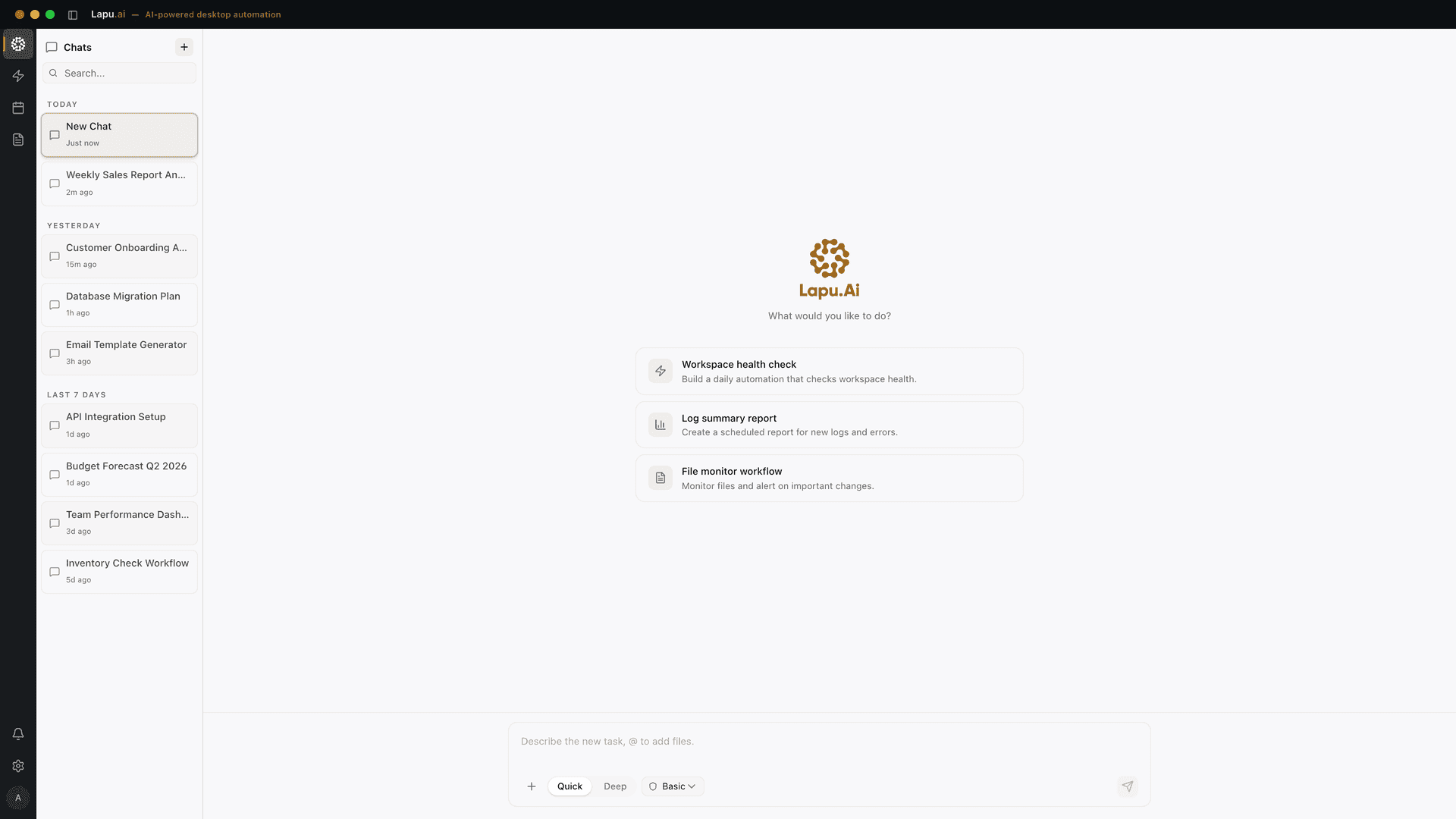
Lapu AI is a native desktop AI application that combines frontier models with local file, shell, and desktop-automation tools: gated by permission-based execution.
- 1-click uninstall
- Cancel anytime
- Files never leave your computer

How desktop AI is structured today
Desktop AI applications fall into three rough categories: chat apps, IDE-embedded coding tools, and full agents. Each is useful for different work.
- Desktop AI: native, not a website
- Chat assistants: answers only
- Coding tools: IDE-embedded
- Desktop AI agents: file, shell, desktop
- Lapu AI: macOS and Windows
Chat assistants
Native wrappers around a chat experience. They give you answers, but operate inside their own window without touching your files or shell.
Coding tools
IDE-embedded coding assistants. Excellent for in-editor work, less suited to cross-application workflows that span the file system, terminal, and other apps.
Desktop AI agents
Native apps that combine reasoning with file, shell, and desktop tools. Built to do the work, not just describe it. Lapu AI is in this category.
Why desktop AI matters
Most knowledge work still happens on a computer rather than in a browser tab: files in folders, scripts in a shell, design work in native apps. AI that lives only in the cloud has to ask you to upload context. Desktop AI removes that friction: the agent reads the actual file, runs the actual command, and produces the actual result on your machine. With permission gates and a visible audit trail, that power stays under your control.
Lapu AI is a desktop AI agent: native on macOS 12+ and Windows 10 or 11, with local file and shell tools and no model API keys.
Try it freeWhat Lapu AI offers
Native macOS and Windows builds
Apple Silicon native on macOS 12+. x86_64 on Windows 10/11. Same agent loop on both platforms.
Built-in frontier AI
No model API keys. Reasoning calls go through Lapu AI infrastructure to the integrated model endpoint.
Local tools
File read, write, edit, grep, and shell execution: all running on your hardware with output captured for the next reasoning step.
Desktop automation
Native accessibility APIs drive other applications: list windows, take screenshots, click, type, navigate.
Permissioned execution
File writes, shell commands, and desktop input pause for explicit approval before they run.
Reusable skills
Package workflows into skills you can rerun and schedule. Operational repeatability without re-prompting.
| Component | Where it runs | Needs a connection |
|---|---|---|
| The desktop application | Your machine | No |
| File tools: read, write, edit, grep | Your hardware | No |
| Shell execution | Your hardware | No |
| AI reasoning calls | Lapu AI infrastructure → the integrated model endpoint | Yes |
What day-to-day desktop AI use looks like
A desktop agent is most useful when it stays close to the work but does not take uncontrolled action. You hand it a bounded task, it shows the plan, and it pauses before a write, command, or external send that needs approval. The result is an agent you can keep available without giving it blanket authority over the machine.
Give it the real context
Point the agent at the document, folder, spreadsheet, or application where the work already lives.
Review the plan
See which files and apps the workflow will touch before the agent starts making changes.
Approve consequential steps
Reads can stay low-friction while writes, sends, and destructive actions stop for explicit permission.
This is different from an AI companion or desktop pet. Lapu is a work agent: it handles files, applications, and repeatable tasks, then leaves a visible audit trail of what it did.
Go deeper
Frequently asked questions
- What is desktop AI?
- Desktop AI refers to AI applications that run as native software on your computer rather than as a website or browser tab. Modern desktop AI ranges from chat assistants to full agents that can read files, run commands, and operate other applications on your behalf.
- What is the difference between desktop AI and a desktop AI agent?
- Desktop AI is the broader category: any AI application that runs on your computer. A desktop AI agent is a specific kind of desktop AI that uses tools to execute multi-step work on your machine, not only chat. Lapu AI is a desktop AI agent.
- Which platforms does desktop AI run on?
- Most desktop AI today targets macOS and Windows. Lapu AI runs natively on macOS 12 Monterey or later (Apple Silicon) and Windows 10 or 11 (64-bit).
- Is desktop AI safer than cloud AI?
- Desktop AI keeps execution and, often, file storage on your machine, which reduces exposure to cloud-side breaches. Safety also depends on whether the agent gates risky actions behind explicit user approval. Lapu AI does both.
- Does desktop AI work offline?
- The desktop application runs offline, and local tools (file, shell) execute without an internet connection. AI reasoning calls require connectivity to reach the model endpoint.
- Is Lapu AI a good AI for desktop work?
- Yes. Lapu AI is built as an AI desktop application: a native macOS and Windows app that pairs frontier reasoning with local file, shell, and desktop-automation tools. Where browser-based assistants stay in a tab, an AI for desktop like Lapu AI acts on the files and apps already on your machine, with permission-based execution on every risky step.
- How is AI on desktop different from AI in the browser?
- AI on desktop runs as an installed application with access to the file system, shell, and native app APIs on your machine. AI in the browser runs inside a web page, so it can only see what you paste in or upload. The desktop model can open a folder, run a command, or drive another application; the browser model can only respond to text you hand it. For work that lives on your computer: spreadsheets, PDFs, native design tools: AI on desktop removes the copy-paste tax that a browser assistant cannot.
Try Lapu AI free
A desktop AI agent that runs on your machine. Free to start, see exactly what it looks like before you download.
- 1-click uninstall
- Cancel anytime
- Files never leave your computer
Automate the work between you and outcomes
Lapu AI handles the repetitive work between you and outcomes. One desktop agent, zero tab-switching. Available now on macOS and Windows.
- 1-click uninstall
- Cancel anytime
- Files never leave your computer
Free to start. Cancel in 1 click. Files stay on your machine.