
Computer use AI: what it is, who builds it, when to use it
Computer use AI lets a model see the screen, move the cursor, and act. Anthropic introduced the capability in October 2024. OpenAI shipped Operator in January 2025 and folded it into ChatGPT Agent in July 2025. Desktop agents like Lapu AI take a third path. Driving apps through the system's own automation layer instead of a synthetic mouse in a remote sandbox. This page is the honest comparison.
- 1-click uninstall
- Cancel anytime
- Files never leave your computer
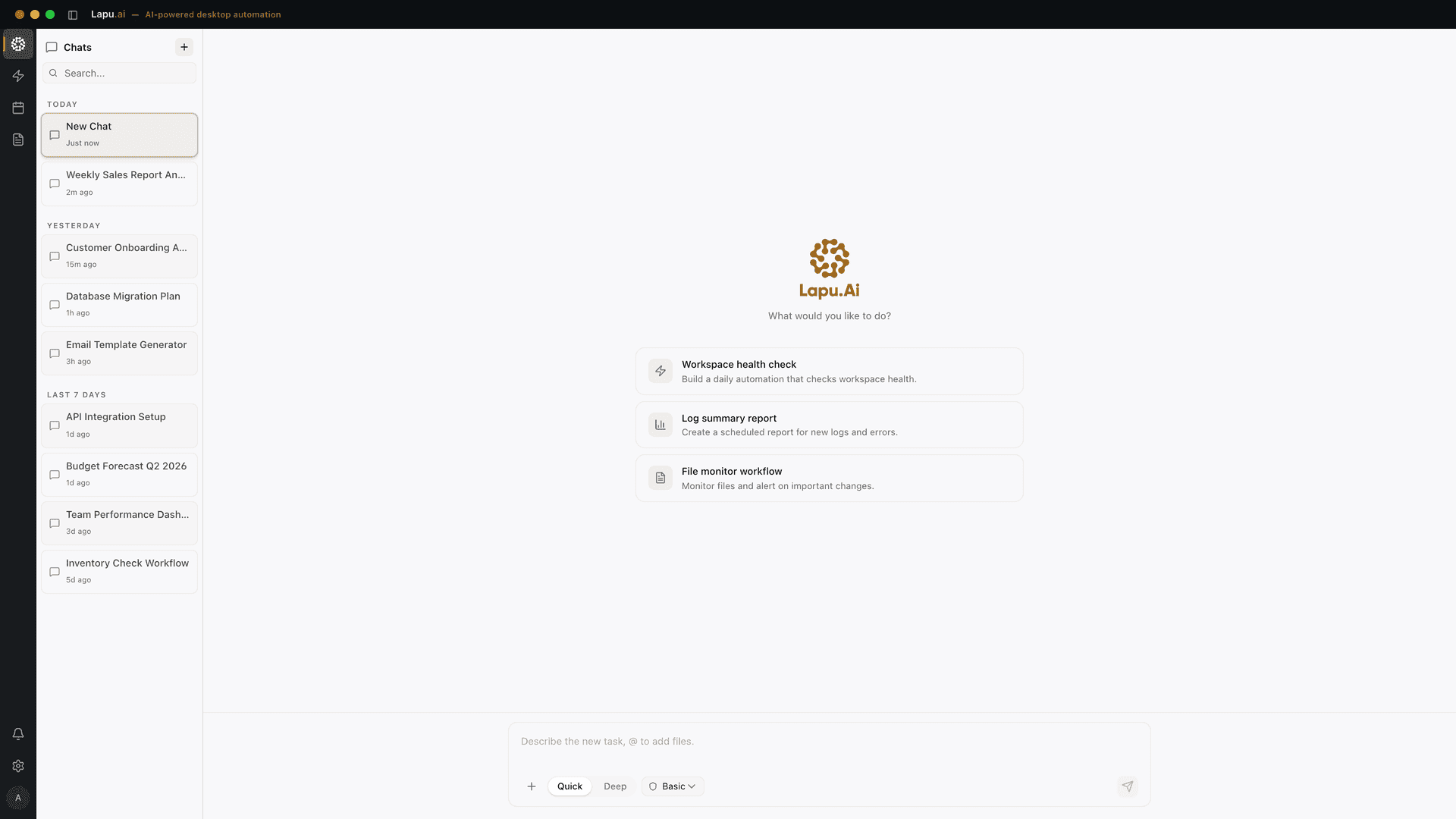

What computer use AI actually is
Strip the marketing and the mechanism is simple. The model is given a screenshot, a cursor position, and a goal. It decides on the next action: click at coordinates, type a string, scroll, take another screenshot, and a host runtime executes that action against a real (or virtual) computer. The loop repeats until the goal is met or the agent gets stuck.
This is a different category from tool use. Tool use means the model calls a structured function like read_file(path) or send_email(to, subject, body). Computer use means the model is driving the GUI itself: the same primitives a human uses, with all the messiness that comes with it. The advantage is reach: any application becomes addressable. The cost is reliability: screenshots are noisy, pixel coordinates drift, and the agent fails in ways tool-use agents do not.
Production agent systems mix both. A good desktop AI agent like Lapu AI uses structured tool calls for everything it can: file read, shell, document parsing, and only falls back to computer use primitives (screenshot, click, type) when there is no API surface for the target app.
Anthropic Computer Use
Anthropic introduced computer use on October 22, 2024, as a public beta with Claude 3.5 Sonnet. In Anthropic's own words, this capability lets Claude “interact with computers by looking at a screen, moving a cursor, clicking buttons, and typing text” (Anthropic, 2024). It launched simultaneously on the Anthropic API, Amazon Bedrock, and Google Cloud's Vertex AI.
What ships is not a product. It is a model capability plus a reference Docker image and example code. You, the developer, run the agent loop, capture screenshots, dispatch the click and type commands, and decide where it runs. Anthropic's guidance is explicit that “Claude's current ability to use computers is imperfect” and that “some actions that people perform effortlessly (scrolling, dragging, zooming) currently present challenges for Claude.”
The safety posture is also explicit. Anthropic's computer use documentation tells developers to run the agent in “a dedicated virtual machine or container with minimal privileges, ” restrict its internet access to an allowlist, and “ask a human to confirm decisions that may result in meaningful real-world consequences” (Anthropic docs). For a deeper look at why that matters, see the desktop AI permission model breakdown.
OpenAI Operator and ChatGPT Agent
OpenAI launched Operator on January 23, 2025 as a research preview for ChatGPT Pro subscribers in the United States: at the time, the $200-per-month tier. Operator was powered by a model OpenAI called Computer-Using Agent (CUA), built on top of GPT-4o, and operated a remote virtual browser hosted by OpenAI rather than the user's own machine (MIT Technology Review, 2025).
On July 17, 2025, OpenAI introduced ChatGPT Agent and folded Operator's capabilities into it. ChatGPT Agent combines a visual browser, a text browser, a terminal, and direct API access inside ChatGPT, and is available to Pro, Plus, and Team users via the “agent mode” toggle (OpenAI, 2025). The standalone Operator preview at operator.chatgpt.com was deprecated and shut down on August 31, 2025.
The shape is fundamentally different from Anthropic's API capability. ChatGPT Agent is an end-user product. It runs in OpenAI's cloud, drives a browser on OpenAI's servers, and asks you for confirmation before logins, payments, or other high-risk steps. It does not touch your laptop's file system or run shell commands on your machine. For a feature-by-feature comparison with Lapu AI, see the Operator vs Lapu AI comparison.
| Date | What shipped | What changed |
|---|---|---|
| October 22, 2024 | Anthropic computer use (public beta) | First mainstream API capability: Claude reads a screenshot and returns click and type actions. |
| January 23, 2025 | OpenAI Operator (ChatGPT Pro) | A managed remote browser, driven by OpenAI's Computer-Using Agent model. |
| July 17, 2025 | ChatGPT Agent | Operator absorbed into a single agent with a visual browser, text browser and terminal. |
| August 31, 2025 | Operator preview shut down | The standalone preview at operator.chatgpt.com was deprecated. |
The desktop agent alternative
There is a third path. Instead of a remote sandbox you build yourself (Anthropic) or a hosted browser you rent (OpenAI), a desktop AI agent runs natively on your computer. Lapu AI is in this category. The agent is a macOS or Windows application; the tools it calls are local file read and write, real shell execution, and native desktop automation via macOS Accessibility and Windows UI Automation APIs. Reasoning calls route through Lapu AI infrastructure to frontier models: no API key management, but the actions execute on your machine.
The trade-offs are honest. Lapu AI cannot do everything a cloud-hosted browser agent can: it does not rent IP addresses, it does not silently solve captchas in someone else's data center, and it is not the right tool if you need an agent for a machine you do not own. What it does instead is touch your actual files, run your actual shell, and drive your actual installed apps, with a permission prompt before every risky action. For users whose work lives on their laptop rather than on the public web, that is a different tool for a different job. See the desktop AI agent hub for the full picture, or alternatives to Claude Desktop for a related buyer's view, or what a native AI desktop application looks like.
Driving the app, not the mouse
“Runs locally” describes where a desktop agent executes. It is not the interesting part. The interesting part is how it reaches the application, and that is where the third path stops being a hosting detail and becomes a different mechanism.
A screenshot-driven agent sees pixels. It decides the Save button is at (412, 283), then synthesizes a mouse move and a click at that point. This is the most general approach available, anything visible can be attempted, and it inherits every weakness of working from a picture. Move the window, change the resolution, or let a dialog open half a second late, and the click lands somewhere else.
Lapu AI works one layer lower. macOS and Windows both expose a running application as a tree of named, typed elements: the same interface a screen reader uses to describe an app to someone who cannot see it. Through macOS Accessibility and Windows UI Automation, the Save button is addressable as the Save button, with its own role, label, and state. There is no coordinate to miss.
- Screenshot loop: 4 steps. Step 4 returns to step 1 (repeat every step); the sequence repeats.
- Capture the screen: a fresh screenshot
- Infer where the button is: click at (412, 283). Note: Depends on window position, resolution and theme staying put.
- Synthesize a mouse click: at those pixels
- Capture again to check: did it work?
- Automation layer: 3 steps. The sequence runs once and ends.
- Query the element tree: AXUIElement / UI Automation
- Resolve the named element: the button labelled "Save"
- Invoke it directly: no cursor involved
It does not take over your machine
Your cursor and keyboard stay yours. A task can run while you keep working, because nothing is puppeteering your physical input.
It survives a moved window
Resized, repositioned, a different resolution, dark mode instead of light: the Save button is still the Save button.
It repeats without drifting
This is the one that matters for recurring work. A coordinate that worked on run one can be wrong on run fifty. A named element is not.
Lapu AI keeps both modes and picks one per application. The driver layer works where an app exposes an automation surface, most macOS and Windows software does, including Microsoft 365 and much of the older line-of-business software that never got an API. Lapu AI can also drive real keyboard and mouse input, and it does so where that is genuinely the better tool, not only where nothing else is left. SAP GUI is the clearest case: driving real input means a customer never has to ask IT to switch on sapgui/user_scripting, a setting many organizations deliberately keep off. In that mode the agent does occupy the mouse and keyboard while it runs, and the three properties above describe the driver-layer path.
So the contrast with a screenshot-only agent is not that Lapu AI never sends input. It is that sending input is the second choice rather than the only one.
This also sets the honest boundary against traditional RPA. Tools like UiPath and Power Automate Desktop target UI elements too, so raw reliability is not the dividing line. The dividing line is what it costs to get there: RPA expects a developer to record and maintain explicit selectors, and the script breaks when the vendor ships a new version. Lapu AI works from a description of the outcome and resolves the elements at run time, no recording step, no selector library to keep alive.
Lapu AI is the desktop agent described here. Free to start on macOS and Windows: no API keys, no credit card.
Try it freeApproaches compared
| Dimension | Anthropic Computer Use | OpenAI ChatGPT Agent (formerly Operator) | Desktop AI agent (Lapu AI)Recommended |
|---|---|---|---|
| Where it runs | API capability, runs in your VM or sandbox | OpenAI-hosted remote browser plus tools | Native app on your macOS or Windows machine |
| Model | Claude 3.5 Sonnet (Oct 2024); current Claude models | ChatGPT Agent (Pro / Plus / Team, Jul 2025) | Built-in frontier AI; no API keys to manage |
| Surface | Whatever surface you build; reference docker image provided | ChatGPT app with a visual browser, text browser, and terminal | Local files, shell, and other desktop apps via accessibility APIs |
| How it controls the app | Screenshots plus synthetic mouse and keyboard events at pixel coordinates | Screenshots of a hosted browser; the model issues clicks and keystrokes | The app's own automation layer (AXUIElement, UI Automation): named elements, not coordinates. Falls back to screen level where an app exposes nothing |
| Permission model | Your code mediates; Anthropic recommends a sandboxed VM | Pauses for confirmation on logins, payments, and high-risk steps | Per-action approval prompts before any file write or shell command |
| Best for | Developers building agentic tooling who want fine control over the loop and the execution environment. | End users who want a managed, browser-first agent inside ChatGPT and do not need access to local files. | People who need an agent that touches local files, runs real shell commands, and drives apps already on their computer. |
Where computer use AI shines, and where it fails
Computer use AI earns its keep on bounded GUI tasks that lack a clean API. Internal admin tools nobody will ever wrap in an SDK. Legacy desktop software with a dozen modal dialogs. Long forms scattered across systems that do not talk to each other. Repetitive cross-app workflows. See desktop automation use cases for concrete examples Lapu AI handles.
If you are deciding where this technology belongs in a wider operating model, use the practical AI for business guide to choose a workflow, set boundaries, and evaluate a pilot.
It fails, predictably, in three places. First, anything that depends on precise pixel work or sub-second timing: drag-and-drop into a moving target, real-time scroll, video scrubbing. Second, tasks where the screen changes faster than the model can take a screenshot and reason about it; the agent loop is on the order of seconds per step. Third, tasks where a structured tool already exists. If a file can be edited with a text tool, you should never be asking the agent to click into a GUI editor. Good agent design picks the cheapest reliable primitive for each step.
Safety, oversight, and the permission gap
Every serious computer use AI system has the same security question at its core: what is the worst thing this thing can do before anyone notices? The model itself is not the threat. The threat is the action surface: the set of operations the agent can execute without checking with a human first. Anthropic's own documentation acknowledges this and recommends a sandboxed VM plus human-in-the-loop confirmation on consequential steps.
ChatGPT Agent handles this by running in OpenAI's cloud and pausing before logins, payments, and explicit external actions. Lapu AI handles it the desktop way: every file write, every shell command, and every accessibility action surfaces a per-action approval prompt with the exact plan. Low-risk reads can be auto-approved per session; destructive operations always require explicit confirmation, and the entire trail is logged.
What you should not do is run a raw computer use loop against an unsandboxed laptop with no permission gating. That is the configuration Anthropic explicitly warns against, and it is the configuration most often hyped in social media demos. The honest choice is between (a) a hosted product whose vendor controls the sandbox or (b) a desktop agent whose permission system you can inspect and tune.
Choosing between Anthropic computer use, ChatGPT Agent, and a desktop agent
- Pick Anthropic Computer Use if you are building a product. You want the model capability, you will own the runtime, you will pick the sandbox, and you will design the permission gating yourself.
- Pick ChatGPT Agent if your tasks live entirely on the public web, you already pay for ChatGPT Pro / Plus / Team, and you want a managed product that takes the sandbox question off your hands. Do not pick it if your work lives in local files or installed desktop apps.
- Pick a desktop agent like Lapu AI if you need an agent that reads your actual files, runs commands in your actual terminal, drives applications you have installed, and asks permission before each action. See the head-to-head views with ChatGPT and Operator.
Frequently asked questions
- What is computer use AI?
- Computer use AI is a capability that lets an AI model operate a computer the way a person does, by reading the screen, moving the cursor, clicking, and typing. Anthropic introduced the public beta of this capability on October 22, 2024 with Claude 3.5 Sonnet. The model receives screenshots, decides on actions, and returns tool calls like 'click at (x, y)' or 'type these characters'.
- How is Anthropic computer use different from OpenAI Operator?
- Anthropic computer use is an API capability: you run the agent yourself, typically in a sandboxed virtual machine, against whatever environment you point it at. OpenAI Operator (launched January 23, 2025 for ChatGPT Pro) ran a managed remote browser inside OpenAI's infrastructure; users typed instructions and OpenAI's Computer-Using Agent model drove a virtual browser tab. Operator was folded into ChatGPT Agent on July 17, 2025, and the standalone Operator preview was deprecated.
- Is computer use AI safe to run on my own machine?
- It depends entirely on the permission model. Anthropic's own guidance is explicit: 'we suggest taking precautions such as: Using a dedicated virtual machine or container with minimal privileges' and 'asking a human to confirm decisions that may result in meaningful real-world consequences'. Running a raw API agent against your unsandboxed laptop with no permission gating is the unsafe path. A desktop agent like Lapu AI implements the gating natively, every file write, shell command, or app action surfaces an approval prompt before it runs.
- When does computer use AI actually work well?
- It shines on bounded, repeatable, GUI-shaped tasks where there is no clean API: filling forms across legacy web apps, scraping data behind a login, driving desktop software that has no automation surface, and operating one-off internal tools. It struggles with tasks that require dragging, zooming, fast scroll, precise pixel work, or anything where the screen changes faster than the model can re-screenshot. Anthropic's own launch announcement warned that 'some actions that people perform effortlessly (scrolling, dragging, zooming) currently present challenges for Claude'.
- Does Lapu AI use Anthropic computer use under the hood?
- Lapu AI is a desktop AI agent, not a wrapper around any single computer use API. It combines built-in frontier AI with native local tools (file read and write, shell, and desktop automation through macOS and Windows accessibility APIs), and routes reasoning calls through Lapu AI infrastructure. You do not bring an Anthropic or OpenAI key. The agent's screen-driving primitives are native, not a remote VM, which is what lets it operate on your real files and your real installed apps.
- What is the permission gap, and why does it matter for computer use AI?
- The permission gap is the distance between what a model wants to do and what your system will let it do without checking with you. A raw computer use loop has no gap, if the model decides to delete a directory, the script deletes it. A permissioned desktop agent inserts a gate: 'the agent wants to run rm -rf node_modules in ~/projects/foo, approve, deny, or always allow for this folder?' For agents that touch local files, that gate is the difference between a useful tool and a liability.
- Should I use Anthropic computer use, ChatGPT Agent, or a desktop agent?
- Pick Anthropic computer use if you are a developer building your own agentic product and you want to own the loop and the sandbox. Pick ChatGPT Agent if you want a managed browser agent inside ChatGPT and your tasks live on the public web. Pick a desktop agent like Lapu AI if your work happens on your local machine (files in folders, shell commands in your real terminal, apps already installed), and you want per-action permission control instead of a remote VM.
Sources
- Anthropic. Introducing computer use, a new Claude 3.5 Sonnet, and Claude 3.5 Haiku. October 22, 2024.
- Anthropic. Computer use tool documentation. Accessed May 2026.
- MIT Technology Review. OpenAI launches Operator: an agent that can use a computer for you. January 23, 2025.
- OpenAI. Introducing ChatGPT agent: bridging research and action. July 17, 2025.
- OpenAI Help Center. ChatGPT agent release notes. Accessed May 2026.
Try Lapu AI
Lapu AI is the desktop-native take on computer use AI: permission-based execution on your real machine, built-in frontier AI, no API keys, free tier without a credit card. Available on macOS 12+ (Apple Silicon) and Windows 10/11 (64-bit).
- 1-click uninstall
- Cancel anytime
- Files never leave your computer
Automate the work between you and outcomes
Lapu AI handles the repetitive work between you and outcomes. One desktop agent, zero tab-switching. Available now on macOS and Windows.
- 1-click uninstall
- Cancel anytime
- Files never leave your computer
Free to start. Cancel in 1 click. Files stay on your machine.