Best Claude Desktop alternatives in 2026

Claude Desktop is a chat interface for Anthropic's Claude. People look for alternatives when they need an agent that executes work on the desktop — not just answers questions in a window. Claude Desktop excels at long-document analysis through Projects and its 200k-token context window, but it does not read your local files outside an upload, run shell commands, or click through other applications. Here are five real options — including open-source picks, tools that run on Linux, and the deepest Model Context Protocol (MCP) support — ranked by how much they actually do on your machine.

Last verified: 2026-05-13

Download freeFree · macOS & Windows · No credit card
  • 1-click uninstall
  • Cancel anytime
  • Files never leave your computer
#1

Lapu AI

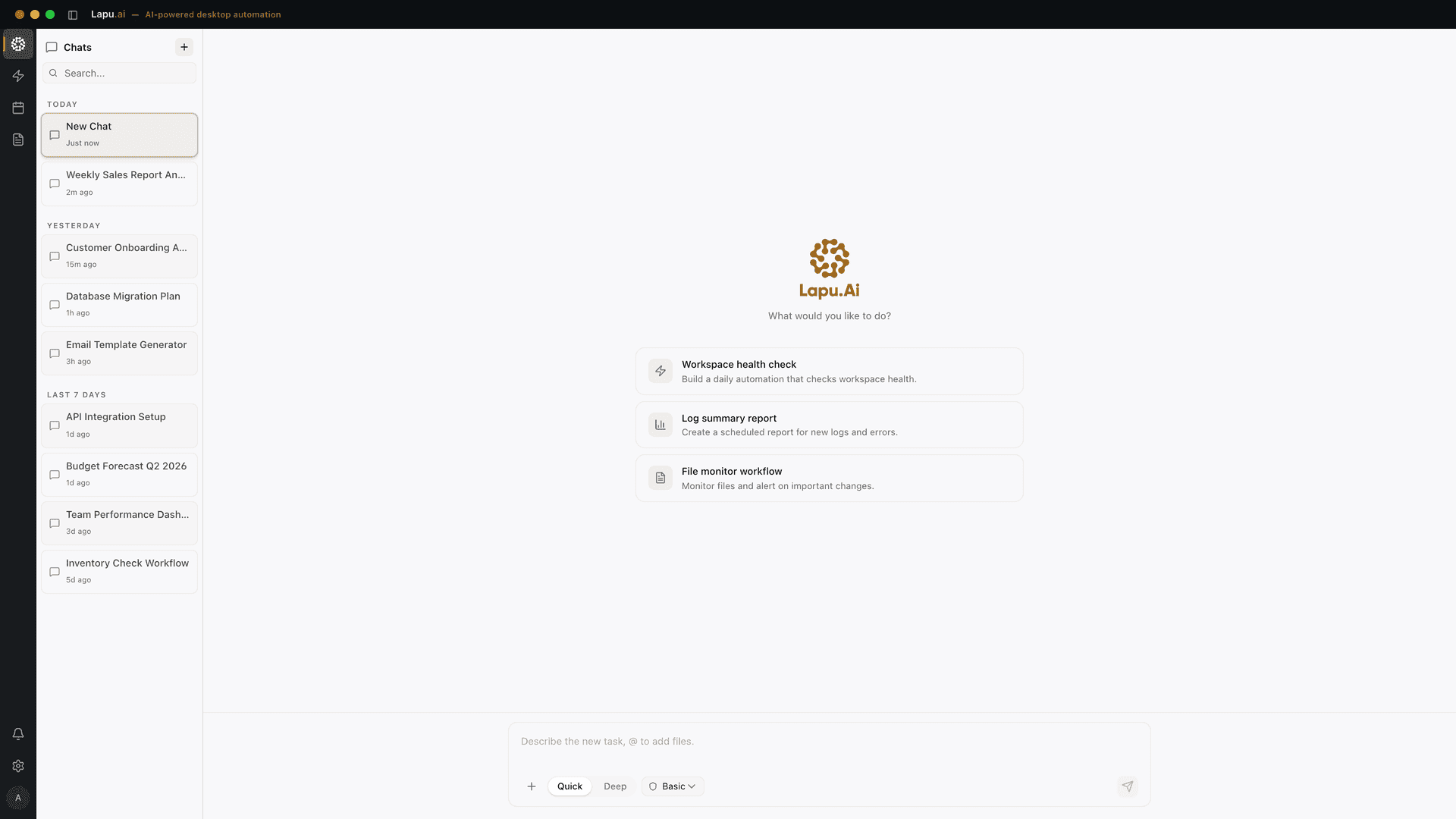
Lapu AI is a desktop AI agent for macOS and Windows. Unlike Claude Desktop, it does not stop at chat — it reads files in place on your filesystem, runs shell commands, and controls applications through native accessibility APIs, with explicit user approval at every sensitive step. Built-in frontier models from multiple providers mean no API keys to manage and no per-token billing surprises. Model selection happens automatically: fast models for quick operations, more capable models for multi-step reasoning. Audit trails of every action are retained for up to 90 days so you can inspect what the agent touched.

Pros

  • Executes multi-step tasks across files, terminal, and apps
  • Permission gate on every risky action with full audit trail
  • Built-in frontier models — no API key, no provider setup, no per-token bill
  • Local-first: file reads happen on your machine, not in a cloud upload
  • Free tier with no credit card; Premium $20/month, Pro $60/month, Max $100/month

Cons

  • Smaller plugin and template ecosystem than Claude.ai or ChatGPT
  • Effective context per task is smaller than Claude Projects' 200k tokens for very large document analysis
  • Reasoning still requires a network connection — the agent is local-first, not fully offline

Best for: Anyone who wants Claude-quality reasoning plus actual desktop execution

Learn more →
#2

Cursor

Cursor is an AI-native fork of VS Code with deep IDE integration. It indexes your entire repository — functions, types, file relationships — and uses that index to power chat, autocomplete, and an in-editor agent that can edit across multiple files, run terminal commands, and iterate on errors. Cursor supports Claude Sonnet, Claude Opus, GPT-5 family, and Gemini, and lets you switch between them per task. Pricing starts free, with Pro at $20/month, Pro+ at $60/month, and Ultra at $200/month; spend is metered against frontier-model usage. Inside the editor it is the leading option for software work, but Cursor does not control non-IDE applications or browse arbitrary parts of your desktop.

Pros

  • Deep IDE integration with full repo indexing
  • Excellent multi-file refactoring and agent mode for end-to-end coding tasks
  • Bring-your-own context: switch between Claude, GPT, and Gemini per prompt
  • Background agents for longer-running coding work

Cons

  • Confined to coding workflows inside the editor
  • Cannot control non-IDE applications or perform general desktop tasks
  • Metered pricing can become expensive on heavy frontier-model usage

Best for: Software engineers who live in their editor

Learn more →
#3

ChatGPT Desktop

OpenAI's desktop wrapper around ChatGPT. It adds a global hotkey (Option+Space on macOS, Alt+Space on Windows) that opens a companion window pinned above other apps, plus screenshot capture, file upload, and on macOS a 'Work with Apps' feature that reads context from supported applications. Voice is available on Windows; on macOS, OpenAI retired the voice experience in January 2026. The plugin and Custom GPT ecosystem is large, and the underlying models are strong general-purpose tools. It is closer to a faster chat experience with limited screen-context features than to an autonomous agent — it will not run shell commands or modify your files directly.

Pros

  • Familiar interface with a strong global hotkey workflow
  • Strong general-purpose models and large plugin/Custom GPT ecosystem
  • Screenshot capture and Work-with-Apps companion mode on macOS

Cons

  • Cannot execute multi-step actions on your machine — no shell, no file writes
  • Context from your apps is read-only and sent to OpenAI servers
  • Voice retired on macOS app as of January 2026

Best for: Heavy ChatGPT users who want a faster wrapper with light desktop awareness

Learn more →
#4

Open Interpreter

An open-source Python tool that lets language models run code (Python, JavaScript, Shell, and more) on your computer through a CLI. It works with cloud models like Claude and GPT or with fully local models through Ollama, LM Studio, Jan, or Llamafile, which makes it the strongest pick for fully offline operation. Open Interpreter asks for confirmation before executing generated code, but the surface area is broad — the model can touch any file or system setting that your user account can. It is powerful for technical users who want a self-hosted, fully programmable agent, but it is a terminal tool, not a polished desktop app, and there is no native GUI or app-control layer.

Pros

  • Open-source under Apache 2.0 — auditable and self-hostable
  • Bring-your-own-model: cloud or fully local through Ollama, LM Studio, Jan
  • Full code execution across Python, JavaScript, and Shell
  • Best option here for fully offline operation with a local LLM

Cons

  • CLI-only, requires Python familiarity and manual setup
  • No native GUI or accessibility-API control of other apps
  • Single confirm-before-execute prompt is a coarser guardrail than per-tool permissioning

Best for: Developers who want full control, OSS, and the option to run fully local

Learn more →
#5

Goose

Goose is an open-source desktop AI agent originally built by Block and now stewarded by the Agentic AI Foundation under the Linux Foundation. It ships as a native desktop app for macOS, Windows, and Linux, with a CLI and an API on the side, and is written in Rust. Its differentiator is depth on the Model Context Protocol — 70+ documented MCP extensions, with the ability for extensions to render interactive UI directly inside the Goose window. Pricing is free; you bring your own model API key. Similar in concept to Lapu AI but the surface is more 'kit of parts' than 'turnkey product' — you wire up extensions and provide your own model credentials before it does much.

Pros

  • Open-source (Apache 2.0), auditable, self-hostable
  • Deepest MCP extension ecosystem of any desktop agent (70+ extensions)
  • Native desktop app on macOS, Windows, and Linux; written in Rust
  • Active community and Linux Foundation stewardship

Cons

  • Requires manual extension setup and a model API key before useful
  • UI is functional but less polished than commercial alternatives
  • Smaller built-in skill library out of the box compared to a turnkey agent

Best for: Engineers who want an open desktop agent with custom MCP tools

Learn more →

How to choose

Use Claude Desktop if your work is mostly reading and reasoning over long documents inside Projects — its 200k-token context, retrieval mode for large project knowledge, and Projects organization are still the best of any tool in this list for that specific job. Choose Lapu AI if you want a polished desktop agent that goes beyond chat — file organization, document processing, cross-application workflows, terminal automation — without managing API keys. Choose Cursor if your day is in an editor and the AI work is almost entirely code; nothing here matches its codebase indexing. Choose ChatGPT Desktop if you only need a faster chat hotkey and live in the OpenAI ecosystem with Custom GPTs. Choose Open Interpreter if you want fully local-model operation and are comfortable in a terminal. Choose Goose if you want an open-source agent and are willing to compose MCP extensions yourself.

Where Lapu AI fits

Most Claude Desktop alternatives are still chat tools — they think but do not act. Lapu AI sits in the smaller category of agents that actually execute work on your machine, paired with a permission system designed for non-technical users. Built-in frontier models remove the API-key step that blocks most casual users from trying agentic tools, and the audit trail makes it auditable for work computers. Honest limits: Lapu AI does not match Claude Projects for very large document analysis with persistent project knowledge, it does not have Cursor's depth inside an IDE, and reasoning still requires a network connection — the agent is local-first for file access, not a fully offline LLM runtime like Open Interpreter with Ollama. If your job is mostly long-document analysis, Claude Desktop is the right tool. If it is mostly coding inside an editor, Cursor is. Lapu AI is for the middle — multi-step desktop work that touches files, terminal, and apps together.

FAQ

Is Lapu AI built on Claude?
Lapu AI uses frontier models from multiple providers, including Claude. Model selection is automatic — fast models for quick operations, more capable models for complex reasoning. You do not bring or manage an API key.
Can Lapu AI replace Claude Desktop entirely?
For most users, yes. Lapu AI handles the chat use case plus desktop execution. If you specifically need Claude Projects for persistent project knowledge or 200k-token document analysis with retrieval mode over many large files, Claude Desktop still has the edge for that workflow.
Does Lapu AI work offline?
File operations and shell commands run locally without network access. AI reasoning still requires an internet connection to reach model providers. If fully offline LLM execution is a hard requirement, Open Interpreter with a local model through Ollama or LM Studio is a better fit.
How much does Lapu AI cost?
There is a free tier with no credit card required. Premium is $20/month, Pro is $60/month, and Max is $100/month for power users. Enterprise pricing is custom. Cursor by comparison starts at $20/month and is metered against frontier-model usage; Claude Pro is $20/month for Claude.ai access; Goose and Open Interpreter are free but require your own model API key or local model setup.
Is Lapu AI safe to run on my work computer?
Lapu AI uses permission-based execution: every risky action — file writes, shell commands, app control — requires your explicit approval, and a full audit trail is retained for up to 90 days so you can inspect what the agent touched. Compare this to Open Interpreter's single confirm-before-execute prompt, which is a coarser guardrail.
Can I bring my own Claude API key?
Lapu AI ships with built-in models so you do not need to bring keys. Bring-your-own-key is on the roadmap for enterprise customers who require sole-tenant billing or model pinning.
When is Claude Desktop still the better choice?
Three scenarios: long-document analysis where you want Claude's 200k-token context and Projects retrieval mode over many files; pure chat work where you do not need the agent to touch your filesystem, terminal, or apps; and teams already standardized on Claude.ai with Projects and shared organizational instructions. For those, Claude Desktop is the right tool.
What are the main Claude Desktop competitors?
The closest Claude Desktop competitors are Lapu AI (a desktop agent that executes work on macOS and Windows), Cursor (an AI code editor), ChatGPT Desktop (OpenAI's chat wrapper), Open Interpreter (an open-source CLI agent), and Goose (an open-source MCP agent). Claude Desktop is a chat-and-reasoning tool; most of these competitors add some form of execution on your machine that Claude Desktop does not.
What is the best open-source Claude Desktop alternative?
Open Interpreter (Apache 2.0) and Goose (Apache 2.0) are the two open-source options here. Open Interpreter is a terminal tool that runs generated code with cloud or local models; Goose is a native desktop app with the deepest Model Context Protocol extension library. Lapu AI is not open source — it trades that for a turnkey setup with built-in models and per-action permissioning.
Is there a Claude Desktop alternative for Linux?
Claude Desktop has no official Linux app. For Linux, Goose ships a native build, and Open Interpreter runs anywhere Python does. Lapu AI currently supports macOS and Windows only, so it is not the pick if Linux is a hard requirement — Goose is the closest desktop-app experience on Linux.
Which Claude Desktop alternative has the best MCP support?
Goose has the most Model Context Protocol (MCP) depth — 70-plus documented MCP extensions, some able to render interactive UI inside the app. If your main reason for leaving Claude Desktop is to compose your own MCP tools, Goose is the strongest fit. Lapu AI focuses instead on built-in execution across files, terminal, and apps without wiring up extensions first.
How do I switch from Claude Desktop to Lapu AI?
Download Lapu AI for macOS or Windows and sign in — there is a free tier with no credit card and no API key to configure, so you can try desktop execution the same day. There is nothing to migrate: Lapu AI reads your existing files in place and asks permission before each action. If you rely on Claude Projects for long-document analysis, keep Claude Desktop for that and use Lapu AI for the tasks that touch your filesystem, terminal, and apps.

Related

Try Lapu AI free

Desktop AI agent for macOS and Windows. No credit card required.

  • 1-click uninstall
  • Cancel anytime
  • Files never leave your computer
Lapu AI agent chat with conversation, tool calls, and execution log

Automate the work between you and outcomes

Lapu AI handles the repetitive work between you and outcomes. One desktop agent, zero tab-switching. Available now on macOS and Windows.

  • 1-click uninstall
  • Cancel anytime
  • Files never leave your computer

Free to start. Cancel in 1 click. Files stay on your machine.

Lapu AI agent chat with conversation, tool calls, and execution log