Anthropic Computer Use is a beta API tool that lets Claude take screenshots, move a mouse, and type into a desktop environment. Anthropic ships it as a developer capability. You supply the model context, the sandbox (usually a Docker container with a Linux desktop on X11 and VNC), and the orchestration loop. People look for alternatives in 2026 when they want a finished desktop app instead of a reference implementation, an open-source option, multi-provider model support, or an agent that actually runs on their real macOS or Windows session instead of a containerized Linux box. Here are five real options ranked by how well they replace what Anthropic Computer Use does for different kinds of users.
·
Download freeFree · macOS & Windows · No credit card
1-click uninstall
Cancel anytime
Files never leave your computer
#1
Lapu AI
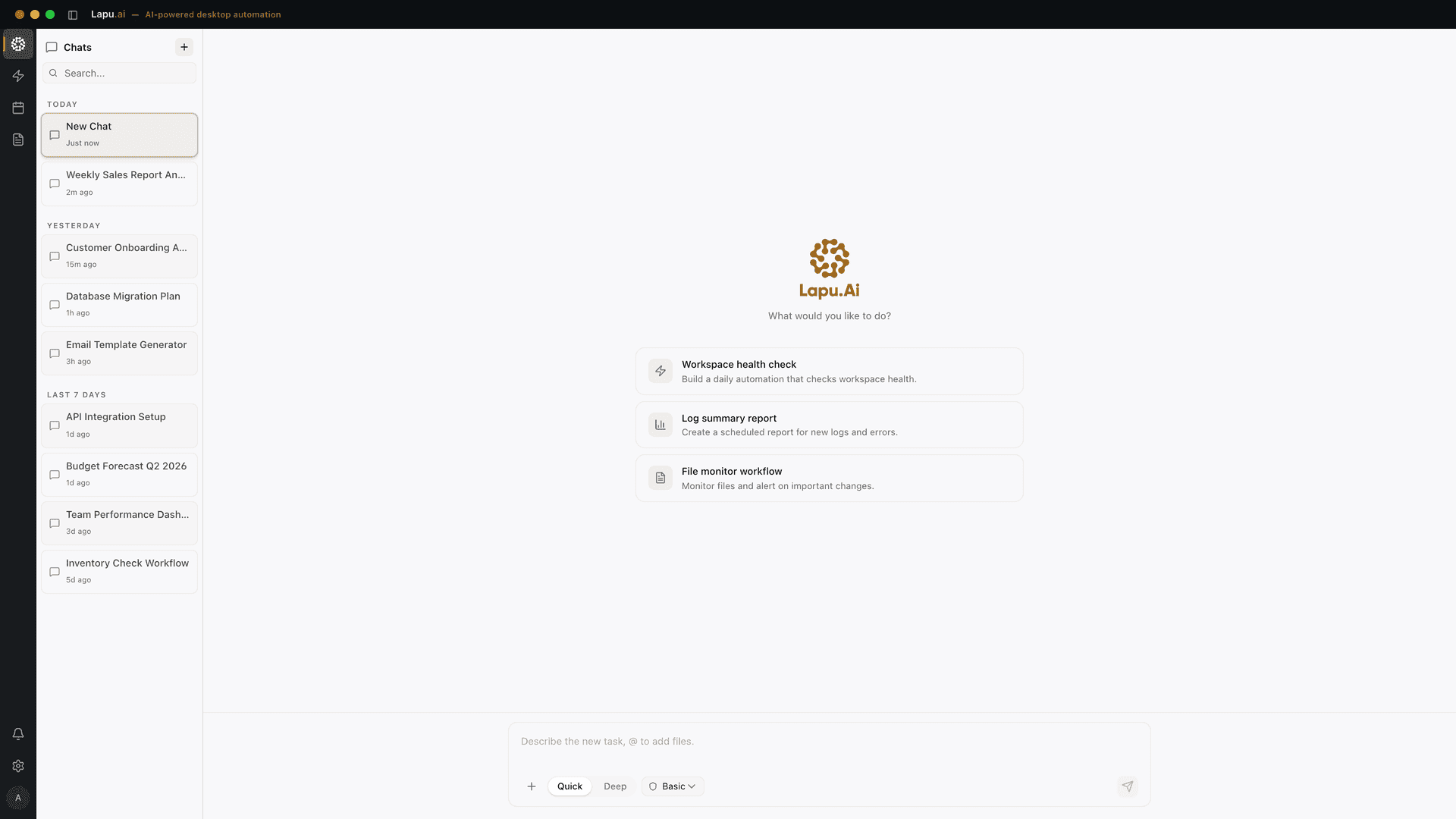
Lapu AI is a desktop AI agent for macOS and Windows. Unlike Anthropic Computer Use, it is not a beta API plus a Docker reference implementation. It is a signed desktop application you install, sign into, and use. It reads files in place on your filesystem, runs shell commands, processes documents (Word, Excel, PDF), and controls applications through native accessibility APIs, with explicit user approval at every sensitive step. Built-in frontier models from multiple providers mean no API key to provision and no metered token bill. Audit trails of every action are retained for up to 90 days so you can inspect what the agent touched.
For users who tried the Anthropic Computer Use quickstart and bounced off: the Docker setup, the X11 / VNC plumbing, the beta header dance, the recommendation to run inside a dedicated VM rather than the user's real desktop: Lapu AI is the no-assembly alternative. It runs on the actual macOS or Windows session, not a Linux sandbox. Honest limits: Lapu is closed source and you cannot swap in a custom system prompt, tool set, or model harness the way you can when you build directly on the Computer Use API. For research, custom evals, or production automation where you need that control, Anthropic's API remains the more flexible primitive.
Pros
Finished desktop app: no Docker, no X11, no reference-implementation assembly
Runs on the user's real macOS or Windows session, not a containerized Linux sandbox
Built-in frontier models: no Anthropic API key, no metered token bill
Permission gate on every risky action with a 90-day audit trail
Free tier with no credit card; Premium $20/month, Pro $60/month, Max $100/month
Cons
Closed source: you cannot fork it, audit the code, or modify the agent loop
Cannot bring your own system prompt, tool definitions, or model the way the raw API allows
Smaller ecosystem than the API and its growing third-party harnesses
Best for: Anyone who wants computer-use AI as a finished product, not a developer primitive
ChatGPT Agent is OpenAI's computer-use agent, available inside ChatGPT itself. It launched as Operator in January 2025 and was folded into ChatGPT as 'agent mode' in July 2025. The agent runs in a cloud-hosted virtual browser plus a small Linux environment: OpenAI's servers handle the screen capture, model reasoning, and mouse / keyboard actions, then stream the result back. There is no separate API for raw computer-use access; it is a product feature inside the ChatGPT app, web, mobile, and desktop clients.
For an Anthropic Computer Use user whose main complaint is the developer-tier setup, ChatGPT Agent is the most polished cloud-product equivalent. You log in, click 'agent mode', and describe a task in plain English, no Docker, no API key. The trade-off: it runs in OpenAI's cloud browser, not on your real desktop, so it cannot touch your local files, your installed apps, your terminal, or anything that requires being signed in on your machine. Pricing: bundled into ChatGPT Pro at $200/month, with a lower daily-task allowance on Plus at $20/month.
Pros
Polished, no-assembly product: no Docker, no API integration
Strong frontier model (GPT-5 / CUA) with multi-billion-dollar training investment
Unified with deep research and chat in one consumer product
Available in the US, EU, UK and most other ChatGPT regions
Cons
Cloud-hosted browser and Linux: cannot touch your local files, apps, or terminal
Pro at $200/month for full access; Plus tier has tight daily task caps
Closed source, OpenAI-only model lock-in
Refuses many sensitive tasks (banking, hiring decisions) by policy
Best for: ChatGPT subscribers who want a cloud-only computer-use agent without any setup
Open Interpreter is an open-source agent (Apache 2.0) with around 64k GitHub stars. It runs on macOS, Windows, and Linux as a CLI you launch by typing `i` or `interpreter` in your shell. It is best known for letting an LLM write and execute code locally (Python, Shell, JavaScript), but it has expanded to include browser automation and native app control with native sandboxing across all major platforms. It is provider-agnostic: OpenAI, Anthropic, Google, Groq, OpenRouter, any OpenAI-compatible endpoint, and local models via Ollama.
For an Anthropic Computer Use user whose priority is open source, bring-your-own-model, and direct local execution rather than a sandboxed container, Open Interpreter is the strongest swap. It runs on your real machine instead of a Docker desktop. Honest limits: it is terminal-first, so the UX is closer to a developer tool than a finished app, and the per-platform native-app control surface is less mature than the screenshot-driven Anthropic loop or a polished desktop product. Pricing: free, open source, BYO model. You pay only the underlying provider's API costs (or zero if you run Ollama locally).
Pros
Open source (Apache 2.0) with around 64k GitHub stars
Provider-agnostic: Anthropic, OpenAI, Google, Groq, OpenRouter, local Ollama models
Native sandboxing on macOS, Windows, and Linux
Per-code-block approval by default; auto-run for trusted repeat tasks
Free: pay only the underlying model provider
Cons
Terminal-first CLI: no polished GUI like Lapu AI or ChatGPT Agent
Bring your own API key: costs scale with usage at provider rates
Native-app control is less mature than screenshot-driven Anthropic loop
Setup and reliability still require comfort with the command line
Best for: Developers who want an open-source local agent with bring-your-own-model freedom
Goose is an open-source AI agent (Apache 2.0) originally built by Block and now hosted under the Agentic AI Foundation at the Linux Foundation. It is around 45k GitHub stars in 2026 and ships as a native desktop app for macOS, Windows, and Linux plus a Rust CLI for terminal workflows. It works with 15+ model providers (Anthropic, OpenAI, Google, Azure, Bedrock, Ollama, OpenRouter), and connects to 70+ extensions via the Model Context Protocol (MCP), making it one of the most extensible open-source agent frameworks in 2026.
For an Anthropic Computer Use user who wants an open-source desktop product rather than a containerized API loop, Goose is the closest match. You install it, point it at a model provider, and it runs natively on your real desktop. Honest limits: Goose is general-purpose with strong coding and MCP-tool reach but its screenshot-and-click computer-use surface is less mature than Anthropic's purpose-built tool, and you still bring your own API key plus pay metered token costs (or run Ollama locally and accept slower output). It is also more developer-flavored than a consumer-grade GUI.
Pros
Open source (Apache 2.0), Linux Foundation governance via the Agentic AI Foundation
Native desktop app for macOS, Windows, and Linux plus Rust CLI
15+ model providers including local Ollama and 70+ MCP extensions
Active community with around 45k GitHub stars
Cons
Bring your own API key: costs scale with usage or you run local models slowly
Screenshot-and-click surface less mature than Anthropic Computer Use's purpose-built tool
Developer-flavored UX; less consumer-friendly than packaged products
No first-party permission UI as granular as Lapu AI's per-action prompts
Best for: Open-source loyalists who want a native desktop agent with MCP extensibility
Manus is an autonomous agent platform that launched in 2025 and was acquired by Meta. It plans multi-step tasks, browses the web, writes and executes code, and ships outputs from a single prompt. In March 2026 Manus added a Desktop app with a feature called My Computer that lets the agent execute terminal commands, read files in directories you've granted access to, and use installed development environments (Python, Node.js, Swift, Xcode), on macOS and Windows. The cloud product remains the primary surface; the desktop app is the local-execution lane.
For an Anthropic Computer Use user who wants the autonomous-task framing but in a finished consumer product rather than a developer API, Manus is the most direct parallel. You hand it a task, it runs through it, you watch it work. Trade-off: it is closed source, credit-metered, and your task data flows through Manus / Meta infrastructure for the cloud surface; the desktop app narrows that for local file and terminal work. Pricing: Free with 300 daily credits, Standard $20/month with 4,000 credits, Customizable $40/month with 8,000 credits, Extended $200/month with 40,000 credits.
Pros
Autonomous multi-step task framing: closer in spirit to Anthropic's agent loop
Both cloud agent and desktop My Computer for local files and terminal
Credit-based pricing with a meaningful free daily allowance
Polished consumer product with web, desktop, and mobile clients
Cons
Closed source and credit-metered: costs scale with task complexity
Cloud agent surface processes data on Manus / Meta infrastructure
Desktop app is newer (March 2026) and less battle-tested than the cloud product
Meta acquisition status has been a moving target: 2025 deal blocked by regulators, since restored
Best for: Users who want autonomous-task framing in a finished product on credit-based pricing
Stay on Anthropic Computer Use if you are a developer building a custom agent loop and you need raw control over the system prompt, the tool set, the model, and the sandbox; that flexibility is the whole point of an API. Move to Lapu AI if you want computer-use AI as a finished desktop product running on your real macOS or Windows session, with built-in models, per-action permissions, and an audit trail, no Docker, no API key, no assembly. Move to ChatGPT Agent if you want a polished cloud-only computer-use agent inside a tool you already pay for, and you do not need it to touch local files. Move to Open Interpreter if open source, bring-your-own-model, and a terminal-first workflow matter more than a GUI. Move to Goose if you want an open-source native desktop agent with deep MCP extensibility and you are happy on metered model APIs. Move to Manus if you want the autonomous-task framing in a finished product and credit-based pricing fits your usage shape.
How it controls your apps
Both address the same job, let a model operate a computer, from opposite layers. Anthropic's tool gives the model a screenshot and a mouse: it looks at pixels and clicks coordinates. Lapu talks to the application's own automation layer instead, so it addresses the Save button rather than the pixel at 412,283.
Behavior
Lapu AI
Anthropic Computer Use
How it finds a button
By name, through the app's own automation layer: AXUIElement on macOS, UI Automation on Windows
Takes a screenshot, then moves the mouse and types at pixel coordinates
Leaves your mouse and keyboard free
Only if you point it at a separate VM: Anthropic's reference implementation drives a Docker Linux desktop over X11 and VNC
Survives a moved window or a resolution change
It re-reads the screen each step, but a window that moves mid-step sends the click to where the button used to be
On the fiftieth repeat run
Addresses the same named element it did on the first
Reads the screen fresh every run; what it clicks depends on what the screenshot showed that time
Setup before the first run
None: describe the task in plain language
You build the harness: agent loop, permission UI, sandbox, audit trail, cost limits
This works where an application exposes an automation surface, most macOS and Windows software does, including Microsoft 365 and older line-of-business apps that never got an API. Lapu also supports driving real keyboard and mouse input and uses it where that is the better tool: SAP GUI is the clearest case, since it means the customer never has to enable sapgui/user_scripting. Sending input is the second choice, not the only one.
Where Lapu AI fits
Anthropic Computer Use is a beta API and a Docker reference implementation, a developer primitive that Anthropic itself recommends running inside a sandboxed VM, not against the user's primary desktop. Lapu AI is the finished product that primitive points toward: a signed desktop application for macOS and Windows that runs on the user's actual session, with built-in frontier models so there is no API key to provision, a permission gate on every sensitive action, and a 90-day audit trail of everything the agent did. The Anthropic API gives you control over the loop; Lapu gives you a working agent you install in two minutes. Honest limits: for custom agent research, evals, or production automation where you need to swap models, tools, and prompts, the raw Computer Use API remains the more flexible primitive. Lapu AI is for everyone else: the users who want computer-use AI as a product, not a build-it-yourself kit.
FAQ
Why are people looking for Anthropic Computer Use alternatives in 2026?
Three reasons drive the search. First, Anthropic ships Computer Use as a beta API plus a Docker reference implementation. There is no end-user app, and Anthropic's own quickstart recommends running it inside a dedicated VM or container with minimal privileges rather than against the user's primary desktop. Second, the API requires an Anthropic key (or Bedrock / Vertex credentials) plus metered token billing, which is not how most non-developers want to pay for a desktop tool. Third, users want choice. Open-source options, alternative models, or finished products like Lapu AI and ChatGPT Agent that work without writing code.
Is Anthropic Computer Use still in beta?
Yes. As of 2026 the Computer Use tool still ships behind beta headers: `computer-use-2025-11-24` for Claude Opus 4.8, 4.7, 4.6, and 4.5 plus Sonnet 4.6, and `computer-use-2025-01-24` for older models including Sonnet 4.5 and Haiku 4.5. Anthropic continues to flag the capability as experimental and notes known weaknesses including prompt-injection susceptibility on screenshots and reliability gaps on long multi-step workflows.
How is Lapu AI different from Anthropic Computer Use?
Anthropic Computer Use is a developer tool: an API beta plus a Docker reference loop where you supply the model context, the sandbox, and the orchestration. Lapu AI is the finished product: a signed desktop app for macOS and Windows that runs on the user's real session, with built-in frontier models so there is no API key to provision, a permission prompt on every risky action, and a 90-day audit trail. For developers building a custom agent, the Computer Use API is the more flexible primitive. For users who want computer-use AI as a working product, Lapu AI is the no-assembly answer.
Which alternative is open source?
Open Interpreter and Goose are the open-source picks on this list. Open Interpreter (Apache 2.0, around 64k GitHub stars) is a CLI-first agent that runs locally on macOS, Windows, and Linux with native sandboxing and provider-agnostic model support. Goose (Apache 2.0, around 45k GitHub stars, now hosted under the Agentic AI Foundation at the Linux Foundation) ships as a native desktop app and Rust CLI with 15+ model providers and 70+ MCP extensions. ChatGPT Agent, Lapu AI, and Manus are closed-source proprietary products.
Which alternative runs on my actual desktop, not a sandbox?
Lapu AI, Open Interpreter, Goose, and the Manus Desktop app run on the user's actual macOS or Windows session, see best AI agent for desktop automation for how they compare on that axis. Anthropic's own quickstart recommends running Computer Use inside a Docker container with X11 and VNC, not against the user's primary desktop. ChatGPT Agent runs in a cloud-hosted virtual browser plus a small Linux environment on OpenAI's servers. It cannot touch local files, installed apps, or your terminal. Manus's cloud agent surface is also cloud-hosted; only its Desktop app touches the local machine.
Which alternative is cheapest?
Open Interpreter is free and open source: you pay only the underlying model provider's API costs, or zero if you run Ollama locally. Goose is also free and open source on the same bring-your-own-key model. Lapu AI has a free tier with no credit card required, then Premium $20/month, Pro $60/month, and Max $100/month with all frontier-model usage bundled (current plans). Manus is free with 300 daily credits, $20/month for Standard, $40/month for Customizable, and $200/month for Extended. ChatGPT Agent at full power requires ChatGPT Pro at $200/month; the Plus tier at $20/month has tight daily caps.
Can I use the Anthropic Computer Use API with one of these alternatives?
Partly. Open Interpreter and Goose support Anthropic as one of many model providers, so you can run them on Claude, but they use their own agent loops, not Anthropic's Computer Use tool specifically. They reach the desktop through their own action layers (code execution, native APIs, MCP servers). The Anthropic Computer Use tool itself is exposed only through Anthropic's API plus the company's reference implementation; Lapu AI, ChatGPT Agent, and Manus do not use it. If you specifically want Anthropic's screenshot-and-click loop, the API remains the way to access it.