Bytebot is an open-source AI desktop agent that runs inside a containerized Linux desktop you self-host on Docker, Railway, or Kubernetes. It is a strong design (Apache 2.0 code, hard container isolation from your host, REST API, parallel scaling), but it asks the operator to clone a repo, run docker-compose, supply an Anthropic, OpenAI, or Gemini API key, and treat agent automation as a piece of infrastructure to run. People look for Bytebot alternatives in 2026 when they want an agent that drives the real machine in front of them (not a separate Ubuntu VM), when the original bytebot-ai/bytebot GitHub repository was archived in March 2026 and they want an actively maintained product, or when they want a finished desktop app with built-in models rather than a self-hosted stack. Here are five real options ranked by how cleanly they replace what Bytebot does for different kinds of users.
·
Download freeFree · macOS & Windows · No credit card
1-click uninstall
Cancel anytime
Files never leave your computer
#1
Lapu AI
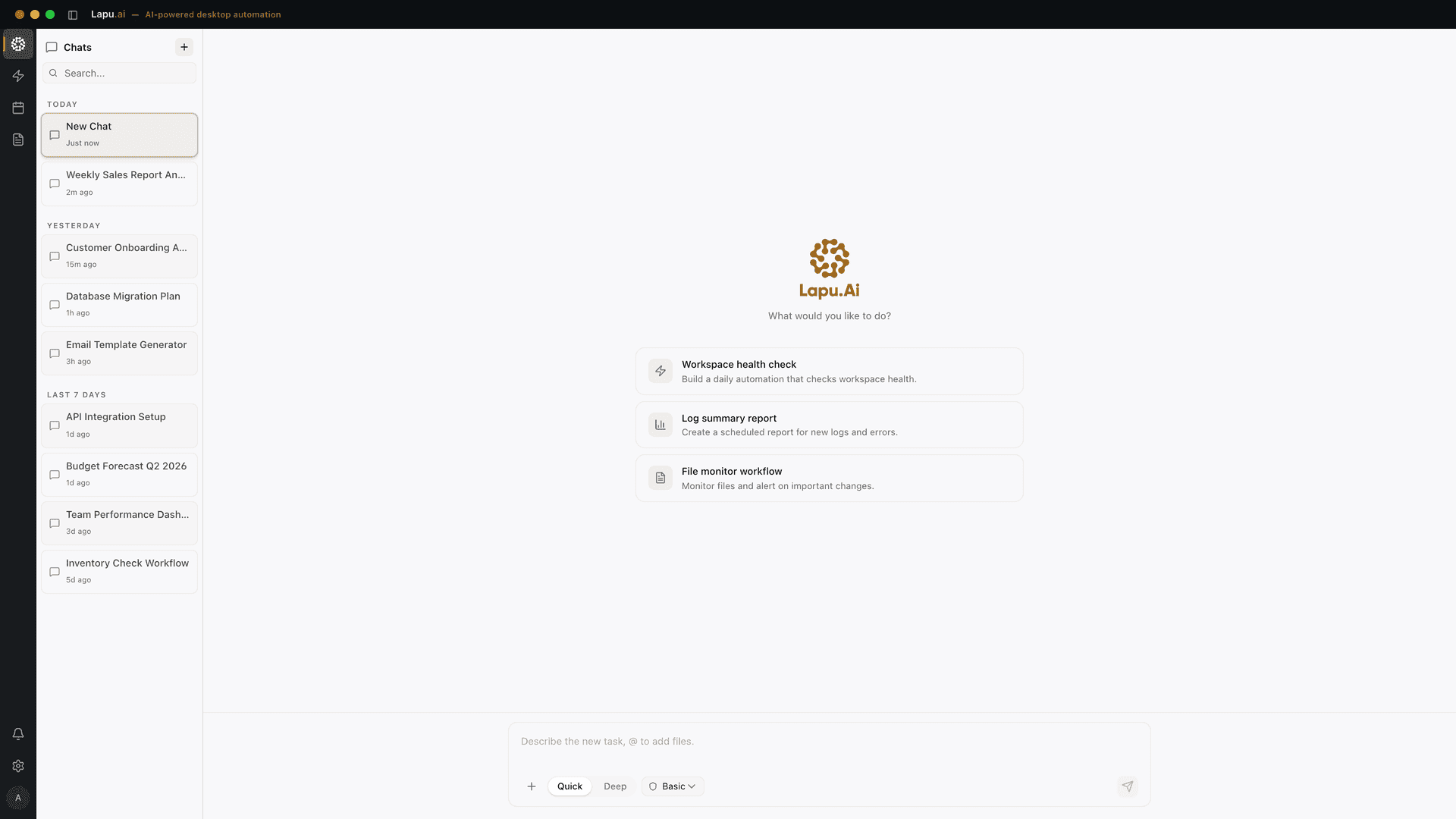
Lapu AI is an AI agent that runs on your real desktop, on macOS and Windows. Unlike Bytebot, it is not a containerized Linux desktop you host on Docker. It is a signed desktop application you install in under two minutes. It reads files in place on your filesystem, runs shell commands, processes documents (Word, Excel, PDF), and controls applications through native accessibility APIs, with explicit user approval at every sensitive step. Built-in frontier models from multiple providers mean no Anthropic, OpenAI, or Gemini API key to provision and no metered token bill. Audit trails of every action are retained for up to 90 days so you can inspect what the agent touched.
For users who looked at Bytebot and realized they did not want to run docker-compose, manage a Helm chart, host a Linux VM, and upload every file into an isolated container just to have an agent work on their data, Lapu AI is the no-assembly answer. It runs on the actual macOS or Windows session, not a containerized Ubuntu desktop. Honest limits: Lapu is closed source. You cannot fork the code or audit the agent loop the way you can with Bytebot's Apache 2.0 codebase, and a single Lapu agent runs in the foreground desktop session rather than scaling out as many parallel REST-driven containers. For batch automation at cloud scale or air-gapped self-hosting, a self-hosted stack like Bytebot's design remains the better primitive.
Pros
Finished desktop app: no Docker, no docker-compose, no Helm chart, no localhost:9992 web UI
Runs on the user's real macOS or Windows session, not a separate containerized Linux desktop
Built-in frontier models: no Anthropic, OpenAI, or Gemini API key to provision
Permission gate on every risky action with a 90-day audit trail
Flat pricing: Free, $20 Premium, $60 Pro, $100 Max, with model access bundled in
Cons
Closed source: you cannot fork it, audit the code, or modify the agent loop the way you can with Bytebot's Apache 2.0 codebase
Single foreground desktop session: does not scale horizontally to many parallel REST-driven containers
No public task REST API for backend automation pipelines
Closed model routing: you cannot swap in a custom provider through LiteLLM the way Bytebot allows
Best for: Individuals who want desktop AI as a finished product on their own machine, not a self-hosted container stack
Anthropic Computer Use is the beta API tool that lets Claude take screenshots, move a mouse, type, and execute keystrokes inside a desktop environment. Like Bytebot, the reference setup is a sandbox: Anthropic's published quickstart runs the agent against a Docker container with Linux, X11, and VNC rather than against the user's real desktop. Unlike Bytebot, it is not an end-user app you install but a beta API capability you call from your own code, gated behind beta headers and metered Anthropic token billing. In March 2026 Anthropic also surfaced Computer Use directly inside Claude Cowork and Claude Code for Pro and Max subscribers, so the same primitive now drives a first-party Anthropic product on macOS as well as the developer API.
For a Bytebot user who liked the 'agent drives a Linux desktop in a Docker container' design but does not want to maintain the rest of the stack (a NestJS orchestrator, a Next.js task UI, Postgres, the desktop container), Anthropic Computer Use is the closest direct swap. You skip the Bytebot orchestration layer and call the Computer Use API directly: Anthropic publishes the reference Docker desktop, and the agent loop is theirs to maintain. Honest limits: it is closed source, API-only, single-vendor (Claude-only), still flagged as beta, and metered per token instead of free under Apache 2.0, none of which matches Bytebot's open-source, model-agnostic posture.
Pros
First-party from Anthropic: the screenshot-and-click agent loop is maintained by the model provider itself
Now wired into Claude Cowork and Claude Code as a finished product surface, not only an API
Sandboxed Docker reference implementation is published and documented
Strong tool-use reliability when paired with Claude Sonnet 4.6 or Opus 4.7
Cons
Closed source and Claude-only: no LiteLLM-style provider switching
Beta-gated API with metered Anthropic token billing instead of Apache 2.0 free
Anthropic recommends running it against a dedicated VM, not your real desktop
Building your own product on the raw API means you re-implement the orchestration Bytebot already gave you for free
Best for: Developers who liked the sandboxed-agent design but want Anthropic to maintain the loop
Open Interpreter is an open-source agent (Apache 2.0) with around 64k GitHub stars. It runs on macOS, Windows, and Linux as a CLI you launch by typing `i` or `interpreter` in your shell. It is best known for letting an LLM write and execute code locally (Python, Shell, JavaScript), but it has expanded to include browser automation and native app control with native sandboxing across all major platforms. It is provider-agnostic: OpenAI, Anthropic, Google, Groq, OpenRouter, any OpenAI-compatible endpoint, and local models via Ollama.
For a Bytebot user whose priority is open source and bring-your-own-model but who does not actually need container isolation and would rather skip Docker and have the agent run directly on the real machine, Open Interpreter is the strongest swap. It keeps the Apache 2.0 license and the provider-agnostic story while dropping the entire containerized-Linux-desktop layer. Honest limits: it is terminal-first, so the UX is closer to a developer tool than a finished app; it does not give you the same hard host-isolation boundary Bytebot's container gets you for free; and the per-platform native-app control surface is less mature than Bytebot's screenshot-driven Linux desktop or a polished commercial product.
Pros
Open source (Apache 2.0) with around 64k GitHub stars and an active maintainer
Provider-agnostic: Anthropic, OpenAI, Google, Groq, OpenRouter, local Ollama models
Runs natively on macOS, Windows, and Linux: no Docker desktop in the way
Per-code-block approval by default; auto-run for trusted repeat tasks
Free: pay only the underlying model provider
Cons
Terminal-first CLI: no polished GUI like Lapu AI or ChatGPT
No hard container isolation from the host the way Bytebot has by design
Bring your own API key: costs scale with usage at provider rates
Native-app control surface is less mature than Bytebot's full Linux desktop
Best for: Developers who want the open-source, BYO-model story without Docker or a containerized Linux desktop
Goose is an open-source AI agent (Apache 2.0) originally built by Block and now hosted under the Agentic AI Foundation at the Linux Foundation. It is around 45k GitHub stars in 2026 and ships as a native desktop app for macOS, Windows, and Linux plus a Rust CLI for terminal workflows. It works with 15+ model providers (Anthropic, OpenAI, Google, Azure, Bedrock, Ollama, OpenRouter), and connects to 70+ extensions via the Model Context Protocol (MCP), making it one of the most extensible open-source agent frameworks in 2026.
For a Bytebot user who wants to keep the open-source, multi-provider story but switch to an agent that runs on their actual desktop and plugs into MCP-based tools instead of a self-hosted Linux container, Goose is the closest match. You install the desktop app, point it at a model provider, and it runs natively on the real machine, no docker-compose, no Helm chart. Honest limits: Goose is general-purpose with strong coding and MCP-tool reach, but its screenshot-and-click computer-use surface is less mature than Bytebot's purpose-built Ubuntu agent, you still bring your own API key plus pay metered token costs, and it does not give you the hard container-isolation safety boundary Bytebot has by design.
Pros
Open source (Apache 2.0), Linux Foundation governance via the Agentic AI Foundation
Native desktop app for macOS, Windows, and Linux plus a Rust CLI
15+ model providers including local Ollama and 70+ MCP extensions
Active community with around 45k GitHub stars and an ongoing release cadence
Cons
Bring your own API key: costs scale with usage or you run local models slowly
Screenshot-and-click surface less mature than Bytebot's purpose-built desktop container
No container-isolation boundary: the agent runs on the host the way Lapu does
No first-party permission UI as granular as Lapu AI's per-action prompts
Best for: Open-source loyalists who want a native desktop agent with MCP extensibility instead of a self-hosted Linux container
Manus is an autonomous agent platform that launched in 2025 and was acquired by Meta. It plans multi-step tasks, browses the web, writes and executes code, and ships outputs from a single prompt. Like Bytebot, the original Manus design ran the agent inside an isolated cloud sandbox (a per-task virtual machine with its own browser, file system, and tools), except Manus hosts the sandbox in its own cloud rather than asking you to self-host the container. In March 2026 Manus added a Desktop app with a feature called My Computer that lets the agent execute terminal commands, read files in directories you have granted access to, and use installed development environments (Python, Node.js, Swift, Xcode), on macOS and Windows.
For a Bytebot user who liked the 'sandboxed agent runs the whole task' framing but does not want to operate the sandbox themselves, Manus is the closest hosted equivalent. You hand it a task, it runs through it in Manus' cloud, you watch it work. Trade-off: it is closed source, credit-metered, and your task data flows through Manus / Meta infrastructure for the cloud surface; the desktop app narrows that for local file and terminal work. Pricing: Free with 300 daily credits, Standard $20/month with 4,000 credits, Customizable $40/month with 8,000 credits, Extended $200/month with 40,000 credits.
Pros
Hosted sandbox: no Docker, no docker-compose, no infrastructure to operate
Autonomous multi-step task framing: closer in spirit to Bytebot's agent loop
Both cloud agent and a Desktop app with local file and terminal access
Credit-based pricing with a meaningful free daily allowance
Cons
Closed source and credit-metered: none of Bytebot's Apache 2.0 transparency
Cloud sandbox processes data on Manus / Meta infrastructure
Desktop app My Computer surface is newer (March 2026) and less battle-tested
Meta acquisition status has been a moving target: 2025 deal blocked by regulators, since restored
Best for: Users who liked the sandbox-runs-the-task framing but want it hosted instead of self-hosted
Stay on Bytebot if open source under Apache 2.0, hard container isolation from your host, a REST API, and horizontal parallel scale are non-negotiable, and your team is comfortable hosting Docker, Railway, or Kubernetes, and you accept that the original bytebot-ai/bytebot repo was archived in March 2026 and active maintenance now lives in community forks and the commercial bytebot.ai product. Move to Lapu AI if you want desktop AI as a finished product running on your real macOS or Windows session, with built-in models, per-action permissions, and an audit trail, no Docker, no API key, no infrastructure. Move to Anthropic Computer Use if you liked the sandboxed-Linux-desktop design but want Anthropic to maintain the agent loop and you are happy on a closed beta API. Move to Open Interpreter if open source and BYO model still matter but you do not actually need container isolation and would rather run the agent on the real machine. Move to Goose if you want an open-source native desktop agent with deep MCP extensibility on a metered model API. Move to Manus if you want the sandbox-runs-the-task framing but hosted in someone else's cloud and billed in credits.
Where Lapu AI fits
Bytebot is a self-hosted Linux desktop in a Docker container, an agent infrastructure pattern that asks you to clone a repo, run docker-compose, supply an Anthropic, OpenAI, or Gemini API key, and treat agent automation as a system you operate. Lapu AI is the opposite design: a signed desktop application for macOS and Windows that runs on the user's actual session, with built-in frontier models so there is no API key to provision, a permission gate on every sensitive action, and a 90-day audit trail of everything the agent did. Bytebot gives you a containerized Linux desktop that an agent drives; Lapu gives you an agent that drives your real desktop. Honest limits: for air-gapped self-hosting, hard container isolation, batch automation at cloud scale, or full source-code transparency, Bytebot's design (and its forks and successors) remains the better primitive. Lapu AI is for users who want the agent to do work on the machine in front of them, not on a separate Linux VM they have to host.
FAQ
Why are people looking for Bytebot alternatives in 2026?
Three reasons drive the search. First, the original bytebot-ai/bytebot GitHub repository was archived by the owner on March 7, 2026: active maintenance now lives in community forks and the commercial bytebot.ai product, which is a signal that prompts evaluators to look at adjacent options. Second, the design asks you to host a containerized Linux desktop on Docker, Railway, or Kubernetes and supply your own AI provider API key, which is more infrastructure than many users want for desktop automation. Third, the agent works inside an isolated Ubuntu desktop, not your actual macOS or Windows session: files have to be uploaded into the container, and it cannot drive the apps already installed on your real machine. Many users want an agent that runs on the real desktop instead.
Was the Bytebot project really archived?
Yes. The original bytebot-ai/bytebot repository on GitHub was archived by the owner on March 7, 2026 and is now read-only. The Apache 2.0 code remains available, several community forks continue, and the bytebot.ai commercial product still markets a hosted version. The original quickstart that ran the agent in a single docker-compose container still works for self-hosters, but the canonical upstream repo is no longer receiving updates.
How is Lapu AI different from Bytebot?
Bytebot runs the agent inside a containerized Linux desktop you self-host on Docker, Railway, or Kubernetes, the agent operates an Ubuntu 22.04 XFCE environment that is completely isolated from your host machine. Lapu AI runs on your real OS session and drives the files, terminal, and applications already on your machine, with permission. Bytebot is open source under Apache 2.0 and asks you to bring your own AI provider API key; Lapu AI is closed source with built-in frontier model access bundled into a flat subscription. Bytebot has hard container isolation but does not act on the host; Lapu AI has per-action permission prompts and a 90-day audit trail because it does act on the host.
Is Anthropic Computer Use a real Bytebot alternative?
Yes, with a caveat. The Anthropic Computer Use API runs against a published Docker reference desktop that is conceptually very similar to Bytebot's containerized Linux setup, same screenshot-driven loop, same sandboxed Linux target, same posture of 'do not point this at the user's real machine.' It is the closest direct swap if you want to keep the sandboxed-agent design but have Anthropic maintain the loop: the full ranking is on Anthropic computer use alternatives. The caveats: it is closed source, Claude-only, metered on Anthropic tokens, still flagged as beta, and you re-implement the orchestration layer Bytebot already gave you (NestJS agent service, Next.js task UI, Postgres). For end users who just want a finished product, Anthropic also surfaces Computer Use inside Claude Cowork and Claude Code on macOS, which sidesteps the API-building step entirely.
Which Bytebot alternative is best if open source matters most?
Open Interpreter and Goose. Both are Apache 2.0, both are model-agnostic, both have large active communities (Open Interpreter around 64k GitHub stars; Goose around 45k under Linux Foundation governance). Open Interpreter is terminal-first and best when you want the open-source / BYO-model story without any Docker layer at all. Goose ships a native desktop app for macOS, Windows, and Linux plus a Rust CLI, and goes further on extensibility through Model Context Protocol with 70+ documented MCP extensions. Neither gives you the hard container-isolation safety boundary Bytebot has by design. That is a feature you give up when you drop the Docker layer.
Which Bytebot alternative is best for non-technical users?
Lapu AI. Bytebot's deployment model assumes someone comfortable running Docker, docker-compose, Railway, or a Kubernetes Helm chart, accessing a web UI on localhost:9992, and provisioning an AI provider API key. Lapu AI is a signed desktop installer for macOS and Windows with frontier model access bundled in: install it and start working in under two minutes, no infrastructure, no API key. The trade-off is that it is closed source and does not give you the Apache 2.0 transparency or REST API a Bytebot self-hoster gets.
Which Bytebot alternative runs many agents in parallel at cloud scale?
Bytebot itself, or Manus' hosted sandbox. Bytebot's tagline at bytebot.ai is 'desktop agents that use computers like a human, at cloud scale,' and the design, Docker containers behind a REST API, is built for horizontal scale. If you want the same model but do not want to operate the infrastructure, Manus runs an autonomous sandbox per task in its own cloud. Lapu AI, Anthropic's Claude Cowork product, Open Interpreter, and Goose are single-session foreground tools, none is built to drive many parallel agents behind an HTTP endpoint.
How does pricing compare?
Bytebot software is free under Apache 2.0; your real bill is your AI provider's per-task API fees (Anthropic, OpenAI, or Gemini) plus the infrastructure cost of running the Docker containers, which is hard to predict for heavy use. Lapu AI is a flat plan (Free, $20 Premium, $60 Pro, $100 Max), with frontier model access bundled in. Anthropic Computer Use is metered on Anthropic API tokens. Open Interpreter and Goose are free open-source software where you pay only the underlying model provider (or zero with local Ollama, slower). Manus uses credit-based pricing, Free with 300 daily credits, Standard $20/month with 4,000 credits, up to Extended $200/month with 40,000 credits.