An AI agent audit trail is the difference between knowing what your software did and guessing. For a desktop AI agent that can read files, run shell commands, and act in real applications, the audit trail is not a nice-to-have. It is the only honest answer to "what did the agent just do?" This guide explains what an audit trail must record, how to store it, and how to evaluate any vendor's logging claims.
What is an AI agent audit trail?
An AI agent audit trail is a structured, time-ordered record of every action an autonomous agent performed on a machine, paired with the prompt or instruction that triggered each step. It captures both intent (what the user asked, what the agent decided to do) and action (which file was read, which command ran, which API was called).
The distinction matters. A traditional application log records what code ran. An agent's audit trail must record what the agent chose to run, why, and whether a human approved it. OWASP's guidance on excessive agency states this directly: "Log and monitor the activity of LLM extensions and downstream systems to identify where undesirable actions are taking place" (OWASP, 2025). Without the agent's reasoning attached to each tool call, the log shows you the explosion but not the spark.
This becomes concrete on the desktop. When a desktop AI agent moves a file, the question "did the user ask for that?" is the audit question. The model that produced the action does not remember it. The shell that executed it does not know about it. The audit trail is the only ground-truth record.
AI audit trail vs. AI agent audit trail
"AI audit trail" is the broader term: any record of what an AI system did, model decisions, data accessed, inferences served, who saw what. Most AI audit trails describe systems that answer: a model returns a prediction and you log the input, the output, and the version that produced it.
An AI agent audit trail is the strict case. The system does not just answer; it acts. It writes files, runs commands, and clicks buttons in real applications. So the record has to capture two extra things a normal AI audit trail does not: the agent's reasoning before each action, and the permission decision that allowed it. Everything below applies to both, but the agent case is where under-logging does real damage, because the missing field is not a wrong answer. It is an irreversible action no one can reconstruct.
What an audit trail must record
The OWASP Top 10 for 2025 lists "Security Logging and Alerting Failures" as a top-tier web application risk specifically because under-logged systems cannot be diagnosed after the fact (OWASP, 2025). For an AI agent, the same logic applies, with extra fields specific to autonomy. A useful audit record captures:
- Timestamp. ISO-8601 with timezone. Used for ordering and replay.
- Session identifier. Which run of the agent did this action belong to?
- User prompt. The text the human entered, in full. Truncating loses context.
- Agent reasoning. The model's plan or step description: what it decided to do and why.
- Tool call. The exact function name, arguments, and target, for example
write_file(path="/Users/you/notes.md", bytes=412)orrun_shell(cmd="git status", cwd="~/projects/x"). - Permission decision. Whether this action was auto-approved at the read-only tier, granted via a per-action prompt, or denied. Include the human's response when present.
- Result. Success, error, exit code, bytes written, response code.
- Files touched. Absolute paths for any reads, writes, deletes, or moves.
Two omissions are common and damaging. First, vendors often log only the tool call and skip the prompt, making it impossible to tell whether the agent followed user intent or drifted. Second, they log only successful actions, hiding refused or errored attempts that are exactly what a security review needs. A good audit trail records every attempt, then marks success or failure.
This is also where compliance frameworks land. The NIST AI Risk Management Framework organizes AI governance around four functions: Govern, Map, Measure, Manage (NIST, 2023). Audit logs sit inside Measure (what the system actually did) and Manage (what to do about it). Anthropic's enterprise product copy explicitly calls out "financial modeling with full audit trails" as a requirement for regulated workflows (Anthropic, 2025), a tacit acknowledgment that without one, the workflow does not qualify.
Storage, integrity, and retention
Where the log lives is as important as what is in it. Three properties matter.
Append-only storage. OWASP's logging guidance is explicit: "All transactions have an audit trail with integrity controls to prevent tampering or deletion, such as append-only database tables" (OWASP, 2025). A log the agent itself can rewrite is not a log. The practical implementation is either an append-only file format with a running content hash, or a database table with row-level immutability enforced by the storage engine.
Local-first by default. A log of everything a desktop agent did is one of the most sensitive artifacts on a machine. It contains file paths, prompt content, and command history. Streaming it to a vendor's cloud by default is a privacy regression compared to traditional desktop software. The defensible default is to keep the audit trail on the user's machine, with optional, customer-controlled export to a SIEM or compliance sink for teams that need it.
Retention that matches the threat model. Most desktop attacks are detected within days, not minutes. A retention window of 30 to 90 days covers virtually every "wait, what did the agent do last Tuesday?" question. Anything shorter starts to look like log gaps that exist to limit liability. Anything longer without rotation produces multi-gigabyte files no one will ever read.
A reasonable default profile: append-only local store, 90-day rolling retention, configurable per workspace, optional export to a customer-owned destination on Teams plans. Nothing exotic, just the desktop equivalent of what every regulated SaaS product has done for years.
A good audit record vs a bad one
The difference between an audit trail you can use and one you cannot is visible at the level of a single record. Compare.
Bad:
2026-05-14T09:14:22Z shell_command ok
The action ran. That is the entire record. There is no prompt, no working directory, no command, no result detail. You cannot reconstruct what happened. You cannot tell whether the user approved it. You cannot tell whether the file it modified mattered.
Good:
{
  "ts": "2026-05-14T09:14:22.481Z",
  "session": "s_8f3a",
  "prompt": "Find duplicate spreadsheets in ~/Documents and trash them.",
  "step": "Listing candidates for deletion before removing.",
  "tool": "run_shell",
  "args": {
    "cmd": "find ~/Documents -name '*.xlsx' -size +1M",
    "cwd": "/Users/you"
  },
  "tier": "read-only",
  "decision": "auto-approved",
  "result": {
    "exit": 0,
    "stdout_bytes": 1843,
    "stderr_bytes": 0
  }
}
You can read this record cold, six months from now, and know what happened. You can grep across a year of records to find every rm the agent ever attempted. You can hand the file to a security team and they can answer their own questions without phoning home.
The expanded record is roughly five hundred bytes. The minimal one is roughly fifty. The difference in disk usage is irrelevant on a desktop with terabytes of storage. The difference in operational value is everything.
| Field | Example value |
|---|---|
| Timestamp (ts) | 2026-05-14T09:14:22.481Z |
| Session | s_8f3a |
| Prompt | Find duplicate spreadsheets in ~/Documents and trash them. |
| Agent step | Listing candidates for deletion before removing. |
| Tool call | run_shell |
| Command args | find ~/Documents -name '*.xlsx' -size +1M |
| Working directory | /Users/you |
| Permission tier | read-only |
| Decision | auto-approved |
| Result | exit 0, stdout 1843 bytes, stderr 0 bytes |
How do you audit what an AI agent actually did?
This is the question the whole AI audit trail exists to answer, so it is worth answering directly. You audit what an AI agent actually did by reading its audit trail in order, not by asking the agent, which does not reliably remember, and not by reading your OS logs, which never knew the agent's intent. The practical procedure is four steps:
- Open the session, not the summary. Find the run by its session identifier and read every record in timestamp order. A summary tells you what the agent claims it did; the trail tells you what it did.
- Pair each action with its prompt. For every tool call (file read, file write, shell command, network call), confirm the trail shows the prompt and the model's reasoning that triggered it. If a tool call has no prompt attached, the action is uninvestigable.
- Check the permission decision. Each record should state whether the action was auto-approved at the read-only tier, granted via a per-action prompt, or denied. This is how you separate "the agent was authorized to do this" from "the agent did this on its own."
- Look for what is missing. A trail that records only successful actions hides refused and errored attempts, which are exactly what a security review needs. Confirm the trail logs every attempt, then marks success or failure.
If you can do all four cold, six months later, without phoning the vendor, the agent has a real audit trail. If any step fails (no session view, prompts detached from actions, silent permission decisions, success-only logging), you cannot actually audit what the agent did, and the rest is guesswork.
Least privilege and the audit trail
The audit trail and least privilege are two halves of the same control. Least privilege limits what the agent is allowed to do. It should receive only the permissions the current task requires, not the full inherited access of the user who launched it. The audit trail records what the agent actually did against those limits. One without the other is incomplete: least privilege with no audit trail means you constrained the agent but cannot prove what happened inside the constraint, and an audit trail with no least-privilege model means you can read a long log of actions the agent was never meaningfully prevented from taking.
The connection is concrete in the record itself. The permission decision field (auto-approved, granted, or denied) is exactly where the two controls meet. A least-privilege design produces a stream of denials and per-action grants that the audit trail captures verbatim, so a reviewer can see not just what ran but what the agent tried to do outside its scope. Repeated denials of the same out-of-scope operation are a signal worth knowing about. For the full permission model behind this (the four tiers, scoping writes to a workspace, and the static-vs-runtime trade-off), see least privilege for a desktop AI agent, and for how isolation backstops both controls, what an AI agent sandbox is.
How Lapu AI implements its audit trail
Lapu AI follows the design above with three specifics tuned for desktop use:
- One JSONL file per workspace, stored locally inside the workspace's hidden
.lapu/directory. Append-only, hash-chained for tamper-evidence, never uploaded. - Every record carries the four desktop-specific fields: working directory, absolute file paths, OS-level user, and the permission tier that gated the action. These are the fields you actually need when reconstructing what a desktop agent did.
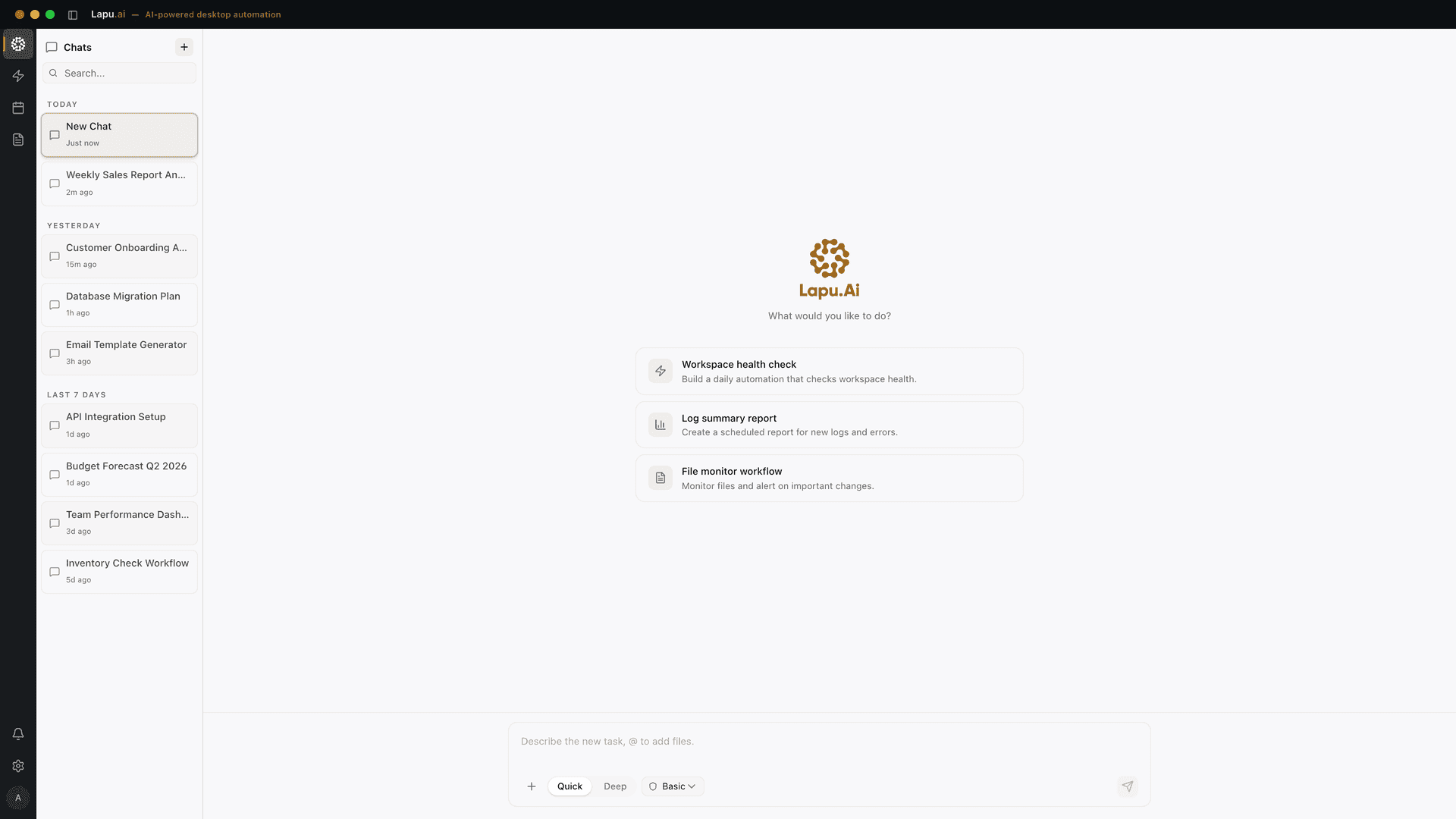
- Replay from the audit panel. Open the panel and the session appears as a step-by-step timeline. Each entry expands to show the prompt, the model's reasoning, the tool call, and the result. Export as JSONL for SIEM ingestion or as a redacted Markdown summary to share with a teammate.
This is what we mean by permission-based execution and a complete audit trail on the security page, and it is the layer that makes the rest of how Lapu AI works operationally honest. The architecture follows from running locally: because the agent loop runs on your machine, the log can stay on your machine too.
Questions to ask before trusting any agent's logging
When evaluating any desktop AI agent, Lapu included, work through this checklist. Each answer should be one sentence of plain text, not a paragraph of hedging.
- Is every tool call logged, including refused ones? "Yes, with the user's decision recorded" is the right answer. "We log successful actions" is not.
- Is the prompt that triggered each action attached to the record? Tool calls without prompts are uninvestigable.
- Is the log append-only with integrity controls? A log the agent can rewrite is not a log.
- Where is the log stored, and who can read it? Local-first, user-owned, optional export beats vendor-default upload.
- What is the retention policy and how do I configure it? A vague "we keep some logs" is not an answer.
- Can I export the log in a format my tools understand? JSON Lines, CSV, or syslog forwarding are the minimums.
An agent that cannot answer these in one paragraph apiece is not ready to run on a machine that holds your real work. This matters most for operations teams and other desktop roles who have to answer compliance and incident questions long after the fact, and for high-stakes flows like AI-assisted data processing, where the record of what changed is the deliverable.
FAQ
- What is an AI audit trail?
- An AI audit trail is a structured, time-ordered log of what an AI system did, what data it read, what decisions it produced, and what actions it took. For an agent that acts on a machine, the record adds the model's reasoning and the permission decision behind each step so a reviewer can answer intent questions, not just execution ones.
- What is an AI agent audit trail?
- An AI agent audit trail is a structured, time-ordered log of every action the agent performed, paired with the prompt and reasoning that triggered the action. For a desktop agent it covers file reads, file writes, shell commands, network calls, and permission decisions. The point is to answer the question 'what did the agent actually do?' without needing to ask the agent, because the agent does not reliably remember.
- Why can't I just use my OS audit log?
- OS-level logs (macOS Unified Logging, Windows Event Log) record system calls and process activity, but they have no concept of the agent's prompt, its reasoning, or which permission tier gated each action. They are a useful belt-and-suspenders signal, not a replacement. A proper agent audit trail captures intent, action, and outcome in one record that you can read in order.
- How long should I keep AI agent audit logs?
- For personal use, 30 to 90 days handles almost every retrospective question without producing unmanageable files. For team or regulated use, match the retention requirement of the underlying data: HIPAA, GDPR, and SOX each have their own multi-year minimums for protected data. Configure rotation so old logs are deleted automatically rather than building forever.
- Can the agent tamper with its own audit trail?
- Only if the design lets it. The correct pattern is an append-only file or table with content hashing, written to a path the agent cannot delete from. In Lapu AI, the audit JSONL lives in a protected directory inside the workspace and is hash-chained. Tampering breaks the chain visibly. Any vendor whose agent can rewrite or selectively delete log entries has built a log, not an audit trail.
- Does the audit trail leave my machine?
- In Lapu AI, no. The log is written locally and is not uploaded by default. Teams and Enterprise customers can configure export to a customer-owned destination (SIEM, S3 bucket, syslog forwarder). For any other vendor, ask explicitly where the log is stored, how it is transmitted, and who has read access, and read the answer carefully.
- Is 'the agent showed me a confirmation dialog' the same as an audit trail?
- No. A confirmation dialog is a permission control: it gates one action at one moment. An audit trail is the historical record across all sessions. You need both. The dialog protects the next action; the audit trail answers questions about the last hundred. Treating one as a substitute for the other is how blind spots accumulate.
- How do agent audit logs differ from regular application logs?
- Agent audit logs are designed for autonomous action, not for code execution. A traditional application log records which function ran and what input it received. Agent audit logs add three fields that have no equivalent in application logging: the user prompt that triggered the run, the model's reasoning before each action, and the permission decision (auto-approved, granted, or denied) that gated execution. Application logs answer 'what did this code do?'; agent audit logs answer 'did the agent follow the user's intent, and was each action authorized?'.
- What does an audit trail for AI interactions need to record that a system log does not?
- An audit trail for AI interactions has to record what the user asked and what the model decided to do, fields a system log has no concept of. macOS Unified Logging and Windows Event Log capture system calls; they tell you a process ran, not why the agent ran it. An audit trail for AI interactions pairs each tool call with the prompt that prompted it and the model's plan before it acted, so a reviewer can answer intent questions, not just execution questions.
- How do you audit what an AI agent actually did?
- You read the agent's audit trail in timestamp order, not the agent's own summary, and not the OS logs. Open the session by its identifier, then for each tool call (file read, file write, shell command, network call) confirm the record shows the prompt and the model's reasoning that triggered it, plus the permission decision (auto-approved, granted, or denied). Finally, check that refused and errored attempts are logged, not just successes. If you can complete those steps cold without asking the vendor, the agent has a real audit trail; if any step fails, you cannot actually audit what it did.
- How does least privilege relate to an AI agent audit trail?
- Least privilege limits what the agent is allowed to do; the audit trail records what it actually did. They are two halves of one control and meet in the permission-decision field of each record. A least-privilege agent receives only the access the current task needs, so its trail shows a stream of per-action grants and denials a reviewer can read directly. Least privilege without an audit trail leaves you unable to prove what happened inside the constraint; an audit trail without least privilege logs actions the agent was never meaningfully prevented from taking. Serious desktop agents implement both.
Sources
- A09:2025 Security Logging and Alerting Failures, OWASP (2025-09-01) · accessed 2026-05-14
- LLM06:2025 Excessive Agency, OWASP Gen AI Security Project (2025-01-15) · accessed 2026-05-14
- AI Risk Management Framework, NIST (2023-01-26) · accessed 2026-05-14
- Claude for Financial Services, Anthropic (2025-07-15) · accessed 2026-05-14