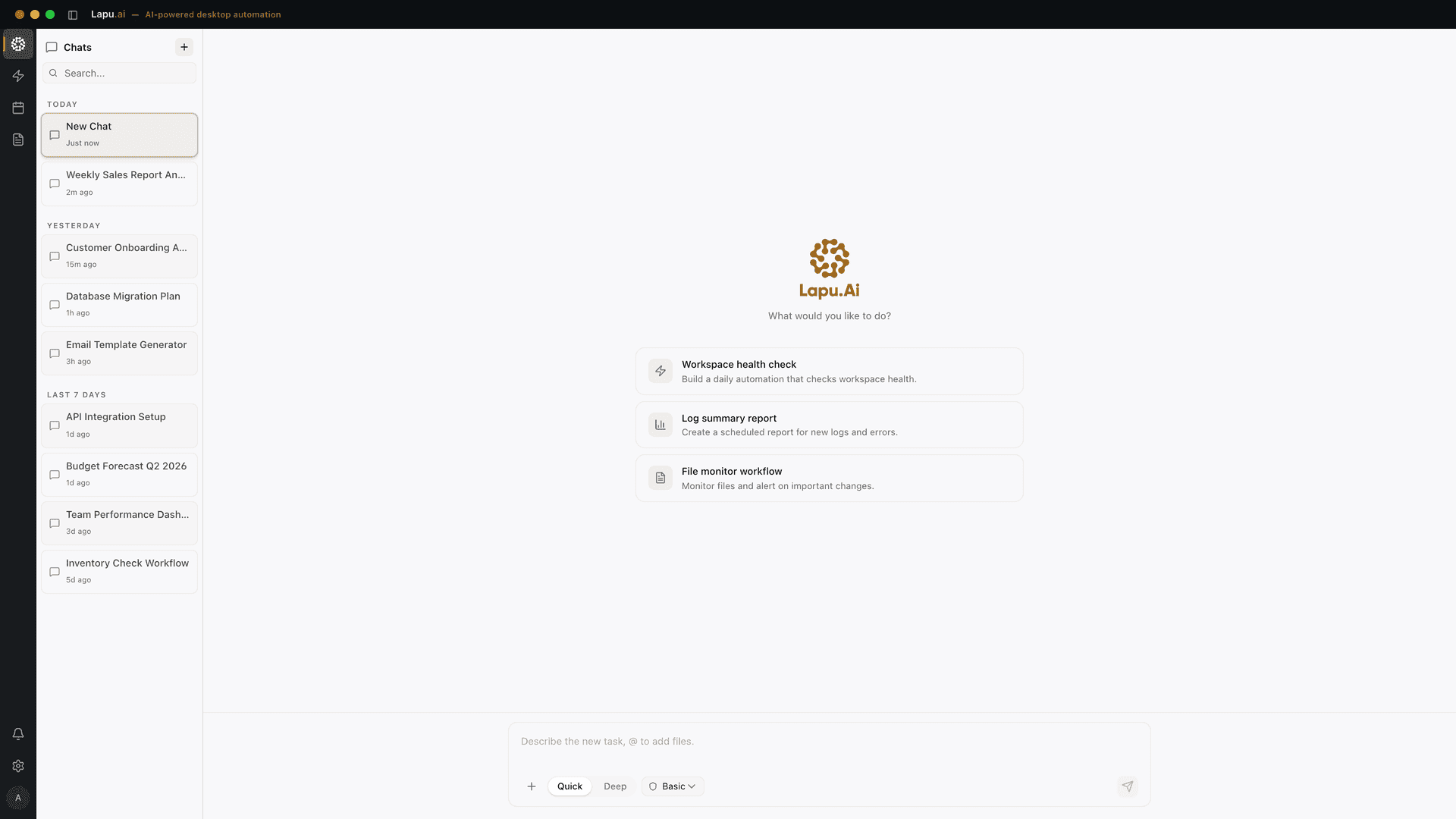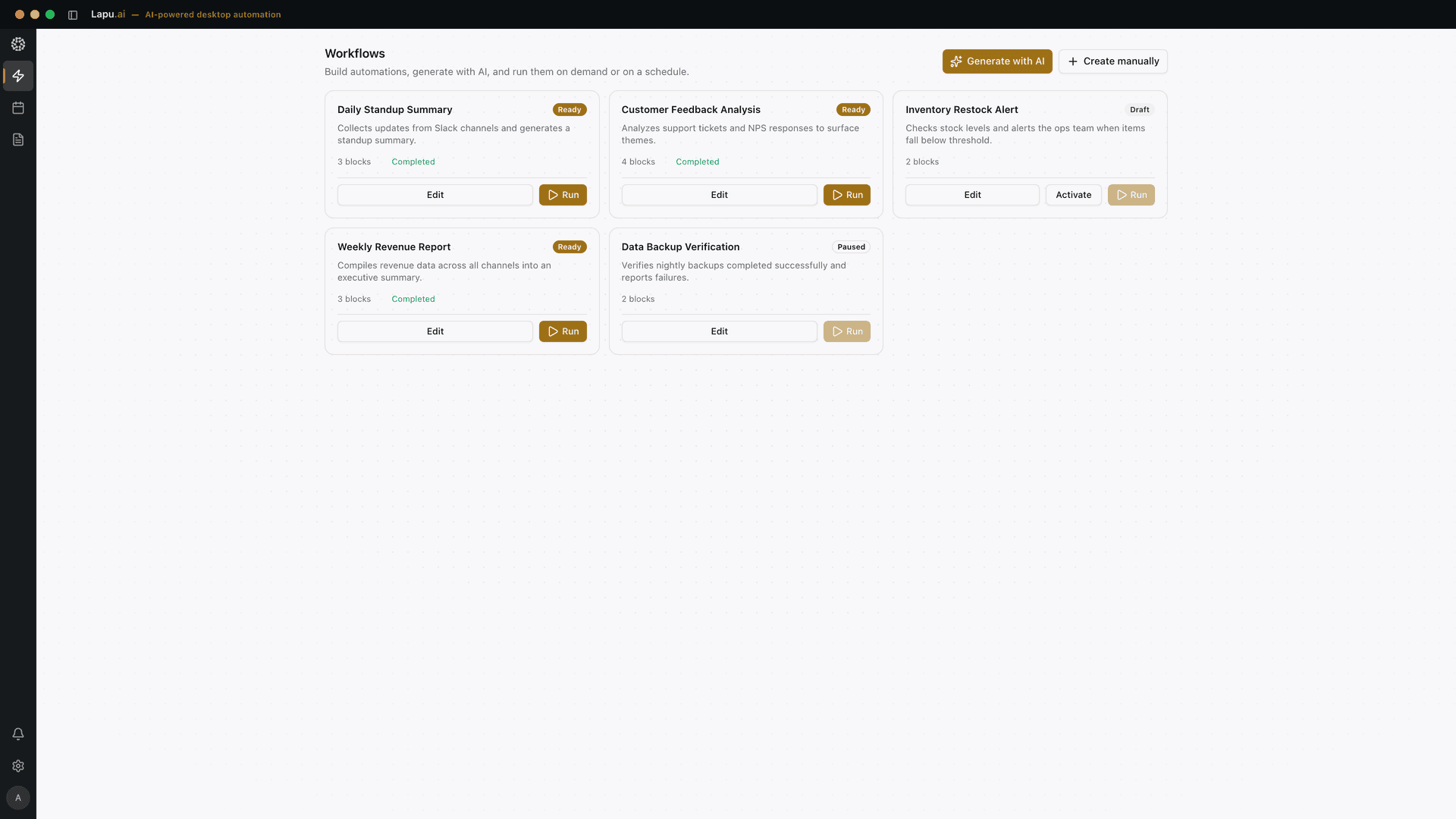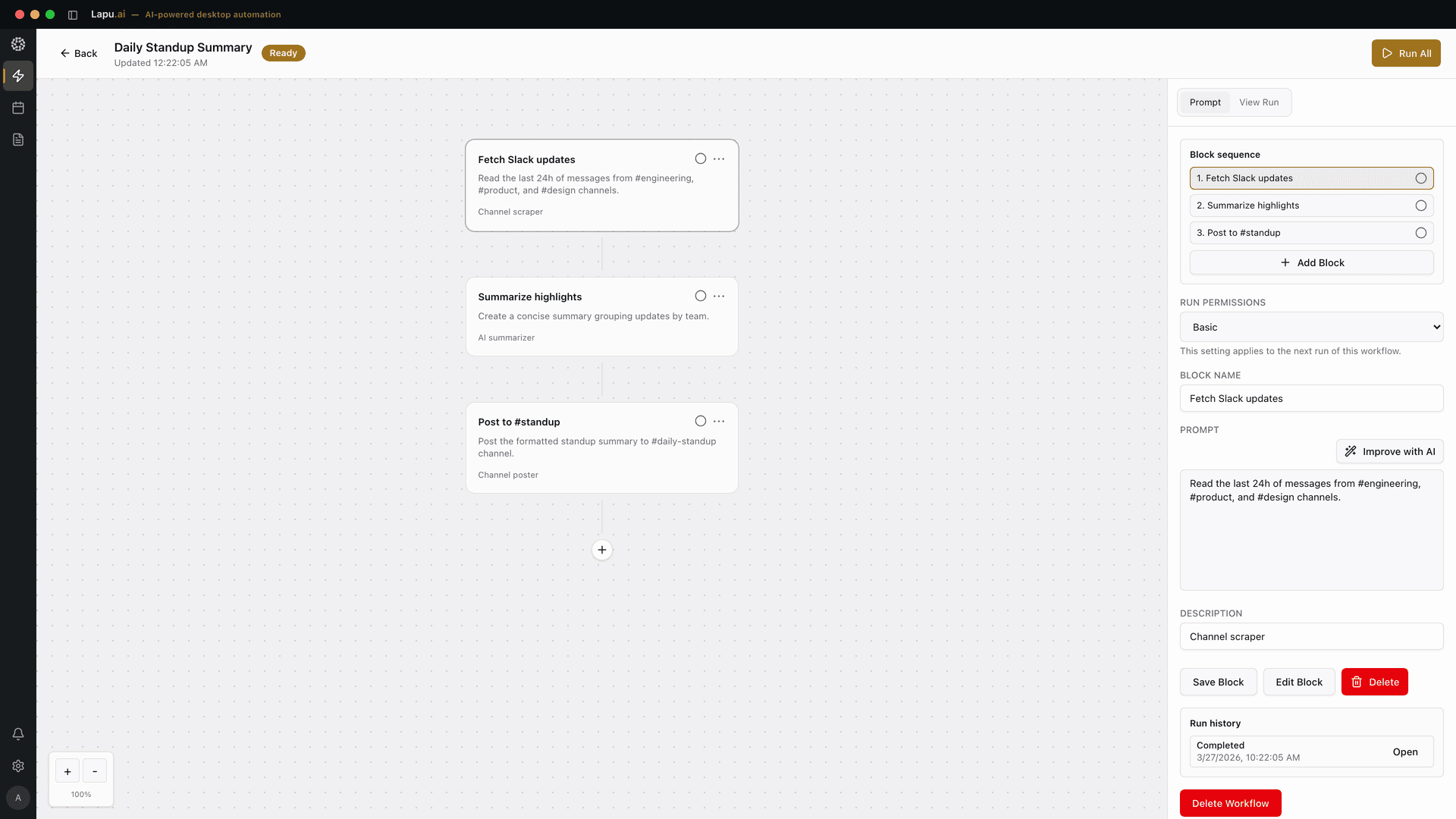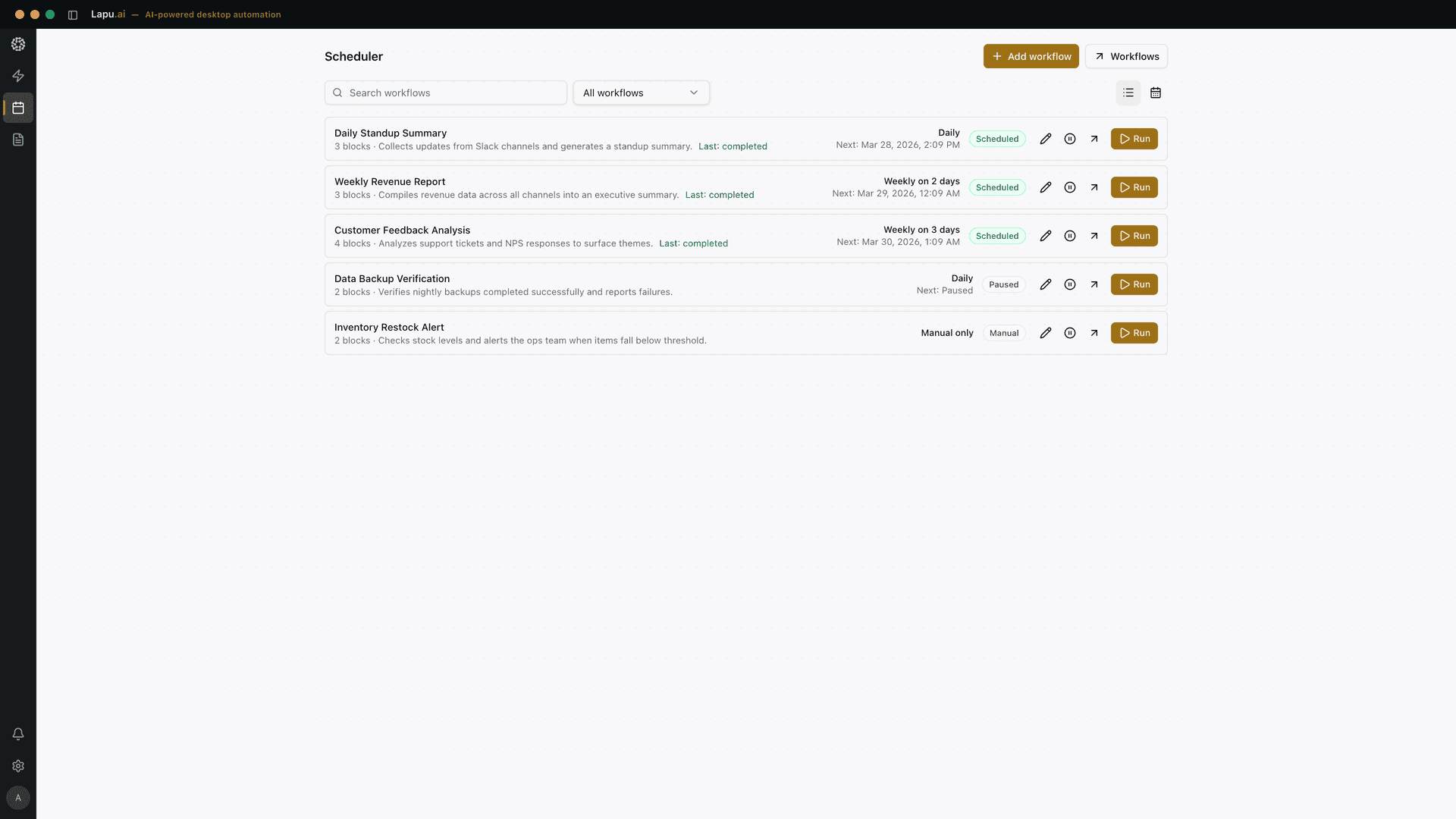
If you have ever wished your computer could just do things for you — organize files, draft emails, run terminal commands, search through documents — without you having to babysit every step, that is exactly the problem Lapu AI was built to solve. Lapu AI is a desktop AI agent that automates real tasks on your computer, combining the intelligence of frontier language models with native access to your operating system.
What is Lapu AI?
At its core, Lapu AI is a desktop-native application that acts as an intelligent assistant capable of executing tasks directly on your machine. Unlike browser-based AI tools that are confined to a chat window, Lapu AI has direct access to your filesystem, running applications, clipboard, terminal, and system APIs. It does not just suggest what to do — it actually does it, with your permission.
Think of it as the difference between asking someone for directions and having someone drive you there. Lapu AI operates at the system level, meaning it can open applications, read and write files, run shell commands, and orchestrate multi-step workflows across different tools on your desktop.
How does it work?
Lapu AI combines three key technologies into a seamless experience:
- Frontier language models — Lapu uses advanced AI models to understand instructions, reason about complex tasks, and generate high-quality outputs. The AI is built into the product — no API keys or model configuration required.
- Desktop automation — The agent has native hooks into your operating system. It can navigate your file system, launch and control applications, execute terminal commands, and interact with system services. Tool execution happens locally on your machine.
- Permission-based execution — Every potentially destructive or sensitive action requires your explicit approval. Lapu AI presents a clear description of what it wants to do and waits for your confirmation before proceeding. You stay in control at all times.
When you give Lapu a task, the agent breaks it down into steps, determines which tools and capabilities it needs, and executes each step sequentially. If it encounters a decision point or a risky operation, it pauses and asks for your input. The result is an agent that feels collaborative rather than autonomous — powerful but safe.
Key features
Built-in AI
Lapu AI uses frontier language models for reasoning, planning, and execution. The AI capabilities are built directly into the product, so there is nothing to configure. You focus on describing your goals, and the agent handles the rest.
Local-first architecture
Lapu AI executes file operations, searches, and workflow orchestration locally on your desktop. There is no cloud workspace, no uploaded documents, no server-side storage of your files. When the agent needs to reason about a task, only the relevant context is sent to AI model providers via Lapu AI infrastructure.
Native desktop integration
Because Lapu runs as a native application on macOS and Windows, it has capabilities that browser-based tools simply cannot match. It can read and write files, run terminal commands, take screenshots, and control desktop applications through native accessibility APIs.
Transparent, permissioned actions
Every action the agent takes is visible to you. Before executing commands, modifying files, or accessing sensitive resources, Lapu presents exactly what it plans to do. You approve, modify, or reject each action. This is not a black-box agent running unsupervised — it is a collaborative tool that respects your authority over your own machine. See how permission-based actions work.
What Lapu AI is built for
Lapu AI is built for the kind of multi-step, multi-app work that does not fit inside a single chat window. The use cases fall into three honest categories.
- Routine file and document work. Sorting downloads, renaming exports from a client, extracting tables from a folder of PDFs, generating weekly reports from a fixed data layout. The kind of task that takes 20 minutes once and 20 minutes every week after.
- Glue between apps you already use. Reading a row in a spreadsheet, finding the matching record in your notes app, drafting a message in your email client, and stopping for your approval before sending. None of these apps were designed to talk to each other; Lapu sits on top and connects them.
- Local research and synthesis. Searching a project folder, summarizing matching files, pulling quotes with citations to the source file and line. The result lives on your disk, not in a vendor's cloud workspace.
The pattern in all three is that the inputs and outputs already live on your machine, and the work involves more than one tool. That is the shape of task a desktop agent does better than a chatbot or a cloud agent. See the full range of desktop automation tasks for concrete examples.
How Lapu AI differs from chat assistants
Most people first reach for ChatGPT, Claude.ai, or a similar chatbot when they think about an AI assistant. Those products are excellent at what they do, but they are a different category of software from Lapu AI. The honest comparison.
ChatGPT and Claude.ai (web chat) are conversational interfaces. They produce text, code, and analysis inside the chat window, and you copy the output back to your environment. If you want them to act on your files, you upload them. They are excellent at single-turn reasoning and at writing; they are not designed to run multi-step tasks against your actual filesystem.
OpenAI's Operator (Computer Using Agent) does take actions, but it does them inside a cloud-hosted virtual browser on OpenAI's infrastructure. It is "laser-focused on browser automation" and "operates through a cloud-based virtual browser environment, keeping everything contained within OpenAI's servers" (WorkOS, 2025). That is a real and useful capability for web-only workflows. It is not a fit for tasks that touch files, terminals, or native apps on your own machine.
Anthropic's Computer Use is the closest peer in concept — an AI that controls a desktop environment with screenshots and mouse/keyboard input. Anthropic's documentation states it "enables Claude to interact with desktop environments" but is shipped as a developer API and recommends running it "in a dedicated virtual machine or container with minimal privileges" (Anthropic, 2024). That posture is right for the underlying technology. Lapu AI is what you get when that capability is wrapped in a product designed for end users, with a permission model, an audit trail, and a workspace boundary built in. We cover the safety architecture in detail in is AI agent safe?.
The short version: chatbots advise, Operator clicks web pages in a remote browser, Anthropic's Computer Use is the engine, and Lapu AI is the agent built on top of that engine for real work on your own desktop.
What Lapu AI is not
It is just as useful to be honest about what Lapu AI does not try to be. We have seen these confusions in the wild.
- Not a coding IDE replacement. Lapu AI can read your code, run shell commands, and edit files, and that overlaps with what a code-assistant IDE does. It is not a substitute for Cursor, Copilot, or Claude Code if your primary workflow is heads-down code authoring. The agents serve different jobs.
- Not a cloud agent. Lapu does not maintain a persistent cloud workspace, scheduled cloud jobs, or a multi-tenant sandbox. The agent runs when your machine is on and you have a session open. If you need a long-running unattended job, Lapu is not the right tool.
- Not a no-code workflow builder. Lapu is not a visual canvas where you drag boxes to define a pipeline. It is a conversational agent that figures out the steps. If you want declarative, auditable workflows that look the same every run, Zapier or n8n is a better shape.
- Not autonomous. Lapu does not run unsupervised across days. Any consequential action stops for your approval. That is a deliberate design choice, not a missing feature — see the permission tiers covered in our security architecture post.
Saying "no" to those four positions clarifies what Lapu is for: bounded, supervised, multi-step tasks on your own desktop.
Where Lapu AI runs
Lapu AI ships as a native application for macOS and Windows. The desktop binary is the agent — there is no browser-tab fallback and no cloud-only mode.
On macOS, Lapu uses the native accessibility APIs, the Apple Events bridge, and the standard filesystem to read files, control apps, and run shell commands. macOS permission prompts (Full Disk Access, Accessibility, Automation) are mapped one-to-one onto Lapu's own permission tiers, so an agent action that needs accessibility access shows you both the macOS-level prompt and the Lapu-level confirmation with a verbatim preview of what is about to happen.
On Windows, Lapu uses UI Automation, the Windows API, and PowerShell for control. The same permission model applies. Writes outside the active workspace — for example, into the registry or C:\Program Files — escalate to a per-action confirmation. We outline the four permission tiers in the safety guide.
The agent is local-first in the practical sense: file operations, searches, application control, and shell commands run on your machine, not on a remote server. When the model needs to reason, only the task context is sent over the network — never your file contents at rest. The architectural difference between this and a cloud agent is covered in how Lapu AI works.
Example workflows
Two concrete sessions, neither hypothetical.
Cleaning up a downloads folder. You say: "Sort everything in ~/Downloads from the last 14 days into ~/Documents/Invoices, ~/Documents/Receipts, and ~/Documents/Screenshots based on file content, not just filename." Lapu lists the matching files, reads each one's content (PDF text, image OCR, filename heuristics for the rest), proposes a destination for each, and shows the full list with checkboxes before moving anything. You uncheck three rows that were misclassified and approve the rest. The whole session is recorded in the audit trail.
Drafting follow-ups from a CRM export. You say: "Open ~/clients-q1.csv. For each row where last_contact > 30 days, draft a short check-in email in Mail.app using the template at ~/templates/check-in.md. Do not send. Show me each draft before saving it." Lapu reads the spreadsheet, identifies 17 matching rows, opens each one in turn, fills the template with the row's name and last topic, and saves each as a draft. You review them in Mail.app and send the ones you want.
In both cases, the inputs (files), tools (terminal, Finder, Mail.app), and outputs (renamed files, draft emails) live on your machine. That is the shape of work the agent is designed for.
Who is Lapu AI for?
Lapu AI is designed for anyone who spends significant time on their computer doing repetitive, multi-step work. The Stanford HAI 2025 AI Index Report found that the share of organizations using AI in at least one business function jumped from 55% in 2023 to 78% in 2024, with generative AI usage more than doubling year-over-year (Stanford HAI, 2025). Most of that adoption is still text generation inside a chat window — Lapu is for the next step, where the AI actually does things on your computer.
- Developers who want to automate code scaffolding, run build pipelines, search through codebases, and manage project files without context-switching.
- Knowledge workers who need to organize documents, extract information from files, draft communications, and manage complex workflows across multiple applications.
- Power users who want the full capability of AI models combined with real system access — not just a chat interface, but an agent that can actually act on their behalf.
- Founders running lean who need to offload repetitive operational work without hiring for it.
If you have ever thought, "I wish I could just tell my computer to do this," Lapu AI is built for you. Browse use cases for concrete walkthroughs by task.
Getting started
Getting up and running with Lapu AI takes just a few minutes. Download the application for macOS or Windows from our website, install it, and sign in with your account. Built-in AI is available out of the box, with no model-provider setup or API keys required.
Once installed, you can start giving Lapu tasks in plain language. Try something simple like "find all PDF files in my Downloads folder from this week" or "create a new project folder with a README and basic directory structure." As you get comfortable, you can move on to more complex, multi-step workflows.
Lapu AI is available now. Visit lapu.ai/download to get started, and join our community to share feedback, request features, and help shape the next chapter of desktop AI agents.
FAQ
- What is Lapu AI?
- Lapu AI is a desktop-native AI agent for macOS and Windows that executes real tasks on your computer — reading and writing files, running terminal commands, and orchestrating multi-step workflows across local applications. Unlike a browser-based chatbot, it has direct access to your filesystem, shell, and running applications, with every sensitive action gated by an explicit permission prompt.
- How is Lapu AI different from ChatGPT or Claude?
- ChatGPT and Claude are chat interfaces that return text. Lapu AI is an agent that takes actions on your machine. When you ask Lapu to organize a folder, refactor a file, or run a build, it actually performs those steps locally — opening apps, modifying files, and executing commands — instead of describing what you should do.
- Do I need an API key or my own model to use Lapu AI?
- No. Lapu AI ships with built-in frontier language models for reasoning and planning. There is nothing to configure, no provider account to set up, and no API keys to manage. You install the app, sign in, and start giving it tasks.
- Does Lapu AI upload my files to the cloud?
- No. File operations, searches, and workflow steps execute locally on your desktop. There is no cloud workspace and no remote file storage. When the agent needs to reason about a task, only the relevant context is sent to AI model providers via Lapu AI infrastructure — your files stay on your machine.
- Which operating systems does Lapu AI support?
- Lapu AI runs natively on macOS and Windows. You can download the installer from lapu.ai/download. A Linux build is not available today.
Sources
- Computer use tool — Anthropic (2024-10-22) · accessed 2026-05-13
- Anthropic's Computer Use versus OpenAI's Computer Using Agent (CUA) — WorkOS (2025-02-04) · accessed 2026-05-13
- The 2025 AI Index Report — Stanford HAI (2025-04-07) · accessed 2026-05-13