
AI automation on the desktop
Zapier and n8n connect APIs. Operator and Devin run remote VMs. A desktop AI agent runs on your machine and uses any app the way a human does. Here is how the three models compare, and when to pick which.
What "AI automation" means in 2026
The term has shifted twice in five years. It used to mean RPA: a script that recorded a fixed click-path and replayed it. Tools like UiPath and Automation Anywhere built that market. Those scripts broke whenever a button moved.
Then it meant Zapier-style API plumbing: trigger in one SaaS app, action in another, with the platform handling auth, retries, and rate limits. That model is still the workhorse of modern operations.
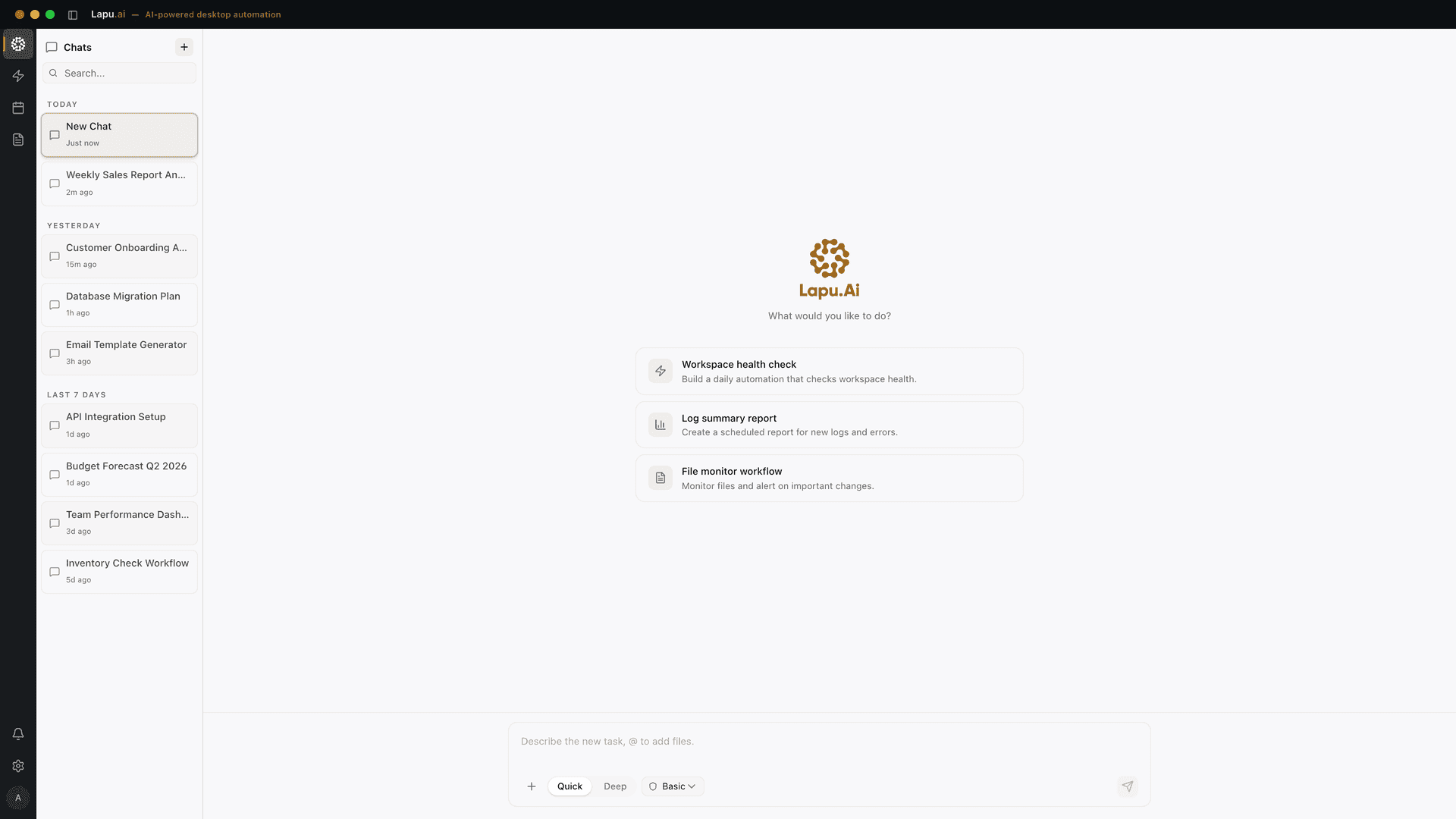
In 2026 the term covers a third model: an AI agent that reasons about each step at runtime, looks at the screen, decides what to click, reads the output, and adjusts. It is not a script. It is a small autonomous worker that uses tools. Lapu AI sits in this third category, deployed natively to your desktop instead of a remote VM.
The Zapier / n8n model: API-to-API
Zapier and n8n connect services through documented APIs. You pick a trigger (new row in Airtable, new Stripe payment), pick an action (send Slack message, update HubSpot deal), and the platform wires authentication, polling, retries, and error handling.
Zapier's free tier covers 100 tasks per month; paid plans start at $29.99/month for 750 tasks and scale up to enterprise contracts for millions of tasks per month. n8n offers a fair-code self-hosted build with no execution cap, you pay for the server it runs on, and 400+ integrations.
This model is excellent at what it does. For high-volume, deterministic, repeatable workflows over well-supported APIs it is cheaper, faster, and more reliable than asking an AI agent to do the same thing. If your job is "every new Shopify order, append a row to a Google Sheet and notify the warehouse Slack," you do not need an agent. You need a Zap.
The model has limits. It breaks when an app has no public API. It breaks when authentication needs human intervention. It breaks on edge cases the workflow author did not anticipate. And it does not help when the work spans your local files, a desktop application, and an internal tool that lives behind SSO.
The desktop-agent model: use any app the way a human does
A desktop AI agent does not need an API. It reads the screen through native accessibility APIs (Swift on macOS, UI Automation on Windows), clicks, types, and reads back the result. It has access to your filesystem, your shell, your installed applications, and any web app you are already logged in to.
That changes the surface area. A Zap can talk to about 7,000 SaaS tools. A desktop agent can talk to all of them, plus every desktop application, every internal portal behind your VPN, and every legacy tool with no integration partner.
The trade-off is honest. UI-driven automation is slower than API calls. It costs more per step because the model has to reason about each screen. It is less predictable. For a job that runs ten thousand times an hour, you want APIs. For a job that runs once a week across four apps, two of which have no API, you want an agent.
When each approach wins
Pick API automation (Zapier, n8n, Make)
- • High volume: thousands of runs per day
- • Deterministic input and output shape
- • Both endpoints have stable public APIs
- • Triggered by an event, not a person
- • Operations team owns and maintains it
Pick a desktop AI agent (Lapu AI)
- • Long-tail apps without APIs
- • Infrequent or ad-hoc tasks
- • Multi-app workflows spanning desktop and web
- • Work that needs judgement on each run
- • Local files and private documents involved
Lapu AI vs cloud agents (Operator, Devin, Manus)
A third class of agent has appeared since 2024: cloud agents that run in a remote virtual machine. OpenAI Operator drives a hosted browser. Cognition Devin runs in a sandboxed Linux desktop with its own shell, editor, and browser, and can keep working asynchronously after you close the session. Manus, from Butterfly Effect, runs fully autonomous tasks in the cloud and is built for long-running asynchronous jobs.
Those are real strengths. Cloud agents can run for hours without tying up your laptop. They can be hit from any device. They handle long-horizon engineering tasks like resolving a GitHub issue end-to-end. Devin posted 13.86% on SWE-bench at launch: a real number, on a real benchmark.
The trade-off is also real. A remote VM cannot see your local files. It cannot drive the Excel install on your machine, the internal app behind your VPN, or the licensed desktop tool that does not have a web version. It runs in a fresh sandbox each time: your credentials, browser cookies, and configured environment are not there.
Lapu AI takes the desktop-native path. It runs on your macOS or Windows machine, sees the apps you are already signed into, reads your local files, and acts inside your environment. Different shape, different job. Pick cloud agents for unattended long-running web work; pick a desktop agent for work that touches your machine.
What Lapu AI actually automates
Concrete examples beat abstract claims. These are jobs the desktop-agent model handles well.
File organisation
Sort the 400 PDFs in
~/Downloadsby topic, rename each by content, and move into client folders. No API exists for "the contents of every PDF on this laptop."Document processing
Open each invoice, extract vendor, amount, and date, write a normalised row into a local spreadsheet, flag anomalies for review.
Recurring reports
Pull metrics from three internal dashboards, drop the numbers into a Notion page, and post a summary to a Slack channel, every Monday at 9am.
Cross-app data movement
Take rows out of a desktop CRM that has no export, paste them into a vendor portal that has no API, and reconcile against a CSV on disk.
Explore further
- AI for business: a practical adoption guide
- Document automation, end to end
- Invoice processing without a new system
- Data entry, automated on your own machine
- Browse all Lapu AI use cases
- Cross-app workflows
- App automation without connectors
- What is a desktop AI agent?
- Desktop-native AI: the overview
- Lapu AI vs OpenAI Operator
- Lapu AI vs ChatGPT: desktop agent vs chat assistant
- Best AI agent for Excel automation
- How to use AI in Excel
- AI PDF extraction without third-party services
- Convert PDF to Excel with AI on the desktop
Frequently asked questions
- What is AI automation?
- AI automation uses AI models to plan and execute work that previously required a human operator. In 2026 it splits into two camps: API-based platforms like Zapier and n8n that connect services through documented APIs, and desktop AI agents like Lapu AI that operate any application, local or web, the way a person would.
- How is AI automation different from RPA?
- Traditional RPA (UiPath, Automation Anywhere) records fixed click-paths and breaks the moment a button moves. AI automation uses a frontier model to reason about each step at runtime, so it can adapt when a UI changes, a dialog appears, or the input data shifts. The agent decides what to do; the RPA script just replays.
- When should I pick Zapier or n8n over a desktop AI agent?
- Pick API automation when the task is high-volume, deterministic, and the apps involved have well-supported APIs, for example, syncing 50,000 Shopify orders to a Google Sheet every hour. The API model is faster, cheaper at scale, and more reliable for repeated structured work.
- When does a desktop AI agent beat an API workflow?
- When the apps you use don't have APIs, when the task is infrequent, when it spans many tools, or when each run needs judgement. Reorganising a folder of mixed PDFs, filling a vendor portal that has no API, or pulling numbers out of a legacy desktop app are jobs a desktop AI agent handles directly and a Zap can't reach.
- Is Lapu AI a replacement for Zapier?
- No. They solve different problems. Zapier is excellent for connecting SaaS apps over their APIs at scale. Lapu AI runs on your machine, uses any application, including ones with no API, and is designed for ad-hoc multi-step work. Many teams will use both.
- How does Lapu AI differ from cloud agents like Operator, Devin, or Manus?
- Operator, Devin, and Manus run in remote virtual machines in the cloud. They are powerful for long-running asynchronous tasks but operate inside a sandbox without access to your local files, your installed apps, or your environment. Lapu AI runs on your macOS or Windows machine and acts on the software you already use.
- How does Lapu AI compare to browser-based automation tools?
- Browser-based automation tools work inside a single browser tab and cannot reach your local files, your installed apps, or your desktop environment. Lapu AI runs on your macOS or Windows machine and operates across your files, your documents, and the desktop apps you already use: the same way you would, but faster and with your approval at each step.
- Is desktop AI automation safe?
- Lapu AI uses permission-based execution: every file write, shell command, or destructive action surfaces an approval prompt with the proposed change. Files stay local. The audit trail records every tool call so you can review exactly what the agent did.
Sources
- Zapier: Plans & Pricing (accessed 2026-05-13)
- n8n: AI workflow automation platform (accessed 2026-05-13)
- n8n on GitHub: fair-code workflow automation (accessed 2026-05-13)
- Cognition: Introducing Devin, the first AI software engineer (accessed 2026-05-13)
- Manus (AI agent): overview (accessed 2026-05-13)
Try Lapu AI
Lapu AI is free to start, with no credit card. If you have a job that lives across your desktop and a few web apps and a Zap will not reach it, this is the tool for that work.
- 1-click uninstall
- Cancel anytime
- Files never leave your computer
Automate the work between you and outcomes
Lapu AI handles the repetitive work between you and outcomes. One desktop agent, zero tab-switching. Available now on macOS and Windows.
- 1-click uninstall
- Cancel anytime
- Files never leave your computer
Free to start. Cancel in 1 click. Files stay on your machine.