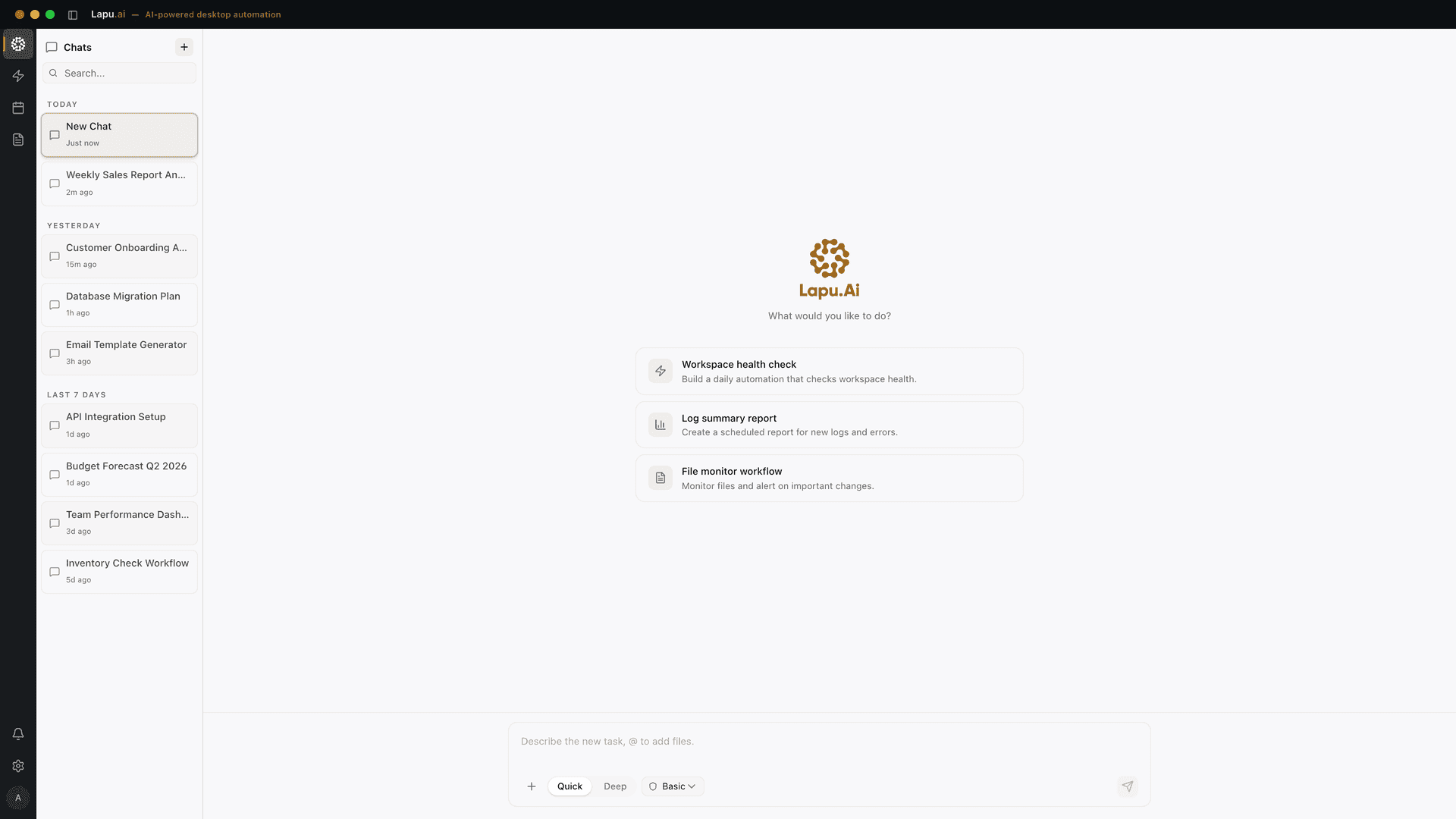
What is AI for desktop? In short: software that runs natively on macOS or Windows and uses a frontier AI model to plan and execute multi-step tasks across your real files, terminal, and applications. The technical name for this category is a desktop AI agent. Unlike a browser-based chatbot, it can touch local data without uploading it. Unlike a cloud agent, the work happens on your machine. This post defines AI for desktop, walks through how it works, and explains what changed in the last eighteen months to make the form factor viable.
What is a desktop AI agent?
A desktop AI agent is a desktop application that takes a goal in plain English, breaks it into steps, and uses a frontier AI model to drive those steps to completion on the user's own computer. The model is the brain; the agent application is the body. The body has hands (file access, a shell, accessibility APIs, mouse and keyboard control), and the brain decides where to put them.
Three properties separate an agent from a chat assistant:
- It acts, not just answers. A chatbot returns text. An agent reads files, runs commands, edits documents, and clicks buttons. The output is a state change in the world, not a paragraph.
- It loops. Anthropic describes the core agent pattern as "gather context -> take action -> verify work -> repeat" (Anthropic, 2025). Each step depends on the result of the previous one. A chatbot completes when it sends a reply; an agent completes when the goal is met.
- It runs on your machine. A desktop AI agent is, by definition, desktop-native. The screenshot capture, the file read, the shell command, and the permission prompt all happen locally on macOS or Windows. Only the model call crosses the network.
That third property is what distinguishes desktop agents from the other agent categories now in market. OpenAI's Operator drives a remote browser inside OpenAI infrastructure. Devin and Manus run autonomous engineering work inside a hosted sandbox. OpenAI Presence governs voice and chat agents inside a cloud runtime for enterprise contact centers. A desktop AI agent runs against the same files, apps, and shell the human is already using.
How a desktop AI agent actually works
Every modern desktop AI agent (Lapu AI, Claude Cowork, Manus Desktop, and the rest) ships some variation of the same loop. The Anthropic computer use docs spell out the canonical four steps (Anthropic Docs, 2026):
- Give the model a tool and a prompt. The agent app sends the model a goal like "save a picture of a cat to my desktop" plus a set of tools the model is allowed to call, typically a
computertool for mouse and keyboard, abashtool for the shell, a text-editor tool for files. - The model decides to act. It returns a
tool_usecontent block (for example,{"action": "left_click", "coordinate": [842, 311]}), and the API response carriesstop_reason: "tool_use". - The agent app executes the action. The desktop runtime carries out the click on the actual screen, captures whatever changed, and returns the result to the model as a
tool_result. - Repeat. The model issues another tool call, or finishes with a plain-text answer. The repetition is the loop.
goal → model → tool_use → desktop runtime → screenshot → model → ... → done
A few things are worth pulling out of that loop:
- The model runs in the cloud, but the actions run locally. Your files never leave your machine; only the screenshots and the model's responses do. This is what people mean when they call a desktop agent "local-first", see local-first AI vs cloud AI for the longer treatment.
- The runtime, not the model, owns the dangerous parts. The runtime decides what counts as a sensitive action, when to ask the human, what to log, and which tools to expose. The model can ask to do anything; the runtime decides what to let through.
- The tool surface matters as much as the model. A desktop agent that exposes only
screenshotandclickwill be slow and brittle. A desktop agent that exposes accessibility-API access, file-system reads and writes, a shell, and computer use as a fallback will be fast where it can be and resilient where it has to be. See computer use AI explained for the action-level detail.
Desktop agents vs chatbots, cloud agents, and workflow tools
The word "agent" gets used for at least four product categories that look similar but solve different problems. The differences matter when you're picking a tool.
| Tool type | Where it runs | What it controls | Example |
|---|---|---|---|
| Chatbot | Cloud | Its own chat window | ChatGPT.com, Claude.ai |
| In-editor coding assistant | Local IDE | One application (the IDE) | Cursor, GitHub Copilot |
| Cloud agent | Cloud | A remote browser or VM | OpenAI Operator, Devin, Manus (cloud mode) |
| Desktop AI agent | Local (macOS/Windows) | Your real files, apps, and shell | Lapu AI, Claude Cowork, Manus Desktop |
| No-code workflow | Cloud | App APIs only (no GUI) | Zapier, n8n |
The key questions to ask of any "agent" product:
- Where does the action run, your machine or the vendor's?
- Can it touch local files without uploading them first?
- Does it work with apps that have no API?
- Who logs what it did?
A desktop AI agent says: local, yes, yes, and your machine. A cloud agent says: vendor's machine, no, only sites it can reach, and the vendor. A no-code tool like Zapier says: vendor's machine, no, only apps with APIs, and the vendor's audit log. None of these answers is universally right. They describe trade-offs between reach, safety, and trust. For the chatbot side of that comparison specifically, see Lapu AI vs ChatGPT.
What changed in the last eighteen months
The desktop AI agent category became plausible in late 2024 and roughly production-grade in early 2026. The trajectory is unusually fast even for AI.
The category-defining release was Anthropic's computer use beta in October 2024, which let a model "perceive and interact with computer interfaces" by "looking at a screen, moving a cursor, clicking buttons, and typing text" (Anthropic, 2024). Before that release, automating arbitrary desktop work required either an API for each app (which most apps do not have) or brittle scripts on top of accessibility frameworks (which break on every UI change).
OpenAI followed in January 2025 with Operator, a cloud agent built on its Computer-Using Agent (CUA) model. MIT Technology Review described it directly: Operator "takes screenshots of a computer screen and scans the pixels to figure out what actions it can take" (MIT Technology Review, 2025). Google DeepMind shipped a comparable system called Mariner around the same time. Different vendors, same mechanic.
The capability has matured fast. On the OSWorld benchmark (369 real computer tasks across Ubuntu, Windows, and macOS), the trajectory looks like this:
| Model | OSWorld | Released |
|---|---|---|
| Best system at launch | 12.24% | early 2024 |
| Claude 3.5 Sonnet (computer use beta) | 14.9% | Oct 2024 |
| Claude Sonnet 4 | 42.2% | mid 2025 |
| Claude Sonnet 4.5 | 61.4% | late 2025 |
| Claude Sonnet 4.6 | 72.5% (verified split) | early 2026 |
| Human baseline | 72.36% | : |
What this number does not say is whether a given agent is reliable on your specific workflow. OSWorld is a directional signal, not a guarantee. But the directional signal is unambiguous: in late 2024 a desktop AI agent was a demo; in mid-2026 it is a runtime you can build a business on, provided the runtime is built carefully.
What a desktop AI agent is good and bad at
The realistic 2026 grade for what a desktop AI agent does well:
- File operations at scale. Renaming, sorting, and tagging hundreds of files based on contents. See best AI agent for file organization for the demo.
- Spreadsheet cleanup. Apply a rule across rows, normalize formatting, reconcile two sheets. Better than a junior analyst at the boring half, see the Excel automation agent guide for the tool comparison behind this job.
- PDF and document processing. Extract structured fields, summarize, draft response emails, including the specific job of extract tables from a PDF into Excel as a real
.xlsxyou can open in Excel with no cloud round-trip. Realistic. - Cross-app handoff. "Open the spreadsheet at
~/clients.xlsxand email each row a personalized note from the template in Apple Mail." This is where desktop agents beat both browser tools and chatbots. - Long-running multi-step research. Open ten papers, summarize each, save notes to a Markdown file in Obsidian.
Where they still fail or struggle:
- Tasks that need perfect precision. A 95% success rate is fine for sorting downloads, unacceptable for sending wire transfers.
- Heavy-state workflows across many windows over hours. Reliability drops as the action chain lengthens: Anthropic's own docs flag scrolling, niche apps, and multi-app interactions as ongoing weak spots.
- Anything inside an environment the model has rarely seen. Bespoke internal apps confuse it; common SaaS does not.
- Tasks that require holding secrets the runtime cannot see. If the agent needs to know your bank login to act on your behalf, the runtime is the wrong design, see the permission discussion below.
The real hard problems: permission, audit, injection
The hard problems for desktop AI agents in 2026 are no longer about model capability. They are about what happens at the runtime layer once the model is fast enough and accurate enough to be trusted with real work.
Permissioned execution. The model can request anything. The runtime decides what to allow without asking, what to allow with a confirm-dialog, and what to refuse outright. Read-only actions are usually safe to auto-approve. Writes, deletes, network sends, financial actions, and credential reads should not be. The longer treatment is in is desktop AI safe? Permission models explained.
Audit trail. Every screenshot, every model decision, every tool call, every permission decision should be logged locally with the prompt that triggered it. If something goes wrong, you should be able to replay the run and see exactly what happened. See the audit trail explainer for the schema and the threat model.
Prompt injection defense. This is the hardest one. Anthropic warns that "Claude will follow commands found in content, sometimes even in conflict with the user's instructions" (Anthropic Docs, 2026). A malicious webpage, email, or document can attempt to hijack the agent: a class of attack that IEEE Spectrum called out plainly: agents may "be exposed to content that includes prompt injection attacks" (IEEE Spectrum, 2025). The defense is not in the model alone. It is in the runtime: a sandbox, an allowlist of trusted sources, a confirmation step before any action with consequences, and a complete log.
The shorthand: a desktop AI agent in 2026 is only as safe as the runtime it ships in. The model capability is roughly solved; the runtime discipline is what teams are still building.
How Lapu AI fits the definition
Lapu AI is one example of the category: a desktop-native agent for macOS and Windows. The relevant pieces relative to the definition above:
- Local actions. All file reads, shell commands, accessibility-API calls, and mouse/keyboard actions run on the user's machine. The model runs in the cloud; the work runs locally. See how Lapu AI works for the runtime breakdown.
- Permissioned by default. Read-only operations can be auto-approved; writes, deletes, and sensitive actions go through an explicit permission dialog with a configurable granularity.
- Full audit log. Every prompt, model decision, tool call, and permission outcome is written to a local log on the user's machine. Nothing about how the agent acted is hidden.
- Tool composition. Accessibility APIs are the fast path; computer use is the fallback for apps that do not expose one. The agent picks the right tool per step.
If you want to see what a desktop AI agent feels like in practice, the download page lists the macOS and Windows builds and the Premium / Pro / Max plans are listed under pricing.
FAQ
- What is the difference between a desktop AI agent and a chatbot?
- A chatbot answers questions inside its own window. A desktop AI agent takes actions outside that window. It reads files on your machine, runs shell commands, fills forms in other applications, and continues working across multiple steps without you sending a new message each time. The chatbot is a conversation; the agent is a worker.
- Does a desktop AI agent run the model locally?
- Usually no. Most desktop AI agents in 2026 still call a frontier model in the cloud (Claude, GPT, or Gemini), because those models are too large to run on consumer hardware. What runs locally is the agent itself: the screenshot capture, the file access, the shell, the permission prompts, and the audit log. Your files stay on your machine; the model just receives the context it needs to decide the next action.
- How is a desktop AI agent different from OpenAI Operator?
- Operator (and its successors like ChatGPT Agent) drive a remote browser running in OpenAI's cloud. A desktop AI agent drives your real computer: local files, native apps, and the same shell you use yourself. The two solve overlapping problems with very different blast radii. A cloud agent cannot touch your filesystem; a desktop agent can, which is why permission models matter so much for the desktop side.
- What can a desktop AI agent actually do today?
- Realistic tasks include: renaming and organizing files based on contents, drafting and sending emails from a templated list, scraping structured data from a series of PDFs, cleaning a spreadsheet against rules you describe, running and triaging unit tests, and producing weekly reports from log files. Realistic limits: anything requiring perfect precision, anything where one wrong click costs money, and long-running multi-app flows that need state across hours.
- How big are these agents? Are they ready for production work?
- On the OSWorld benchmark: 369 real computer tasks across operating systems, Claude Sonnet 4.6 reached 72.5% in early 2026, roughly matching the 72.36% human baseline reported in the original paper. That said, benchmark scores hide the operational gap: real production usage requires sandboxing, permission gating, an audit trail, and a human-in-the-loop policy for anything irreversible. The model capability is there; the runtime discipline is what teams are still building.
- Is it safe to let a desktop AI agent use my computer?
- Only with a runtime that asks for permission, logs every action, and isolates the model from your secrets. Anthropic's own documentation warns that 'Claude will follow commands found in content, sometimes even in conflict with the user's instructions', meaning a prompt injection inside an email or a webpage can attempt to redirect the agent. The defense is not the model; it is the harness around the model. A desktop AI agent that auto-approves every action is unsafe by construction; one that requires explicit confirmation for destructive operations and writes a full local audit log is the form factor most teams actually want.
Sources
- Introducing computer use, a new Claude 3.5 Sonnet, and Claude 3.5 Haiku, Anthropic (2024-10-22) · accessed 2026-05-18
- Computer use tool: Claude API Docs, Anthropic (2025-11-24) · accessed 2026-05-18
- Building agents with the Claude Agent SDK, Anthropic (2025-09-29) · accessed 2026-05-18
- Are You Ready to Let an AI Agent Use Your Computer?, Eliza Strickland, IEEE Spectrum (2025-02-13) · accessed 2026-05-18
- OpenAI launches Operator: an agent that can use a computer for you, Will Douglas Heaven, MIT Technology Review (2025-01-23) · accessed 2026-05-18