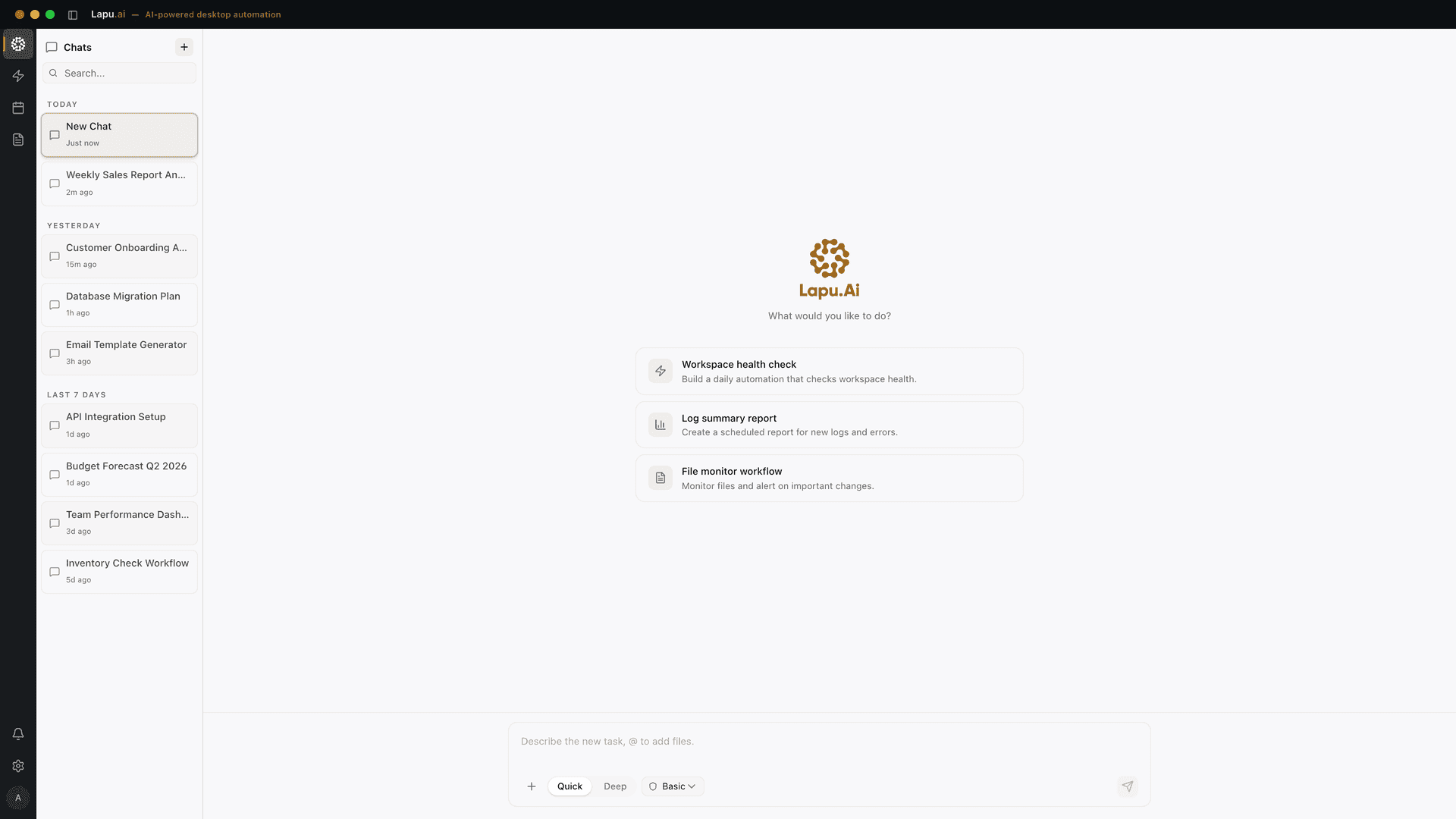
AI automation without Zapier is not a smaller version of Zapier. It is a different architecture. Instead of stitching together public APIs with trigger-action rules, a desktop AI agent reads your screen, drives your keyboard and mouse through the operating system's accessibility tree, and decides the next step using a frontier model. This post explains where the desktop-agent pattern wins, where Zapier still wins, and how the two fit together in 2026.
What AI automation without Zapier actually means
Zapier connects two cloud apps by calling their public APIs and applying a rule shaped like "when X happens in app A, do Y in app B." That rule is a Zap, and Zapier's value is making it ten-minute work to wire up two services that have official integrations. The constraint is also right there in the description — both apps need APIs, the rule needs to fit inside if-this-then-that, and a real human needs to predict the right branches in advance.
AI automation without Zapier inverts each of those assumptions. The driver is a desktop AI agent that runs on your computer and operates software the way you do — by looking at the screen, querying the operating system for what UI elements are present, and clicking, typing, or scrolling to make the next step happen. Anthropic shipped the first commercially viable version of this pattern in October 2024 when it added computer use to Claude 3.5 Sonnet, allowing the model to "perceive and interact with computer interfaces" through screenshots and mouse-and-keyboard control (Anthropic, 2024). The agent does not need an integration to exist before it can use an app. If a human can do it on a computer, the agent can attempt it.
The three cases Zapier cannot reach
Zapier's own documentation is candid about what its platform cannot do. The Workflow API supports only public apps, does not support paths, and has no endpoint to enable or disable existing Zaps (Zapier, 2025). Those are the small-print limits. The three structural limits matter more:
- Native desktop apps with no public API. Finder, Preview, Excel macros, AutoCAD, a CAM tool from 2008 with a serial dongle — none of them have webhooks. Zapier cannot reach them. A desktop agent reads the accessibility tree the OS already maintains for screen readers and drives the UI directly — the AI Excel automation buyer guide is the tool-shortlist view of that specific case.
- Web apps where the action exists in the UI but not in the API. Many SaaS vendors expose a fraction of their UI as a REST endpoint, often missing exactly the operation you wanted to automate. A desktop agent uses the UI the customer already pays for.
- Workflows where the next step depends on what the previous step returned. Zapier's branching is rigid: paths are defined in advance, and exceptions fall out the bottom of the funnel. A desktop agent treats each step's output as input to the next planning decision, which is how a human handles unfamiliar input.
The Vellum 2026 alternatives roundup makes the same point in business language — Zapier's "trigger-action patterns" become expensive at scale and cannot "handle complex branching or AI-driven decision-making" (Vellum, 2026). The desktop-agent pattern is one answer to that gap.
How a desktop AI agent does the work
The mechanical loop is the same on every desktop AI agent worth using:
- You describe the task in plain English. "Open the spreadsheet at
~/clients.xlsx, draft a follow-up email for every row whose last contact is more than 30 days ago, save the drafts in Mail, and produce a CSV of who got drafted." - The agent plans. It breaks the request into discrete steps, picks the right tools for each, and shows you the plan before touching anything.
- The agent observes the desktop. On macOS, that means the Accessibility API. On Windows, UI Automation. Both give the agent a structured view of every button, label, and text field on screen — the same data the OS provides to screen readers — without sending pixels off the machine.
- The agent acts. It clicks, types, scrolls, opens files, runs commands. Sensitive actions wait for your permission. Low-risk actions like reading a file can be auto-approved if you trust the workflow.
- The agent records the trail. Every action — what was clicked, what was typed, what file was written, what command ran — lands in a local audit log you can inspect later. The full anatomy of a defensible AI action log — fields, retention, tamper resistance — is in the audit-trail explainer.
The model in the loop is the planning brain; the tools are the hands. Anthropic's API documentation is explicit that "you own the loop" — the developer's application executes each action the model proposes, returns a tool result, and the loop continues until the task is done (Anthropic, 2025). On a finished product like Lapu AI, you do not assemble that loop yourself; the desktop app ships with it, the permission tiers, and the audit log in one binary.
Where Zapier still wins
The desktop-agent pattern is not a universal upgrade. Zapier still wins on three axes that matter for a serious workflow:
- Unattended reliability. A Zap runs on Zapier's servers forever. A desktop agent runs on your laptop, which sleeps, reboots, loses Wi-Fi, and stops being a server when you close the lid. For unattended scheduled work, a server-side platform is the right tool.
- Speed per hop. A webhook fires in milliseconds. A desktop agent that has to find a button, click it, wait for the page to load, and verify the result takes seconds. For single-step trigger-to-action flows between two API-rich apps, the desktop pattern is slower and more expensive.
- Cost predictability. A Zap consumes tasks at a flat rate per execution. A desktop agent consumes model tokens, which scale with how much screen content the agent has to reason about. The unit economics flip in the desktop agent's favour only when the workflow is too complex for the Zap to express at all.
A 2026 honest comparison should say so. Most "Zapier alternative" lists overstate the case in the opposite direction.
- Native desktop apps with no public API (Finder, Excel macros, legacy tools)
- Web apps where the action exists in the UI but not the API
- Workflows where the next step depends on what the previous step returned
- Unattended reliability — a Zap runs on a server; a laptop sleeps and reboots
- Speed per hop — a webhook fires in milliseconds; UI steps take seconds
- Cost predictability — a Zap is flat per task; an agent scales with tokens
The hybrid architecture most teams end up with
Look at what mature teams actually deploy in 2026 and you find a layered stack, not a religious choice:
- Zapier or n8n at the top, for unattended event-driven flows between API-rich SaaS — new Stripe charge, new HubSpot lead, new GitHub issue. Anything that needs to run while everyone is asleep and that does not need judgment.
- A desktop AI agent in the middle, for the workflows that touch local files, native apps, or legacy software, and for anything that needs judgment on what to do next. This is where Lapu AI fits.
- Direct API code at the bottom, for the high-throughput, latency-sensitive paths that pay off custom engineering.
Related: see how Lapu AI handles cross-app workflows and interface-driven app automation once a step needs judgment.
The mistake is forcing every workflow into the layer that happens to be installed. A team that owns Zapier will try to express judgment-heavy tasks as ever-more-baroque Zaps; a team that owns a desktop agent will try to use it as a scheduled job runner. The boundary is the question to ask first: does this workflow need a human-in-the-loop or judgment-in-the-loop on each step? If yes, the desktop AI agent layer is the right answer. If no, push it down the stack.
What this looks like on your desktop
A concrete example is the clearest way to see the difference. Suppose you need to triage a folder of 200 PDF invoices into client subfolders, extract the totals, and write them into a Google Sheet for accounting.
The Zapier version is hard. There is no native trigger for "a new PDF appeared in ~/Downloads/invoices" — you would need a watcher script, an upload step to Google Drive, an OCR action, a parser action, a filter, a paths block, and a Sheets row insert. Each step is a separate Zap configuration. The first invoice with a layout the parser was not trained on goes to the error queue.
The desktop agent version is one prompt: "Sort the PDFs in ~/Downloads/invoices into subfolders by client. For each PDF, extract the total and the date and append a row to the 'AP-2026' sheet in my open Google Sheets tab." The agent reads the folder, opens each PDF in Preview or extracts the text directly, decides which client folder to use based on the contents, asks for permission before moving files, switches to your browser to update the sheet, and produces an audit log of every action. The first invoice with an unusual layout does not crash the flow — the agent describes what it saw and asks how to handle it. Under the hood the PDF half is the on-desktop PDF data extraction recipe — the parser runs on your machine, only cleaned text ever leaves. For the full accounts-payable pipeline — capture, extraction, two- and three-way match, and posting — see how AI automates invoice processing.
This is what AI automation without Zapier means in practice. Not "Zapier with an LLM" — Zapier with an LLM is still Zapier. A desktop agent with permissioned execution is a different category of tool, suited to a different category of work. For the full picture of what an AI agent for macOS and Windows covers across files, shell, and other applications, see the hub page.
FAQ
- What does 'AI automation without Zapier' actually mean?
- It means automating a workflow without using a trigger-action integration platform — instead, a desktop AI agent reads the screen, drives the keyboard and mouse through the operating system's accessibility tree, and decides the next step using a frontier model. There is no Zap to build and no webhook URL to register; the agent uses the same UI you use, and you grant it permission to act. Anthropic shipped the first commercially viable version of this pattern in October 2024 with the computer-use tool, which lets Claude 'perceive and interact with computer interfaces' by looking at a screen, moving a cursor, clicking buttons, and typing text.
- How is this different from a Zapier integration?
- A Zapier integration calls a vendor's public REST API. If the vendor does not expose the action you need, the integration cannot do it. A desktop AI agent uses the UI itself — the same buttons, fields, and menus a human user would — through the OS accessibility tree. That means it works on native desktop apps with no public API, on web apps whose API does not cover the action, and on legacy line-of-business software the vendor will never integrate. Zapier itself acknowledges its Workflow API does not support paths, private apps, or webhook reads — the desktop-agent pattern routes around the entire API question by not asking for one.
- Is this slower than a Zapier webhook?
- For the single trigger-to-action hop, yes — clicking through a UI is slower than firing an HTTP webhook. For the multi-step workflow that actually gets done, the question is different. A Zap that needs five steps must define five integrations, five field mappings, and a rigid branching rule for any exception. A desktop agent runs the same five steps inside one session, adapts to whatever each step returns, and asks for permission only at the steps you flagged as sensitive. The latency cost is paid back the first time the workflow encounters input the original Zap was not built for.
- Is it safe to let an AI agent drive my desktop?
- The risk is real and the safeguard is permission tiers plus an audit trail. Anthropic ships classifiers that 'automatically run on your prompts to flag potential instances of prompt injections,' and when the classifiers spot a problem in a screenshot, the model is steered to 'ask for user confirmation before proceeding with the next action.' On a desktop agent, the equivalent is permissioned execution: low-risk actions like reading a file run quietly, medium-risk actions like writing a file ask once, and high-risk actions like deleting files or sending external requests require explicit confirmation every time. Combined with a local audit trail that records what the agent saw and what it did, the safety story holds up under a security review.
- When should I still use Zapier?
- When the workflow is genuinely simple, both endpoints have first-class APIs, the trigger is event-driven (a new row in Airtable, a new email in Gmail), and you want it to run unattended on a server forever. That is the original Zapier sweet spot and a desktop agent is the wrong tool for it. Use a desktop AI agent for the workflows that need judgment, that touch apps without APIs, or that you want to run interactively on your own machine while you do other work.
- Can a desktop AI agent replace n8n or Make?
- Not fully — n8n and Make occupy a middle ground between Zapier's rigidity and a desktop agent's flexibility. They give you visual branching, custom code steps, and self-hosting; they still rely on APIs and run on a server, not your laptop. The honest answer is hybrid: keep n8n for unattended server-side orchestration of API-rich services, and use a desktop AI agent for the long tail of work that needs to happen on your actual machine with your actual files and credentials. The two patterns address different layers of the stack.
- What does Lapu AI do that Zapier cannot?
- Lapu AI runs natively on macOS and Windows and drives any application — native or web — through the operating system's accessibility APIs and shell. You describe the workflow in plain English, the agent plans the steps, and every sensitive step (file write, command execution, external network call) waits for your permission before running. There is no Zap to configure, no integration to wait for, and no API key to provision. The audit trail records each action with a preview of what the agent saw, so the question 'what did it do at 3pm on Tuesday' has a concrete answer instead of a shrug.
- What does "AI automation without Zapier" actually mean?
- It means automating a workflow without using a trigger-action integration platform — instead, a desktop AI agent reads the screen, drives the keyboard and mouse through the operating system's accessibility tree, and decides the next step using a frontier model. There is no Zap to build and no webhook URL to register; the agent uses the same UI you use, and you grant it permission to act. Anthropic shipped the first commercially viable version of this pattern in October 2024 with the computer-use tool, which lets Claude "perceive and interact with computer interfaces" by looking at a screen, moving a cursor, clicking buttons, and typing text.
Sources
- Introducing computer use, a new Claude 3.5 Sonnet, and Claude 3.5 Haiku — Anthropic (2024-10-22) · accessed 2026-05-22
- Computer use tool — Claude API docs — Anthropic (2025-11-24) · accessed 2026-05-22
- Known Limitations — Zapier Workflow API — Zapier (2025-01-15) · accessed 2026-05-22
- 15 Best Zapier Alternatives in 2026 — Vellum (2026-04-12) · accessed 2026-05-22