
Lapu AI vs Aider
Last verified: 2026-06-15
Download freeFree · macOS & Windows · No credit card
- 1-click uninstall
- Cancel anytime
- Files never leave your computer
What is Aider?
Aider is an open-source AI pair-programming CLI that runs inside a local git repo. It builds a tree-sitter repo map of the codebase, sends edits to a cloud or local LLM you bring (Claude, GPT, Gemini, DeepSeek, or Ollama), applies the diff, and auto-commits each change with a generated message. It is Apache 2.0 licensed, free to use, and supports 100+ programming languages from the terminal.
Feature comparison
| Feature | Lapu AI | Aider |
|---|---|---|
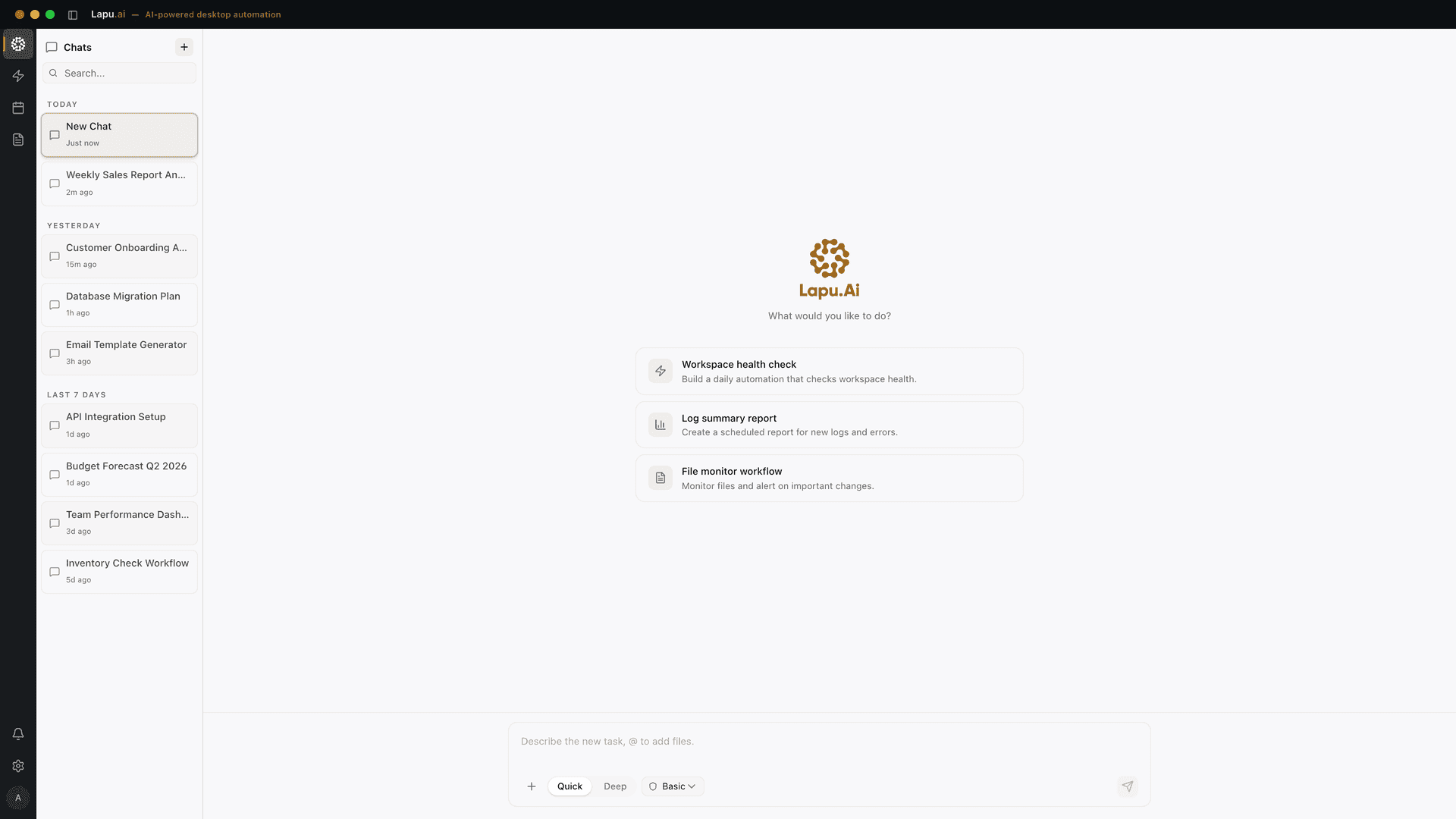
Primary interface Lapu AI is a desktop application with a chat panel, action log, and visible permission prompts. Aider runs entirely in a terminal session. | Native desktop GUI (macOS, Windows) | Terminal CLI |
Scope of work Lapu drives any GUI app via OS accessibility APIs. Aider focuses on source-file edits. | General desktop agent — files, terminal, apps, documents | Code editing inside a git repo |
Open source Aider is Apache 2.0 on GitHub (44k+ stars). Lapu AI is a closed-source product. | ||
Built-in frontier models (no API key) Lapu bundles model access in the subscription. Aider requires you to bring an API key (Anthropic, OpenAI, DeepSeek, etc.) or run a local model. | ||
Pricing model Aider itself is free; you pay per token to whichever provider you point it at. | Flat subscription (Free, $20, $60, $100 / month) | Free tool + your LLM API spend |
Multi-model / bring-your-own-key Aider is provider-agnostic by design. | No (managed pool of frontier models) | Yes (Claude, GPT, Gemini, DeepSeek, Ollama, LM Studio) |
Git-aware repo map Aider builds a tree-sitter repo map and dynamically loads relevant files into context. Lapu reads files but does not maintain a codebase index. | ||
Automatic git commit per edit Aider treats git as a first-class citizen — every accepted edit becomes a commit with a generated message. | ||
Architect mode (planner + editor models) Aider can split a request between a reasoning architect model and a faster editor model that produces the diff. | ||
Drive non-coding GUI apps (Excel, browsers, design tools) Lapu controls desktop apps through native accessibility APIs and synthetic input. Aider cannot leave the repo. | ||
Document processing (PDF, Word, spreadsheets) | ||
Local file access and editing Aider is scoped to the git working tree. Lapu can read and write anywhere on disk the user permits. | ||
Shell / terminal command execution Aider can run linters and tests on AI-generated code; it is not a general shell agent. Lapu runs arbitrary shell commands under permission. | Limited | |
Permission-based execution Both ask before changing files. Lapu's gate covers shell, apps, and files; Aider's covers edits, commits, and shell on the model's request. | Per-action approval gates | Per-edit confirm prompt |
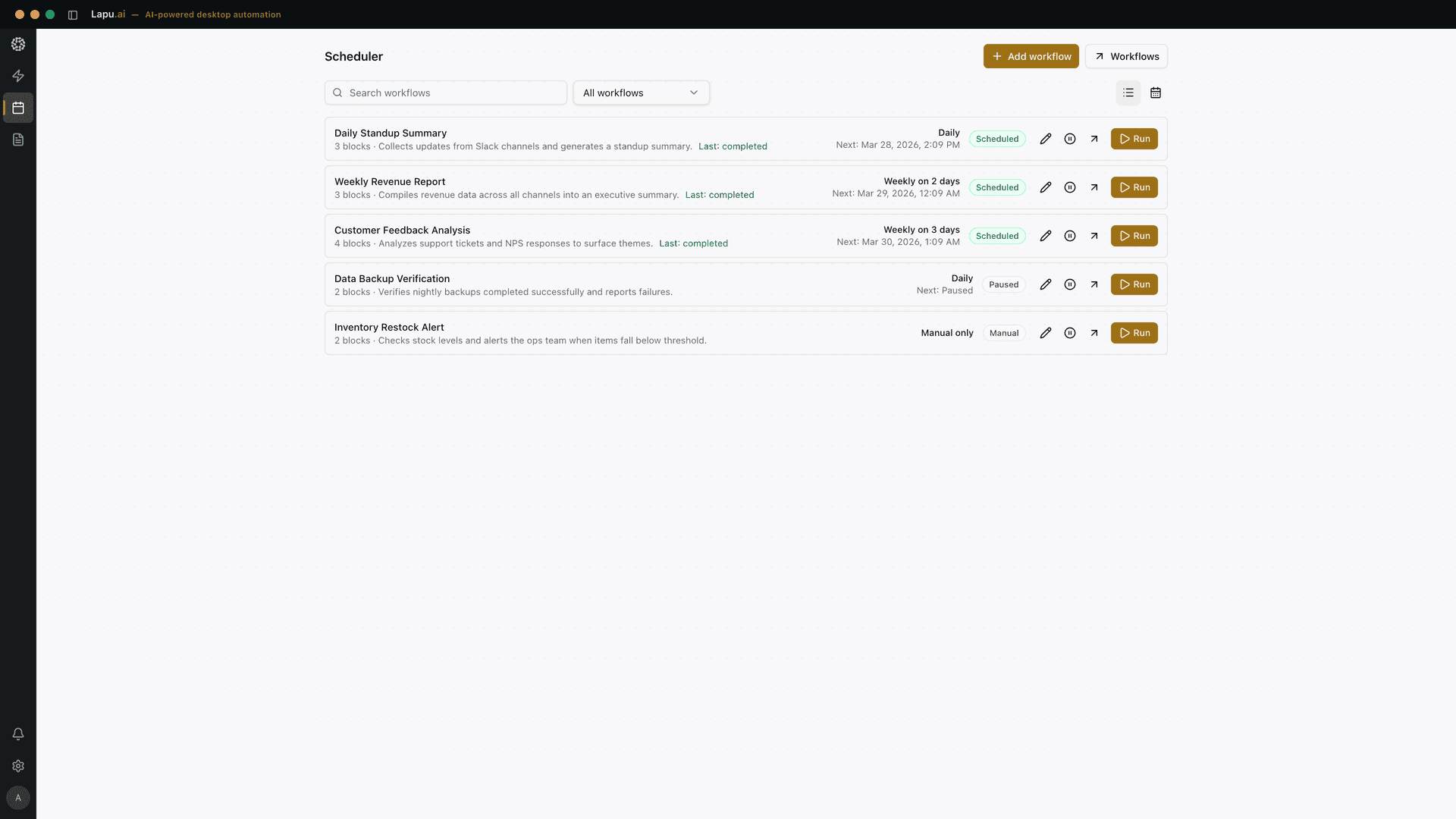
Audit trail Aider's audit trail is the git log itself — clean for code review, scoped to repo activity. | Up to 90 days of action logs | Git history (per-edit commits) |
Language coverage Aider has first-class repo-map support for 100+ languages including Python, Rust, Go, TypeScript, C++, Ruby. | Any (via shell + general models) | 100+ languages with tree-sitter parsers |
Voice input Aider supports voice-to-code via its `/voice` command. | ||
Cross-app workflows (e.g. read PDF → fill spreadsheet → send email) | ||
Runs offline with local LLM Aider works with locally hosted models. Lapu requires network access to its hosted reasoning providers. | Yes (Ollama, LM Studio) | |
Setup for non-developers Aider assumes a working Python toolchain and git knowledge. | Installer + sign in | Python 3.8-3.13 + pip + API key + git repo |
Where Lapu AI is stronger
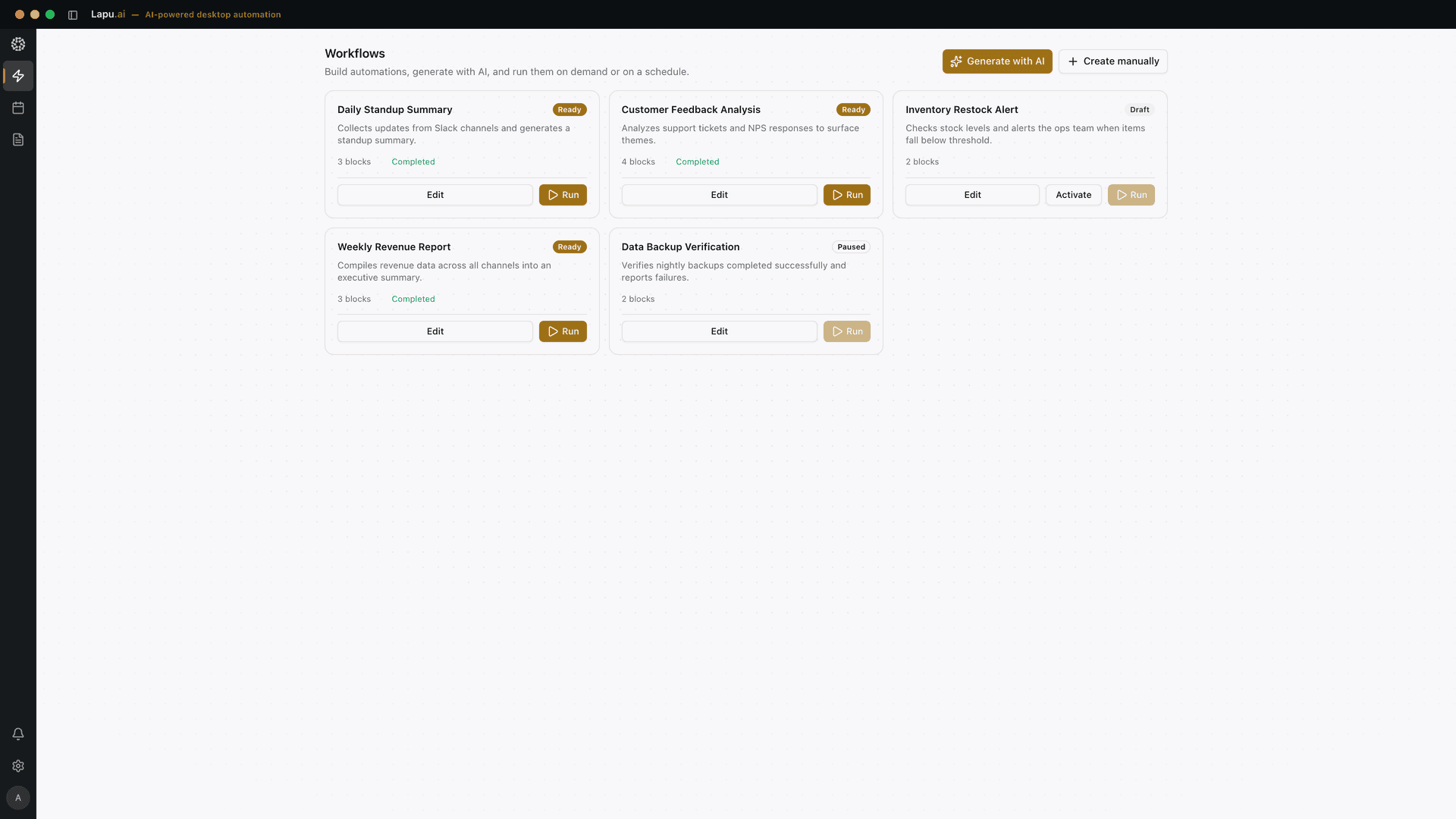
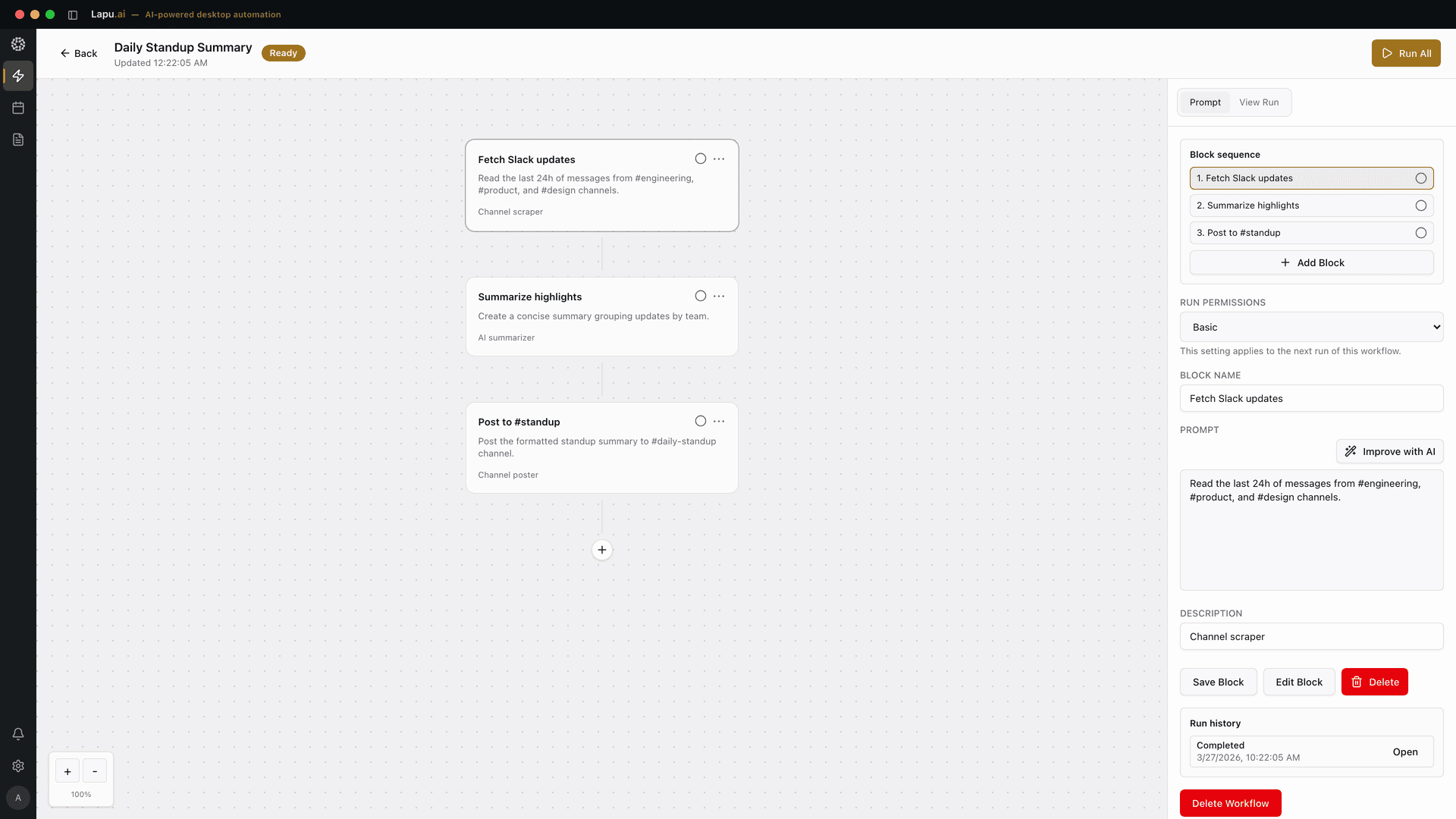
- Drives any desktop app, not just code -- Lapu AI uses native accessibility APIs to operate Excel, browsers, mail clients, design tools, and line-of-business apps under per-action permission. Aider is bound to source files inside a git repo — it cannot open Photoshop, fill a web form, or move data between two GUI apps. If your work crosses coding and the apps around coding, Lapu covers the second half that Aider never reaches.
- No API keys, no per-token bill -- Lapu ships with built-in frontier models on a flat subscription (Free tier, then $20 / $60 / $100 per month). With Aider, the tool itself is free but you pay your LLM provider per token — typical heavy use lands at $30-80/month in API spend, with surprise bills when a long session expands context. Flat pricing is easier to budget and easier to expense.
- Permissioned execution across files, shell, and apps -- Lapu's gate covers every sensitive action: reading a file, running a shell command, sending keystrokes to an app, modifying a document. Each action is logged for up to 90 days as an audit trail. Aider's permission model is good for code edits and commits, but it has no concept of approving a click in a browser, a drag in Finder, or a write to ~/Library.
- GUI for non-developers and mixed-role teams -- Lapu installs like any desktop app and runs from a chat window — no Python, no pip, no API key configuration, no `aider --model deepseek --api-key deepseek=<key>` step. Operations, analysts, finance, and support staff can use the same agent that engineers use, which matters when a single workflow spans engineering and a non-coding step.
- Document and spreadsheet work out of the box -- Lapu reads and edits PDF, Word, Excel, and CSV files as part of its standard tool set. Aider can edit source files that happen to be `.md` or `.csv`, but it has no document semantics — no understanding of a PDF as a structured document or a spreadsheet as a named range with formulas. For the half of desktop work that is documents, Lapu is the right tool.
Where Aider is stronger
- Free and open source under Apache 2.0 -- Aider's code is on GitHub with 44k+ stars and 6.8M+ pip installations. You can read every line, fork it, audit how it builds the repo map, and modify how it generates diffs. For teams with a hard open-source requirement or a security review process that requires source access, Aider clears the bar that Lapu does not.
- Git-first workflow with automatic per-edit commits -- Aider treats git as a first-class citizen. Every accepted edit becomes a commit with a generated message — so reviewing an AI session is `git log`, reverting a bad edit is `git revert <sha>`, and bisecting through AI-introduced bugs works the same way it does for human commits. No other agent in this category enforces this discipline as cleanly.
- Repo map with tree-sitter context selection -- Aider builds a compact tree-sitter summary of your entire repo (functions, types, file relationships) and dynamically loads the right files into context for each prompt. On a large codebase this is the difference between an AI that understands the project and one that hallucinates symbols. Lapu has no equivalent codebase index.
- Bring-your-own-model across cloud and local providers -- Aider works with Claude, GPT, Gemini, DeepSeek, o1/o3-mini, and fully local models via Ollama or LM Studio. Switch providers per project, run cheap models for boilerplate and frontier models for architecture work, or stay fully offline. Lapu's managed model pool gives up that knob in exchange for zero setup.
- Architect mode for hard problems -- Aider can route a request through an `architect` model that plans the solution and an `editor` model that produces the actual diff. The split lets you pair a slow reasoning model (o3, Claude Opus) with a fast cheap editor (GPT-4o-mini, DeepSeek Coder) and get better results than either alone, at lower cost than running the reasoning model end-to-end.
- 100+ language coverage with linting and test loops -- Aider has tree-sitter parsers for 100+ languages — Python, Rust, Go, TypeScript, C++, Ruby, PHP, Elixir, Lua, and the long tail. It automatically runs your linter and test suite on AI-generated code and feeds errors back to the model to fix. This is mature, repo-disciplined coding tooling that Lapu does not attempt to replicate.
Which should you choose?
Choose Lapu AI if you need...
- Engineers and operators whose work crosses coding, documents, and desktop apps
- Teams that want a single GUI agent the whole org can use without Python or API keys
- Workflows that need to drive Excel, browsers, PDFs, or line-of-business apps under permission
- Buyers who want flat-rate pricing instead of per-token API bills
- Users who need a 90-day audit trail of every agent action for compliance
Choose Aider if you need...
- Developers who live in a terminal and want git-disciplined AI edits
- Open-source loyalists who need to read or modify the agent's source
- Teams working on large codebases where the repo map and tree-sitter context matter
- Engineers who want to pair architect-grade reasoning models with cheap editor models
- Workflows that benefit from automatic per-edit commits and `git revert` rollback
- Users who need fully offline operation via Ollama or LM Studio
Try Lapu AI for free
Download Lapu AI and see how it handles your desktop workflows — not just how it compares to Aider.
- 1-click uninstall
- Cancel anytime
- Files never leave your computer
Frequently asked questions
- Does Lapu AI replace Aider for pure software development?
- No, and it is not trying to. Aider is purpose-built for git-disciplined terminal coding with a tree-sitter repo map, automatic per-edit commits, and 100+ language coverage. Lapu AI is a general desktop agent that drives any app and processes documents — it can run shell commands and edit code, but it does not maintain a codebase index or auto-commit each edit. For deep work inside a single repo, stay on Aider. For workflows that wrap around coding, pick Lapu.
- Can Lapu AI and Aider be used together?
- Yes — they target different surfaces and do not conflict. A common pairing: Aider handles disciplined coding inside the repo with auto-committed edits and tree-sitter context, and Lapu handles everything around it — reading specs from a PDF, pulling sample data out of Excel, updating a ticket in a web app, running the build, and screenshotting the result for a Slack message. The git log stays clean and the rest of the desktop work is permissioned.
- How does the cost actually compare at heavy usage?
- Aider itself is free but you pay your LLM provider per token. Independent reviews land typical heavy use at $30-80/month in API spend, and a single long architect-mode session can spike higher. Lapu AI's $20/month Premium and $60/month Pro tiers bundle model access at a flat rate. For light use, Aider plus a cheap provider like DeepSeek can be the cheaper option; for sustained heavy use, Lapu's flat tier is usually cheaper and more predictable.
- Does Aider need a git repo to work?
- Effectively yes. Aider is designed around a local git repository and uses git for its core safety story — every accepted edit becomes a commit. You can technically run Aider in a directory without git, but you lose the per-edit commit, the revert workflow, and most of what makes Aider Aider. Lapu has no such requirement; it works against any file or app the user gives it permission to touch.
- Why is Aider listed as a strength of CLI tools when Lapu is GUI?
- Because the choice is real and many engineers genuinely prefer a CLI for coding work — it composes with tmux, ssh, dotfiles, and existing terminal muscle memory. Lapu is the right pick when the desktop is the work surface (apps, documents, files across folders); Aider is the right pick when the terminal is the work surface (one repo, git history, per-edit discipline). The honest comparison is in our [Aider alternatives roundup](/alternatives/aider), which ranks Lapu second behind Claude Code for terminal-first users.
- Can Aider drive desktop applications outside the terminal?
- No. Aider is scoped to source-file edits inside a git working tree and shell commands the model requests as part of the coding loop (linters, tests). It cannot click in a browser, drive Excel, open Figma, or move a file in Finder. Those are exactly the surfaces Lapu AI is built for through native accessibility APIs and synthetic input.
- Which tool has better safety guarantees for unattended use?
- Different models. Aider's safety comes from git — every edit is a commit you can revert, and edits stay inside the working tree. Lapu's safety comes from per-action permission prompts plus a 90-day audit log of every file read, shell command, and app interaction. For unattended runs on a repo, Aider's git story is hard to beat. For unattended runs that touch documents, apps, and files outside a repo, Lapu's permission gate is the right shape.
- Does Lapu AI support bring-your-own-model like Aider?
- Not today. Lapu manages a pool of frontier models internally and selects per task — the tradeoff is zero setup and a flat bill in exchange for losing the per-prompt provider switch that Aider offers. If pointing the agent at DeepSeek for cheap drafts and Claude Opus for architecture work is a hard requirement, Aider is the better fit.
Related comparisons
Automate the work between you and outcomes
Lapu AI handles the repetitive work between you and outcomes. One desktop agent, zero tab-switching. Available now on macOS and Windows.
- 1-click uninstall
- Cancel anytime
- Files never leave your computer
Free to start. Cancel in 1 click. Files stay on your machine.