
Lapu AI vs Open Interpreter
Last verified: 2026-03-29
Download freeFree · macOS & Windows · No credit card
- 1-click uninstall
- Cancel anytime
- Files never leave your computer
What is Open Interpreter?
Open Interpreter is an open-source project that lets language models run code on your computer. It provides a terminal-based interface where an LLM can execute Python, JavaScript, shell commands, and more. It is developer-focused and highly extensible through its open-source codebase.
Feature comparison
| Feature | Lapu AI | Open Interpreter |
|---|---|---|
Desktop-native GUI application Lapu AI has a native desktop GUI. Open Interpreter is primarily a terminal / CLI tool. | ||
Local code execution Both tools can execute code locally on your machine. | ||
Shell / terminal command execution | ||
Local file access and editing | ||
Desktop automation (screenshots, clicks) Both support desktop automation, though approaches differ. Lapu AI uses native-driver integration; Open Interpreter uses its computer use capabilities. | ||
Built-in AI (no setup) Lapu AI includes built-in AI out of the box. Open Interpreter supports AI, but typically requires user-provided API keys or local model setup. | Partial | |
Permission-based execution Both require user confirmation for actions, though Lapu AI has a more granular permission system built into its GUI. | ||
Open source | ||
Graphical user interface Lapu AI provides a polished desktop GUI. Open Interpreter is terminal-based (though a desktop app is in development). | ||
Structured workflow / skills system Lapu AI supports reusable skills and structured workflows that can be saved and scheduled. | ||
Python / JavaScript code execution Open Interpreter has a built-in code execution sandbox for Python and JS. Lapu AI executes code through shell commands. | Via shell | |
Self-hostable |
Where Lapu AI is stronger
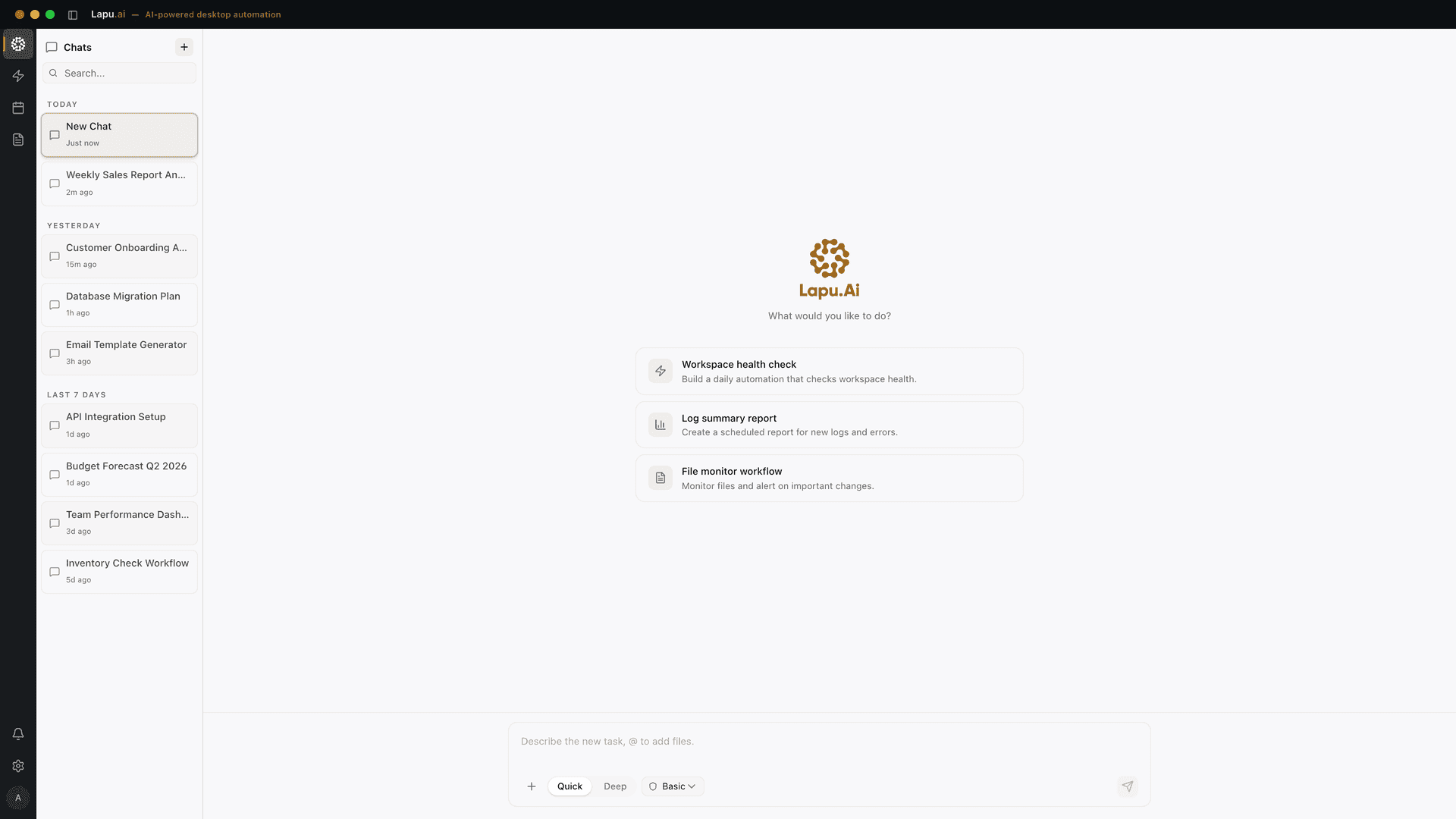
- Polished desktop GUI -- Lapu AI provides a full graphical interface with session management, action logging, and visual feedback. Open Interpreter is primarily a command-line tool.
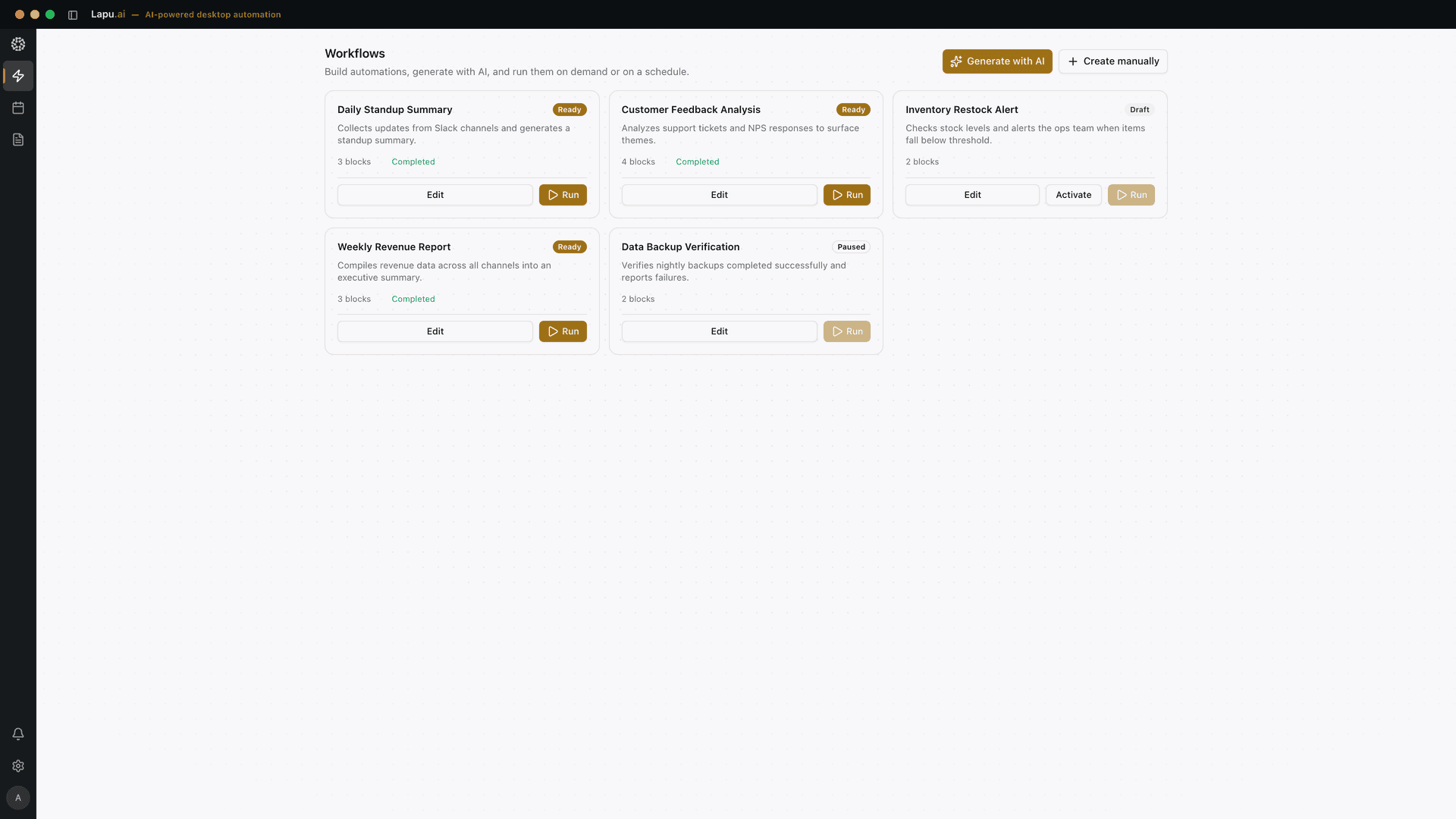
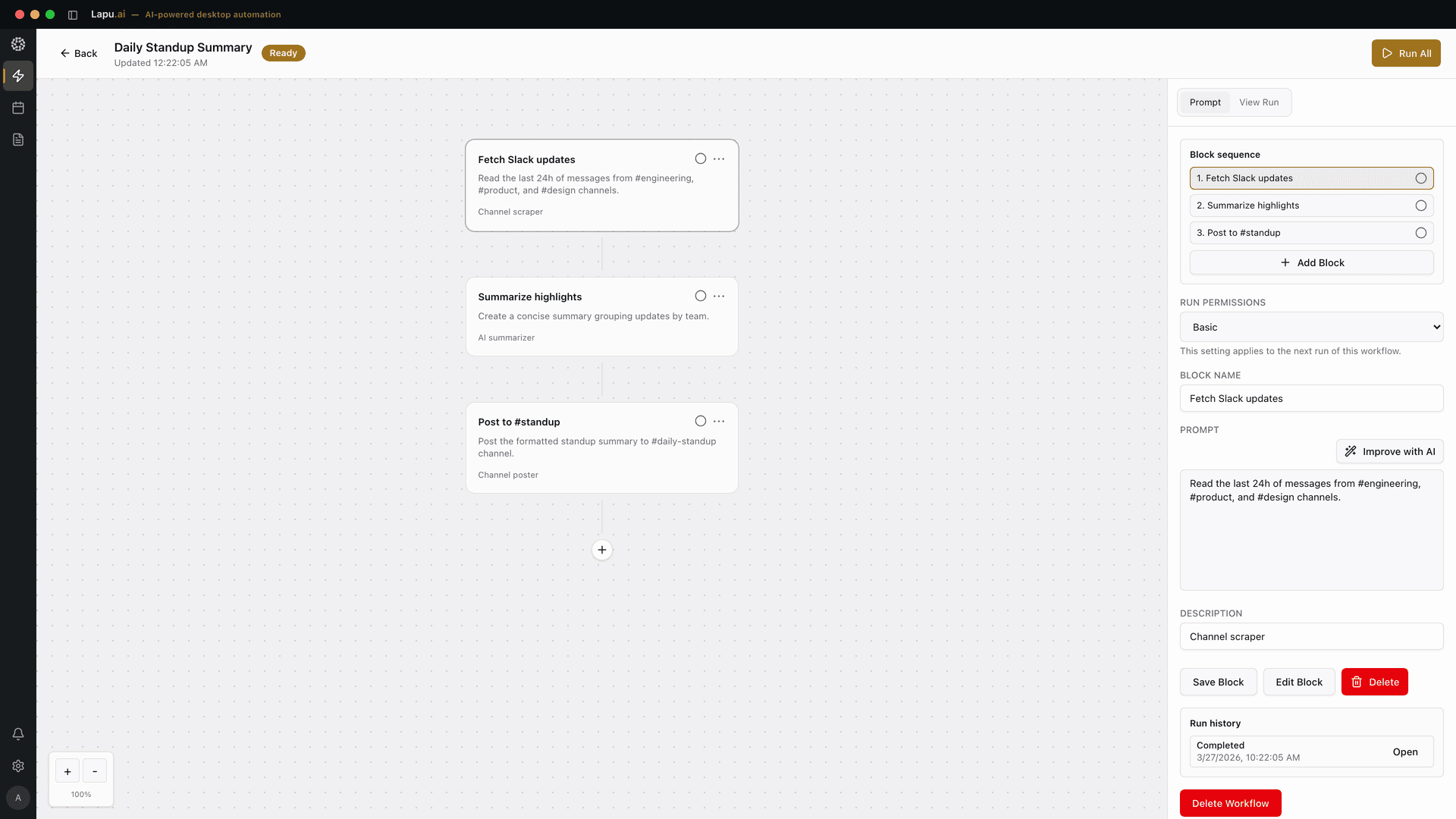
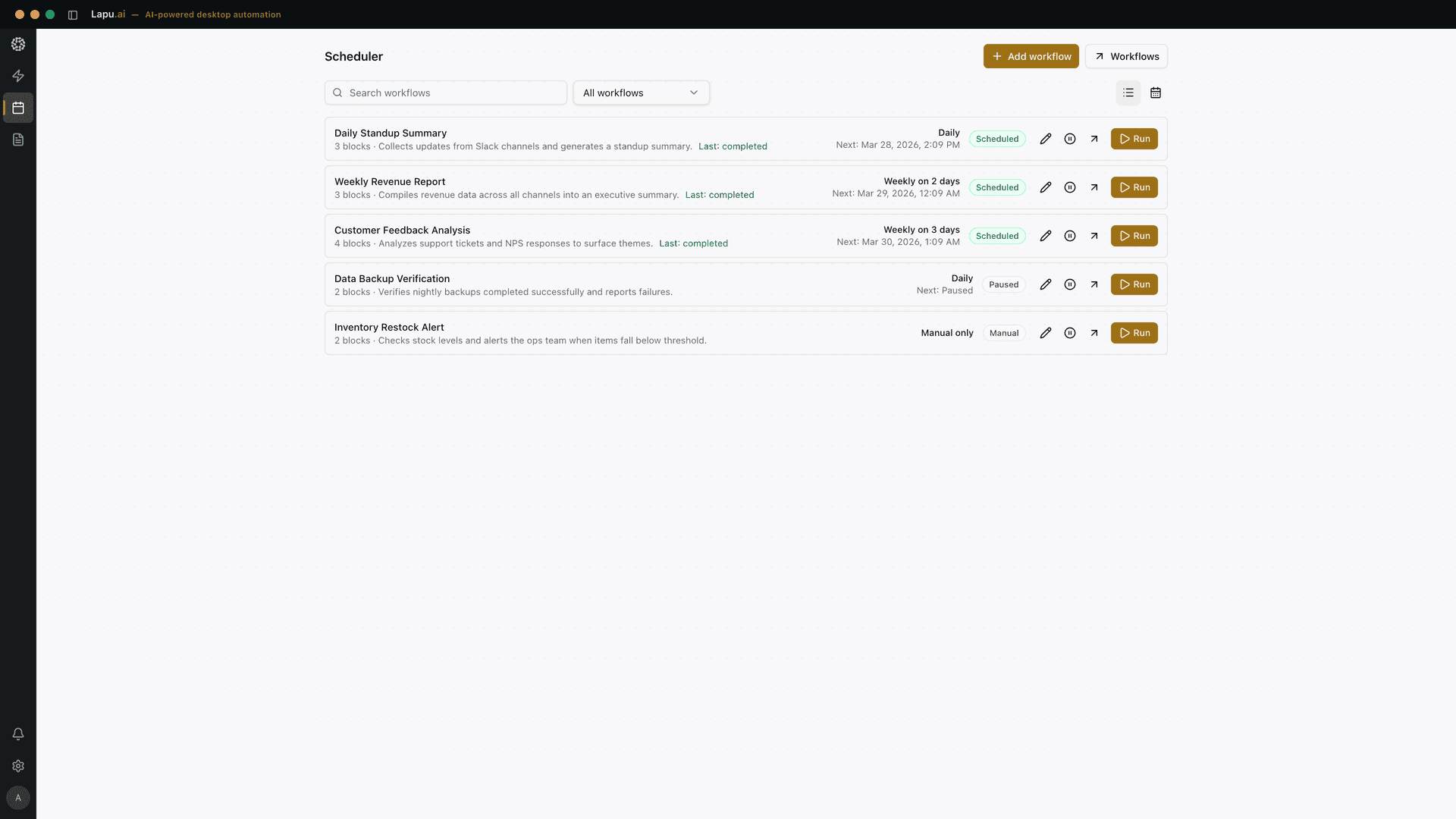
- Structured workflows and skills -- Lapu AI supports reusable, saveable skills and workflows that can be scheduled. This is useful for recurring tasks that need consistency.
- Native desktop integration -- Lapu AI uses native OS drivers for desktop automation (screenshots, synthetic input), providing deeper integration with desktop applications.
- Easier setup for non-developers -- Lapu AI installs as a standard desktop application. Open Interpreter requires familiarity with Python, pip, and the command line.
Where Open Interpreter is stronger
- Open source and free -- Open Interpreter is fully open source (AGPL-3.0). You can inspect, modify, and contribute to the codebase. This provides full transparency and community-driven development.
- Built-in code execution sandbox -- Open Interpreter has native support for executing Python, JavaScript, and other languages in a managed environment, making it powerful for data science and scripting workflows.
- Highly extensible -- As an open-source Python project, Open Interpreter can be extended, forked, and customized to fit specific needs. Power users and developers may prefer this flexibility.
- Self-hostable and embeddable -- Open Interpreter can be self-hosted, embedded in other applications, or integrated into custom pipelines. Lapu AI is a standalone desktop application.
- Lightweight -- Open Interpreter is a lightweight CLI tool that can run on minimal hardware. Lapu AI is a full desktop application with higher resource requirements.
Which should you choose?
Choose Lapu AI if you need...
- Users who prefer a graphical interface over a terminal
- Non-developers who want desktop AI automation without writing code
- Teams that need structured, repeatable workflows and scheduling
- Users who want native desktop integration with visual action feedback
Choose Open Interpreter if you need...
- Developers comfortable with terminal-based tools
- Data scientists who need direct Python / JavaScript code execution
- Users who value open-source transparency and want to inspect or modify the tool
- Advanced users who want to embed AI code execution into custom pipelines
- Users on constrained hardware who need a lightweight solution
Try Lapu AI for free
Download Lapu AI and see how it handles your desktop workflows — not just how it compares to Open Interpreter.
- 1-click uninstall
- Cancel anytime
- Files never leave your computer
Frequently asked questions
- Is Open Interpreter free?
- Yes. Open Interpreter is open source under the AGPL-3.0 license. You can use it for free. You will still need API keys for the LLM providers you want to use, which may have their own costs.
- Can Lapu AI run Python scripts like Open Interpreter?
- Lapu AI can execute Python scripts through shell commands. However, Open Interpreter has a more integrated code execution environment with built-in support for multiple programming languages and automatic package management.
- Which is better for non-technical users?
- Lapu AI is generally more accessible for non-technical users because it provides a graphical interface and does not require command-line familiarity. Open Interpreter is designed for developers and power users comfortable with terminals.
- Does Open Interpreter have a desktop app?
- Open Interpreter is primarily a CLI tool. The team has explored various desktop interfaces, but the core product remains terminal-based as of our last verification. Lapu AI is built from the ground up as a native desktop application.
- Can I bring my own model or run a local LLM with each tool?
- Open Interpreter is model-agnostic: you can point it at OpenAI, Anthropic, Groq, or run fully local models via Ollama, LM Studio, or llama.cpp. That flexibility is a core part of the project. Lapu AI ships with built-in AI reasoning, so there is nothing to configure — but you do not currently swap in your own local model. Pick Open Interpreter if BYOM or air-gapped inference is a hard requirement.
Related comparisons
Automate the work between you and outcomes
Lapu AI handles the repetitive work between you and outcomes. One desktop agent, zero tab-switching. Available now on macOS and Windows.
- 1-click uninstall
- Cancel anytime
- Files never leave your computer
Free to start. Cancel in 1 click. Files stay on your machine.