
Best Aider alternatives in 2026

Aider is a popular open-source AI pair-programming CLI that runs in your git repo, edits files, and auto-commits each change. People look for alternatives when they want a polished GUI, integrated editor experience, or an agent that goes beyond coding into general desktop work. Aider remains excellent at git-first terminal coding with bring-your-own-model flexibility, but it is a CLI for engineers — not a desktop agent for cross-app workflows. Here are five real options ranked by how well they replace what Aider does for different kinds of users.

Last verified: 2026-05-15

#1

Claude Code

Claude Code is Anthropic's official AI coding agent. It runs from the terminal, a VS Code or JetBrains extension, a web interface, and Slack, with Claude Sonnet 4.6 and Opus 4.7 as the underlying models. Inside a project it reads files, makes edits, runs shell commands, and supports Model Context Protocol (MCP) servers plus per-step permission gates so you can wire it into CI or review workflows. For Aider users who want to stay terminal-first but trade BYO-model and 44k GitHub stars for a polished, vendor-supported coding agent, Claude Code is the closest spiritual successor. Pricing is bundled into Claude Pro at $17/month annually, with higher Max, Team, and Enterprise tiers for heavier use. The catch: you are locked to Anthropic's models — no GPT, Gemini, or local Ollama models like Aider supports.

Pros

  • Terminal-native like Aider, with the same git-aware project workflow
  • Strong frontier models (Claude Sonnet 4.6, Opus 4.7) included in subscription
  • Per-step permission gates and MCP server support for CI and review
  • First-party Anthropic product with active development and support

Cons

  • Locked to Anthropic models — no GPT, Gemini, DeepSeek, or local Ollama
  • Not open source; closed-source proprietary product
  • Subscription-only pricing vs Aider's pay-per-token model flexibility

Best for: Aider users who want a polished, supported terminal coding agent and are happy on Claude models

Learn more →
#2

Lapu AI

Lapu AI is a desktop AI agent for macOS and Windows. Unlike Aider, it is not a coding CLI — it is a general-purpose agent that reads files across your machine, runs shell commands, processes documents, and automates desktop applications through native accessibility APIs, with explicit user approval at every sensitive step. Built-in frontier models from multiple providers mean no API keys to manage. Audit trails of every action are retained for up to 90 days. For Aider users whose workflow is shifting beyond pure coding — organizing files, processing PDFs, filling cross-app workflows, scripting data transformations across Excel and a database — Lapu AI covers ground that no terminal coding CLI does. Honest limits: Lapu does not have Aider's deep repo-map indexing, automatic per-edit git commits, or 100+ language editing precision. For a developer who lives in `git diff` and wants AI that produces clean commits on a Python or Rust codebase, Aider is still the better tool. Lapu is for the broader desktop work that wraps around coding.

Pros

  • Executes multi-step tasks across files, terminal, and apps — not just code editing
  • Permission gate on every risky action with full audit trail
  • Built-in frontier models — no API key, no provider setup, no per-token bill
  • Local-first: file reads happen on your machine, not in a cloud upload
  • Free tier with no credit card; Pro $29/month, Max $199/month

Cons

  • Not a coding-specialized tool — no repo map or git-aware per-edit commits like Aider
  • Newer product with a smaller ecosystem than CLI tools with 44k+ GitHub stars
  • Not open source — closed-source desktop application

Best for: Engineers and operators whose work crosses coding, documents, and desktop apps

Learn more →
#3

Cursor

Cursor is an AI-native fork of VS Code with deep IDE integration. It indexes your entire repository — functions, types, file relationships — and uses that index to power chat, autocomplete, and an in-editor agent that edits across files, runs terminal commands, and iterates on errors. Cursor supports Claude Sonnet, Claude Opus, GPT, and Gemini families, and lets you switch between them per task. For an Aider user whose main complaint is the lack of a visual diff and editor experience, Cursor is the strongest swap. You give up Aider's strict per-edit git-commit discipline, but gain a real editor, autocomplete, codebase indexing, and a Cmd-K refactor flow. Pricing starts free, with Pro at $20/month, Pro+ at $60/month, and Ultra at $200/month; spend is metered against frontier-model usage.

Pros

  • Deep IDE integration with full repo indexing — better visual context than any CLI
  • Excellent multi-file refactoring and agent mode for end-to-end coding tasks
  • Multi-model: Claude, GPT, and Gemini per prompt
  • Background and cloud agents for longer-running coding work

Cons

  • Confined to coding workflows inside the editor
  • Cannot control non-IDE applications or perform general desktop tasks
  • Metered pricing can become expensive on heavy frontier-model usage

Best for: Aider users who want a real GUI editor with codebase indexing and visual diffs

Learn more →
#4

Cline

Cline is an open-source AI coding agent that runs primarily as a VS Code extension, with a CLI tool and SDK on the side. It works across VS Code, JetBrains, and Cursor, integrates with Anthropic's Claude and other providers, and supports an MCP marketplace for custom tools. Visual approval gates show every proposed edit, terminal command, and file change before it runs. For Aider users who want to keep the open-source, bring-your-own-key model but get a visual diff and approval flow, Cline is the natural step. CLI 2.0 (released February 2026) added parallel multi-session execution, headless CI/CD mode, and Agent Client Protocol editor support. The repo sits around 61k GitHub stars with 5M+ installs across platforms, putting it in the same open-source tier as Aider.

Pros

  • Open source with visual approval for every edit, command, and file change
  • Works in VS Code, JetBrains, and Cursor — and now in a terminal CLI
  • Bring-your-own-key model support, including Claude, GPT, and local providers
  • MCP marketplace for extending the agent with custom tools

Cons

  • Primarily editor-bound — best experience requires VS Code or a peer IDE
  • Pay-per-token model means costs scale with usage like Aider does
  • Smaller language coverage than Aider for the long tail of obscure languages

Best for: Open-source loyalists who want a Cline-style visual approval flow with IDE integration

Learn more →
#5

Open Interpreter

Open Interpreter is an open-source Python tool that lets language models run code (Python, JavaScript, Shell, and more) on your computer through a CLI. It works with cloud models like Claude and GPT or with fully local models through Ollama, LM Studio, Jan, or Llamafile, which makes it the strongest pick for fully offline operation. There is now an editor surface for Word, Excel, and PDF files for non-coding document work. For an Aider user who wants something even more general — running shell commands and Python beyond pure coding — Open Interpreter overlaps in spirit. It is not a coding-specialized agent and has no repo map or per-edit git-commit flow, so it loses ground for serious software work. The strongest reason to pick it: full local-model operation, which Aider supports via Ollama but Open Interpreter is more polished for.

Pros

  • Open-source with auditable code execution and self-hostable model setup
  • Best option here for fully offline operation with a local LLM (Ollama, LM Studio, Jan)
  • Document editors for Word, Excel, and PDF beyond pure coding
  • Free tier with paid hosted plans at $20–$60/month if you do not want to bring your own keys

Cons

  • No repo map, codebase indexing, or per-edit git-commit flow like Aider
  • CLI-only — no native GUI for non-technical users
  • Single confirm-before-execute prompt is a coarser guardrail than per-tool permissioning

Best for: Aider users who want general code execution and the option to run fully local models

Learn more →

How to choose

Stay on Aider if your work is git-disciplined terminal coding across many languages with bring-your-own-model flexibility — nothing in this list matches its per-edit commit story or its 100+ language coverage. Move to Claude Code if you want a polished, vendor-supported terminal coding agent and you are willing to live on Anthropic models. Move to Lapu AI if your daily work crosses coding, documents, and desktop apps together and you want a permissioned agent that touches files, terminal, and applications under one approval flow. Move to Cursor if your main pain is the lack of a visual editor and codebase index. Move to Cline if you want the open-source story plus a visual approval flow inside VS Code. Move to Open Interpreter if local-model operation is the deciding factor.

Why Lapu AI differs

Most Aider alternatives are still coding tools. Lapu AI sits in a different category — a general desktop agent that happens to be good at coding tasks but is built for the broader work that wraps around them: file organization, document processing, spreadsheet automation, cross-app workflows, and terminal scripting. Built-in frontier models remove the API-key step that Aider requires, and the per-action permission gate plus 90-day audit trail make it auditable for work computers. Honest limits: for pure repo-disciplined coding with one clean commit per AI edit, Aider remains better, and for in-editor visual coding, Cursor remains better. Lapu AI is for engineers and operators whose desktop work has moved beyond just the codebase.

FAQ

Why are people looking for Aider alternatives in 2026?
Aider is excellent at what it does — a git-first terminal coding CLI — but several gaps drive users to alternatives: no visual diff or editor (Cursor and Cline solve this), no work beyond coding (Lapu AI and Open Interpreter solve this), and the friction of managing API keys for multiple models when a single subscription would do (Claude Code and Lapu AI solve this).
Is Claude Code basically Aider with Anthropic backing?
Spiritually close, but with two key differences. Claude Code is locked to Anthropic models (Claude Sonnet and Opus), where Aider supports Claude, GPT, Gemini, DeepSeek, and local Ollama models. Claude Code is closed source where Aider is Apache 2.0. In return Claude Code gives you a Pro subscription that bundles model usage, MCP server support, and per-step permission gates designed for CI and review.
How is Lapu AI different from a coding-specialized tool like Aider?
Lapu AI is a general desktop agent, not a coding CLI. It reads files anywhere on your machine, runs shell commands, processes documents (Word, Excel, PDF), and automates desktop applications through native accessibility APIs. For pure software work inside a repo, Aider is still better — it has the repo map, the per-edit git commits, and the 100+ language coverage. Lapu is the right choice when your work has moved beyond just the codebase to file organization, cross-app workflows, and document processing.
Which Aider alternative is best for local-only operation?
Open Interpreter has the most polished local-model story today — it pairs cleanly with Ollama, LM Studio, Jan, and Llamafile for fully offline operation. Aider also supports local models through Ollama. Lapu AI, Claude Code, Cursor, and Cline all require network access to their reasoning providers. None of the GUI agents are fully offline LLM runtimes.
Can I use Aider and one of these alternatives together?
Yes. Aider plus Lapu AI is a common pairing — Aider handles disciplined coding inside a single repo with auto-committed edits, while Lapu AI handles cross-app workflows, document processing, and desktop automation. Aider plus Cursor is also viable, with Cursor for visual refactoring and Aider for terminal commits. The tools do not conflict because they target different surfaces.
Which Aider alternative is the cheapest?
Aider itself is the cheapest if you have an existing API key and light usage — the tool is free and Apache 2.0 licensed, you only pay model API costs. Open Interpreter and Cline are similar pay-per-token open-source models. Lapu AI's free tier and Claude Code's $17/month bundled Pro plan can be cheaper than pay-per-token at moderate-to-heavy usage, since model costs are absorbed by the subscription.
Does any Aider alternative match its multi-model support?
Cline and Open Interpreter are the closest open-source matches with broad multi-provider support. Cursor lets you switch between Claude, GPT, and Gemini per prompt inside the editor. Claude Code and Lapu AI take a different approach — Claude Code is Anthropic-only, and Lapu AI selects models automatically from its built-in pool rather than letting you bring your own key.

Related

Try Lapu AI free

Desktop AI agent for macOS and Windows. No credit card required.

Download Lapu AI

Automate the work between you and outcomes

Lapu AI handles the repetitive work between you and outcomes. One desktop agent, zero tab-switching. Available now on macOS and Windows.

  • 1-click uninstall
  • Cancel anytime
  • Files never leave your computer

Free to start. Cancel in 1 click. Files stay on your machine.

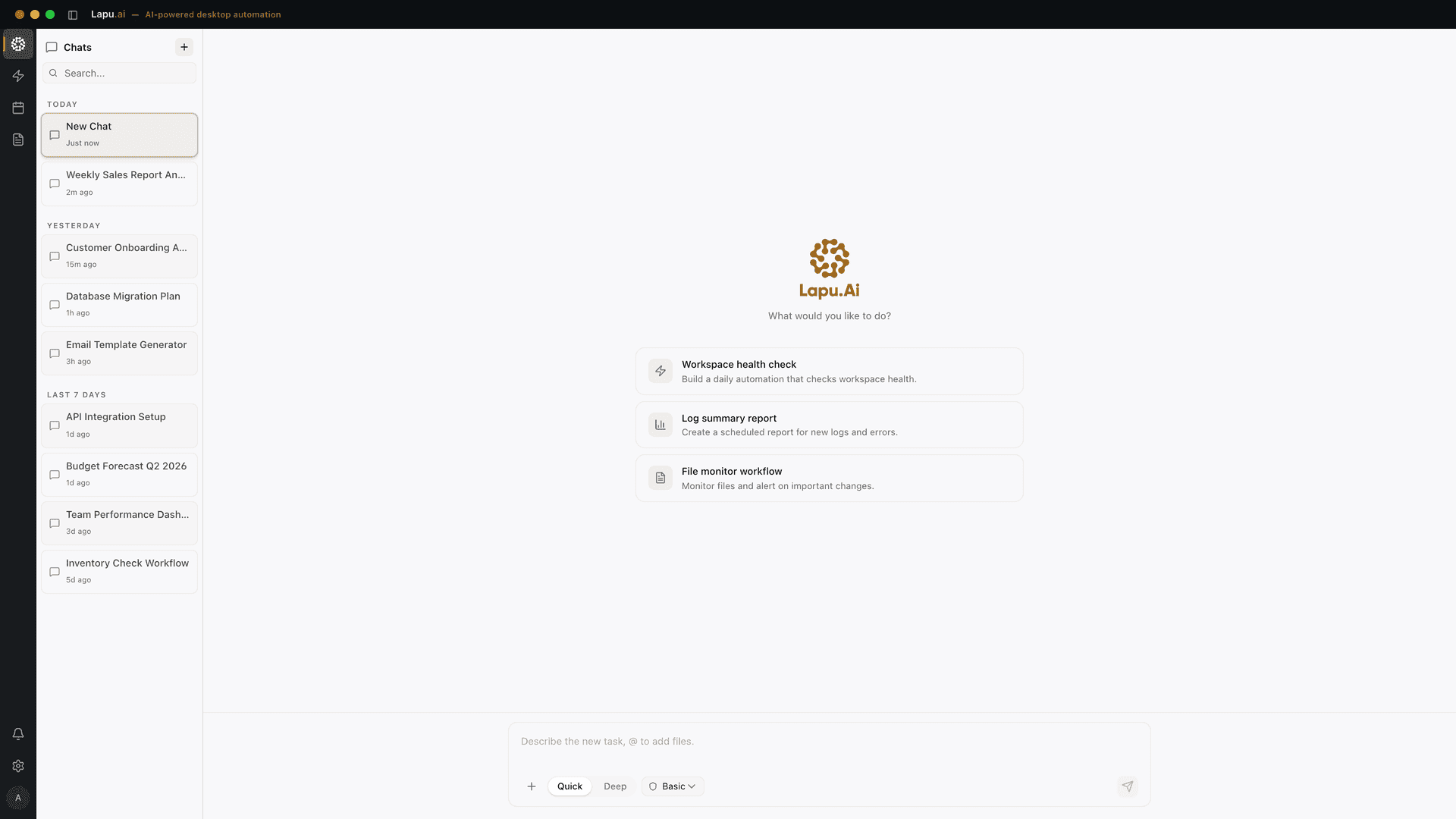
Lapu AI Agent Chat interface with conversation history and workflow suggestions