
The best AI agent for Competitor Monitoring in 2026
Competitor monitoring is the work of watching a handful of rival companies and telling someone on your team when a page, a price, a feature, an ad, a job listing, or a press post changes in a way that actually matters. It is not generic 'market research' and it is not a one-off SWOT — it is a recurring loop: a defined set of competitor pages and feeds, a defined cadence (daily, weekly, on-event), and a defined output (a brief, a battlecard update, a Slack post). AI tools that do this work fall into two camps. The first runs in the cloud and watches public web pages on a vendor server — Visualping, Klue, Crayon, Kompyte, Competely, Similarweb. They are paid hosted services that watch pricing pages, blog posts, changelogs, review sites, and ad libraries on their own crawlers, then summarise the change and pipe it into Slack, Salesforce, or a battlecard. The second runs as a desktop-based agent on the analyst's own machine — Lapu AI. It opens the same pages a human would, runs whatever browser-based or local tooling the analyst is already using (Notion, Excel, a private brief template, a Google Doc), and writes the change summary back into those files, with an audit trail of every page it read and every action it took. The desktop angle matters when the watch list includes pages or accounts your hosted vendor cannot see — gated competitor portals you have logged into in your browser, internal analyst notes that are not allowed to leave the laptop, or BI dashboards behind SSO. Concrete tasks a good competitor-monitoring agent should handle on a recurring schedule, without hand-holding: 'every Monday at 8am check the pricing page of these five competitors, screenshot any change, and append a row to ~/Competitive/pricing-log.xlsx with the date, the diff, and a one-line summary' (the spreadsheet half of that is AI agents for Excel automation); 'every weekday morning open the GitHub releases page of each open-source competitor and post a Slack message in #competitive-intel if a new tag is published'; 'once a week run a search query against the ad library for each competitor brand, save new creatives to ~/Competitive/ads/, and update the battlecard in Notion'; 'on every job posting that mentions a role we care about, drop a brief into ~/Competitive/hiring-signals.md with the role, location, and a guess at the team they are building'.
- 1-click uninstall
- Cancel anytime
- Files never leave your computer
What to look for
- Handles the *recurring loop*, not just a one-off lookup — a competitor-monitoring tool is judged on the Monday-morning brief, not the first demo. The agent has to schedule the watch, do it on cadence, and tell you when something changed without you re-asking
- Diffs pages meaningfully — surfaces a price change, a new pricing tier, a removed feature, a new logo on a customer wall; ignores cookie banners, A/B test wording, and tracking-pixel rotations. A wall of raw HTML diffs is worse than no diff
- Reads pages your team can actually see — including a gated competitor portal you logged into in your browser, an analyst dashboard behind SSO, a private SaaS comparison report you paid for. A cloud crawler cannot reach those; a desktop agent driving your own browser session can
- Writes back to the files and apps where your team already works — appends a row in your real Excel file, updates the real Notion battlecard, posts to the real Slack channel — instead of trapping the output in a vendor portal that nobody opens
- Permissioned: any write to a file, any post to Slack, any update to the CRM shows a preview and waits for approval; high-risk actions (overwriting a brief, sending an external message) require explicit confirmation
- Keeps sensitive inputs on the analyst's machine — internal notes about strategy, draft battlecards, account-team commentary — and only sends the minimum context the model needs to reason. The audit trail records what was sent for each summary
- Produces structured output that another tool can read — Markdown, JSON, a spreadsheet row — not a wall of prose buried inside a vendor dashboard
Top tools compared
1. Lapu AI
High fitDesktop AI agent for macOS and Windows that runs the recurring monitoring loop on the analyst's own machine. The agent opens the competitor pages your browser is already logged into, reads them the way a human would, writes the diff and a one-line summary back into the files and apps your team already uses — appends a row to ~/Competitive/pricing-log.xlsx, updates the Notion battlecard, posts to the Slack channel — and schedules the whole loop to repeat on Monday mornings or any cadence you set. Every action is permissioned: the first time the agent wants to open a page, write a file, or post a message, you see a preview and approve it; you can pre-approve a class of actions (like 'append rows to this spreadsheet') for the workflow. Source documents, draft briefs, and internal commentary stay on the laptop; only the minimum context the model needs to reason about a change is sent to the model endpoint, and the audit trail records what was sent for each summary. Free tier covers solo analyst use. Where it shines: small competitive-intel teams or solo product/marketing operators who want a private, programmable watcher that can reach the gated dashboards a hosted crawler cannot — Salesforce account views, internal BI, paid analyst portals — and write straight into the team's real working files. Where it is weaker than Klue or Crayon for this task: it does not ship with prebuilt battlecard templates, a multi-tenant curator workflow, a roster of dedicated CI analysts you can hire alongside the software, or G2's review-aggregation graph. Many teams use both layers: a hosted CI platform for the org-wide battlecard programme, plus Lapu on the analyst's desktop for the watch-list work that needs a logged-in browser session or private files.
Learn more →2. Visualping
High fitHosted website change-monitoring service used by analysts at over 85% of Fortune 500 companies, per Visualping's marketing. Free plan covers 5 monitored pages, 150 checks per month, and 60-minute minimum check intervals; personal plans start at $10/month; business plans start at $100/month and add Slack and Microsoft Teams alerts, team workspaces, native integrations (n8n, Google Sheets), and higher check volumes. Where it shines: the canonical 'just watch these competitor pages and tell me when they change' use case — pricing pages, product pages, customer-logo walls, careers pages, changelogs. Every alert ships with an AI-generated summary of what changed and an importance flag, so the human work is deciding what to do, not reading raw HTML diffs. Where it is weaker for this task: it watches public pages on its own crawlers, so it cannot reach a competitor dashboard you are logged into in your own browser, a paid analyst report behind SSO, or anything else gated; and the output lives in Visualping's dashboard plus an alert in Slack/email, not as a row written directly into your team's brief, Notion page, or spreadsheet (Zapier and webhooks bridge that gap for the price of more wiring).
Learn more →3. Klue
High fitEnterprise competitive-intelligence platform built around sales battlecards and win-loss analysis. Pricing is quote-based and is widely reported to land in the $16,000–$40,000/year range for mid-sized teams, rising with curator and consumer counts. Klue runs continuous web monitoring on its own infrastructure, summarises competitor news and page changes with AI, and feeds the result into battlecards that live inside Salesforce, Slack, Highspot, and the sales rep's day-to-day tools. Klue also ships a dedicated Compete Agent that surfaces deal-level competitive intel inside the seller's workflow. Where it shines: organisations with a real CI function — a product marketing lead, multiple sales pods, a battlecard programme — that want one platform owning the loop from web monitoring to sales enablement to win-rate reporting, with quoted adoption rates above 70% across revenue teams. Where it is weaker for this task: budget and footprint are sized for mid-market and enterprise CI programmes, not a solo analyst or a five-person product team; the watch happens on Klue's crawlers, so private/gated competitor surfaces you have logged into in your own browser are out of scope; and the workflow lives inside Klue's dashboard and integrations rather than the analyst's own desktop files.
Learn more →4. Crayon
High fitEnterprise competitive-intelligence platform that monitors over 100 data types — pricing pages, product pages, messaging, ads, job posts, reviews, news — and surfaces what changed through importance scoring and AI summaries. Pricing is quote-based and is publicly reported to land in the $20,000–$40,000/year range for Professional and to climb past $100,000/year at Enterprise; add-ons (custom integrations, dedicated CSM, professional services) commonly add 15–30% to the base. Crayon plugs into Salesforce, Slack, Highspot, and similar tools so that sales reps see battlecards inside the deal flow, and Crayon's own State of Competitive Intelligence report documents productivity gains and win-rate lifts for teams that use AI-summarised intel daily. Where it shines: established B2B GTM organisations running a formal CI programme, with battlecards, newsletters, and win-loss measurement as part of one platform. Where it is weaker for this task: the price tag and the curator/consumer model assume a multi-person team; the watch is cloud-side, so private/logged-in surfaces and internal-only files stay out of reach; and the output lives inside Crayon's battlecards and integrations rather than directly inside your analyst's own files.
Learn more →5. Kompyte
Medium fitCompetitive-intelligence platform owned by Semrush. Tracks competitors across websites, reviews, content, social media, ads, and job postings; uses AI to surface what is worth a human's attention; builds sales battlecards; and integrates with HubSpot, Salesforce, Slack, Microsoft Teams, Google Drive, OneDrive, Highspot, and Showpad. Pricing is quote-based and is positioned alongside Klue and Crayon for mid-market CI buyers. Where it shines: teams that already pay for Semrush and want their competitor monitoring, ad tracking, and battlecards inside the same vendor — the daily AI summaries are designed to compress research to roughly an hour per week. Where it is weaker for this task: same hosted-crawler footprint as Klue and Crayon, so gated portals and logged-in dashboards remain invisible; the workflow lives in Kompyte's interface and downstream sales tools; and for solo analysts and small product teams the dedicated-CI-platform price band is heavy relative to a $10–$100/month watcher or a desktop agent.
Learn more →6. Competely
Medium fitAI competitor-analysis SaaS that produces an on-demand competitive analysis across 100+ data points — marketing, product, pricing, customer sentiment, SWOT — and then re-runs the scan every 2–4 weeks, emailing a brief that highlights key moves. Pricing starts at $39/month and runs to $99/month, billed monthly, with continuous monitoring on every plan. Where it shines: founders, marketers, product managers, agencies, and consultants who want a one-shot competitive briefing now, plus a low-touch every-fortnight re-check, without standing up a full CI programme; the per-month cost is roughly an order of magnitude below Klue/Crayon and comparable to Visualping's personal tier. Where it is weaker for this task: scans run on Competely's infrastructure and produce a vendor-side brief, so gated dashboards, internal notes, and private comparison reports remain out of reach; the 2–4 week cadence is good for big-picture moves but slower than a daily Visualping check or a desktop agent triggered by an event; and the output is an emailed brief, not a row written into your team's real spreadsheet or battlecard.
Learn more →
Why Lapu AI is built for Competitor Monitoring
Lapu AI is the right competitor-monitoring agent when the watch list reaches past the public web and into the files and accounts your team already uses. The agent runs on macOS or Windows, opens the competitor pages your browser is logged into (gated portals, SSO-protected dashboards, paid analyst reports), reads them the way a human would, and writes the diff plus a one-line summary back into the files where your team actually works — a row in ~/Competitive/pricing-log.xlsx, a section in the Notion battlecard, a message in the #competitive-intel Slack channel — on whatever cadence you set. Every action is permissioned: file writes, Slack posts, CRM updates show a preview and wait for approval, and you can pre-approve a class of actions (like 'append rows to this spreadsheet') for a recurring workflow. Internal notes and draft briefs stay on the laptop; only the minimum context the model needs to reason about a page change is sent to the model endpoint, and the audit trail records what was sent for each summary. A practical decision framework: if your team is mid-market or enterprise, runs a formal CI programme, and wants one vendor owning monitoring, battlecards, sales enablement, and win-rate measurement, Klue, Crayon, or Kompyte is the right platform layer — and many teams happily pair one of those with a desktop agent for the watch-list work the cloud crawler cannot reach. If your watch list is just a handful of public pricing and product pages and you want a $0–$100/month hosted watcher that posts to Slack, Visualping is the cleanest choice. If you want an on-demand competitive brief plus a fortnightly re-run for under $100/month, Competely is a reasonable fit. If you want a private, programmable watcher that can reach a logged-in browser session or a private spreadsheet, schedule itself on a cadence, and write back into your team's real files with an audit trail — Lapu AI is the answer.
FAQ
- Does Lapu AI upload my competitive notes or briefs to a vendor cloud?
- No. Source files — your draft battlecard, the spreadsheet of competitor pricing history, the analyst notes on each rival — sit on your machine and Lapu AI reads them locally. When the model needs to reason about a page change, only the minimum context — the diff hunks of the changed page plus the specific files referenced — is sent to the model endpoint; the rest stays on your laptop. The audit trail records exactly what was sent for each summary, so a security review later has a real answer.
- How is this different from Visualping, Klue, or Crayon?
- Those are hosted watchers: they run on a vendor's crawlers, see only public pages (or pages exposed to their crawler), and write the output into the vendor's dashboard plus downstream integrations like Slack, Salesforce, or a battlecard tool. Lapu AI is a desktop watcher: it runs on the analyst's own machine, can read the gated competitor portal you are logged into in your own browser, and writes the diff plus a summary straight into the files and apps your team already uses. The two layers are complementary — many teams pair a hosted CI platform for the org-wide programme with Lapu on the analyst's desktop for the watch-list work that needs a logged-in browser session or private files.
- Can Lapu AI watch a gated competitor dashboard I have logged into?
- Yes, on the same terms as any other browser-based task. The agent drives your browser inside your own logged-in session, so a page you can open after SSO or a paid login is a page the agent can read. You approve each domain the agent visits and each file it writes, and the audit trail records every action. This is the watch-list surface that hosted crawlers (Visualping, Klue, Crayon, Kompyte) cannot reach by design, because they run from their own servers without your browser session.
- How does scheduling work for a recurring weekly watch?
- Premium and Max plans include workflow scheduling: you describe the watch once ('every Monday at 8am open these five pricing pages, append any change as a row in ~/Competitive/pricing-log.xlsx, and post to #competitive-intel in Slack'), pre-approve the class of actions involved, and the workflow runs on cadence. Free-tier users can run the same watch manually whenever they want, which is fine for ad-hoc weekly use; recurring automation is the paid-tier feature.
- Will the agent post to Slack or update the CRM without asking me?
- It posts and updates only after you approve. The first time the agent wants to post to a Slack channel or write to a Salesforce record, you see the exact message, the target channel or record, and a one-sentence rationale; nothing sends until you approve. For a recurring workflow you can pre-approve a class of actions ('post to #competitive-intel', 'append to this spreadsheet') for the session so the watch runs unattended, but there is no silent first send and the audit trail records every external write.
- Does this work on Windows?
- Yes. Lapu AI runs natively on macOS 12 and later (Apple Silicon) and Windows 10 or 11 with the same competitor-monitoring features. The agent drives whichever browser you have signed into and writes to local files via the standard filesystem on each platform; the permission gate, audit trail, and local-first behaviour are identical across both.
- Can Lapu AI replace a hosted CI platform like Klue or Crayon for an enterprise sales team?
- Not directly. Klue, Crayon, and Kompyte ship with battlecard templates, a curator/consumer permission model, deep CRM integrations, and a roster of CI analyst services that an enterprise GTM team often needs. Lapu AI is a desktop agent: it is the better tool for the watch-list work that a hosted crawler cannot reach (logged-in dashboards, private files, internal notes), and for analysts and small product teams who want a programmable, auditable monitor without a five-figure annual contract. The two layers are complementary, not substitutes.
Related
- Best AI agent for Data Cleanup →
- Best AI agent for Data Entry Automation →
- Best AI agent for Desktop Task Automation →
- Best AI agent for Document Automation →
- Best AI agent for Excel Automation →
- Best AI agent for File Organization →
- Best AI agent for Form Filling →
- Best AI agent for Invoice Automation →
- Best AI agent for Screen Scraping →
- More best-for guides →
- See Lapu AI use cases →
- Compare with alternatives →
- Pricing →
Try Lapu AI free
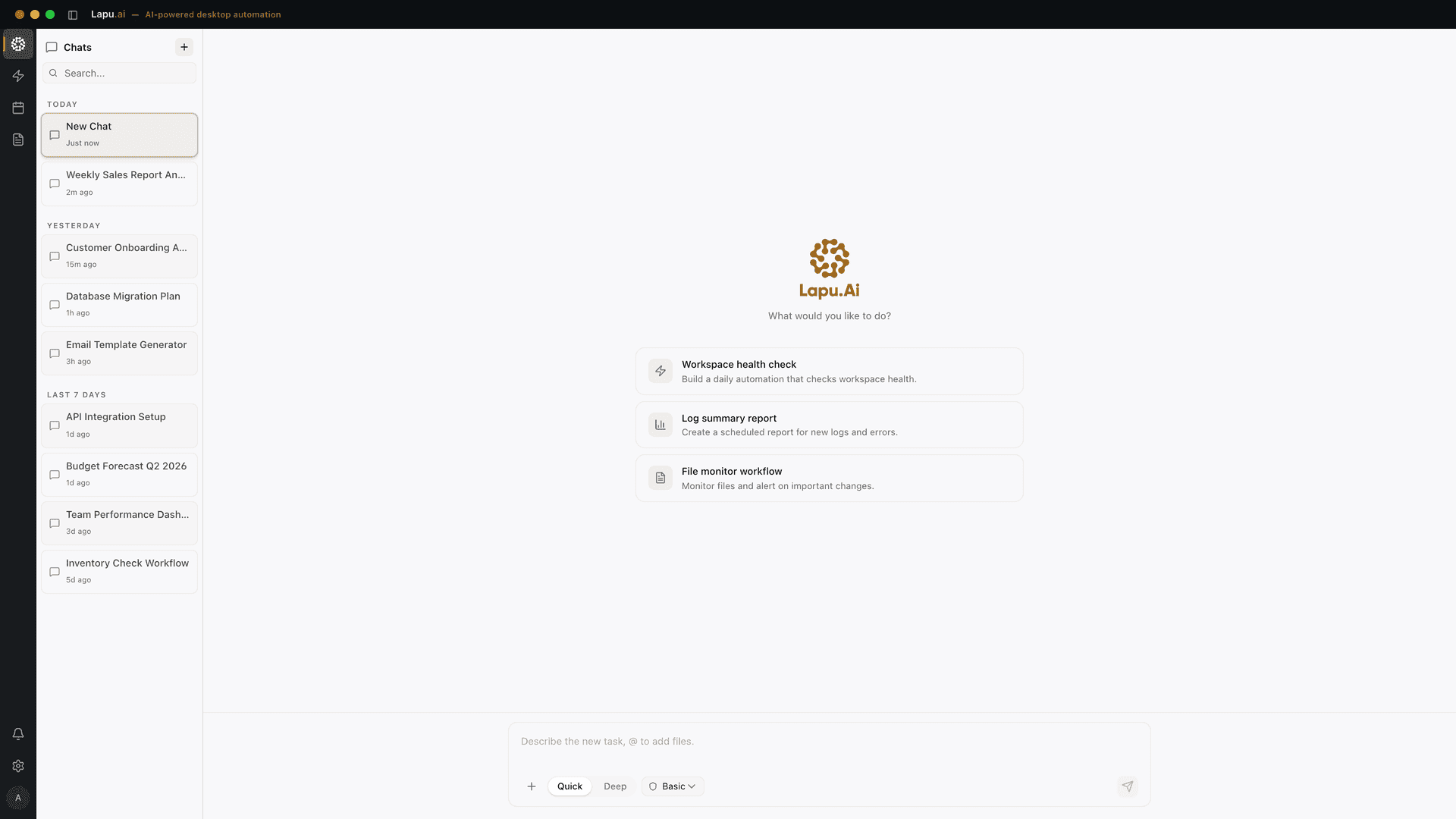
Built for Competitor Monitoring. Free download — see exactly what the app looks like first.
- 1-click uninstall
- Cancel anytime
- Files never leave your computer
Automate the work between you and outcomes
Lapu AI handles the repetitive work between you and outcomes. One desktop agent, zero tab-switching. Available now on macOS and Windows.
- 1-click uninstall
- Cancel anytime
- Files never leave your computer
Free to start. Cancel in 1 click. Files stay on your machine.