Claude Mythos 5 desktop access is the question of the week. Anthropic just announced Mythos 5 and Claude Fable 5 — the most capable models the company has ever shipped — but neither one runs on your machine on its own. This post is what a bigger frontier model upstream actually changes for desktop AI agents, and what it does not.
What Anthropic actually shipped on June 9
On June 9, 2026, Anthropic announced Claude Fable 5 alongside Claude Mythos 5, the first two models in a new Mythos-class tier that Anthropic positions above its Opus class in capability. The announcement frames Fable 5 as the public release — a Mythos-class model with safeguards that route a small fraction of high-risk queries to Opus 4.8 instead — and Mythos 5 as a restricted release with safeguards lifted in certain areas, including cybersecurity tradecraft.
Both ship at the same list price: ten dollars per million input tokens and fifty dollars per million output tokens. That is less than half the rate Anthropic charges Glasswing participants for Mythos Preview today. Fable 5 is included on Pro, Max, Team, and seat-based Enterprise plans through June 22 at no extra cost; on June 23 it moves to credit-based pricing for those plans.
- Fable 5 / Mythos 5
- Mythos Preview
Mythos 5 itself does not go on sale. It is deployed initially through Project Glasswing, Anthropic's cyberdefense program with the US government and roughly 150 partner organizations across 15-plus countries, as an upgrade to Mythos Preview. Anthropic plans periodic additions of new partners; it does not list the specific enterprises by name.
Here is what the public-facing announcement looks like as raw API metadata — the same shape any application that calls Anthropic's models will consume:
| Model | id | tier | availability |
|---|---|---|---|
| Claude Fable 5 | claude-fable-5 | mythos-class | Public |
| Claude Mythos 5 | claude-mythos-5 | mythos-class | Restricted (Glasswing) |
| Claude Opus 4.8 | claude-opus-4-8 | opus | Public — safeguard fallback for Fable 5 |
The relevant fields are mundane: identifier, class, tier, price. Nothing in the API tells the calling application where the work happens. That is the part a desktop agent has to figure out on its own.
Frontier capability is upstream of where it runs
A frontier model is a planner and a writer. It does not have hands. Whether the next token comes from Opus 4.8 or Mythos 5, the model returns text — sometimes a tool call, sometimes a JSON action — and something else has to execute it.
On a cloud chat surface, that "something else" is the cloud. The model proposes an action; the cloud runs it on a sandboxed VM or in a remote browser; the user sees the result in a chat window. The user's actual desktop is never touched. This is what TechCrunch described when it noted that Fable 5's safeguards defer roughly five percent of sessions to Opus 4.8 — the gating decision is about what the model is allowed to say, not about what gets to happen on the user's machine.
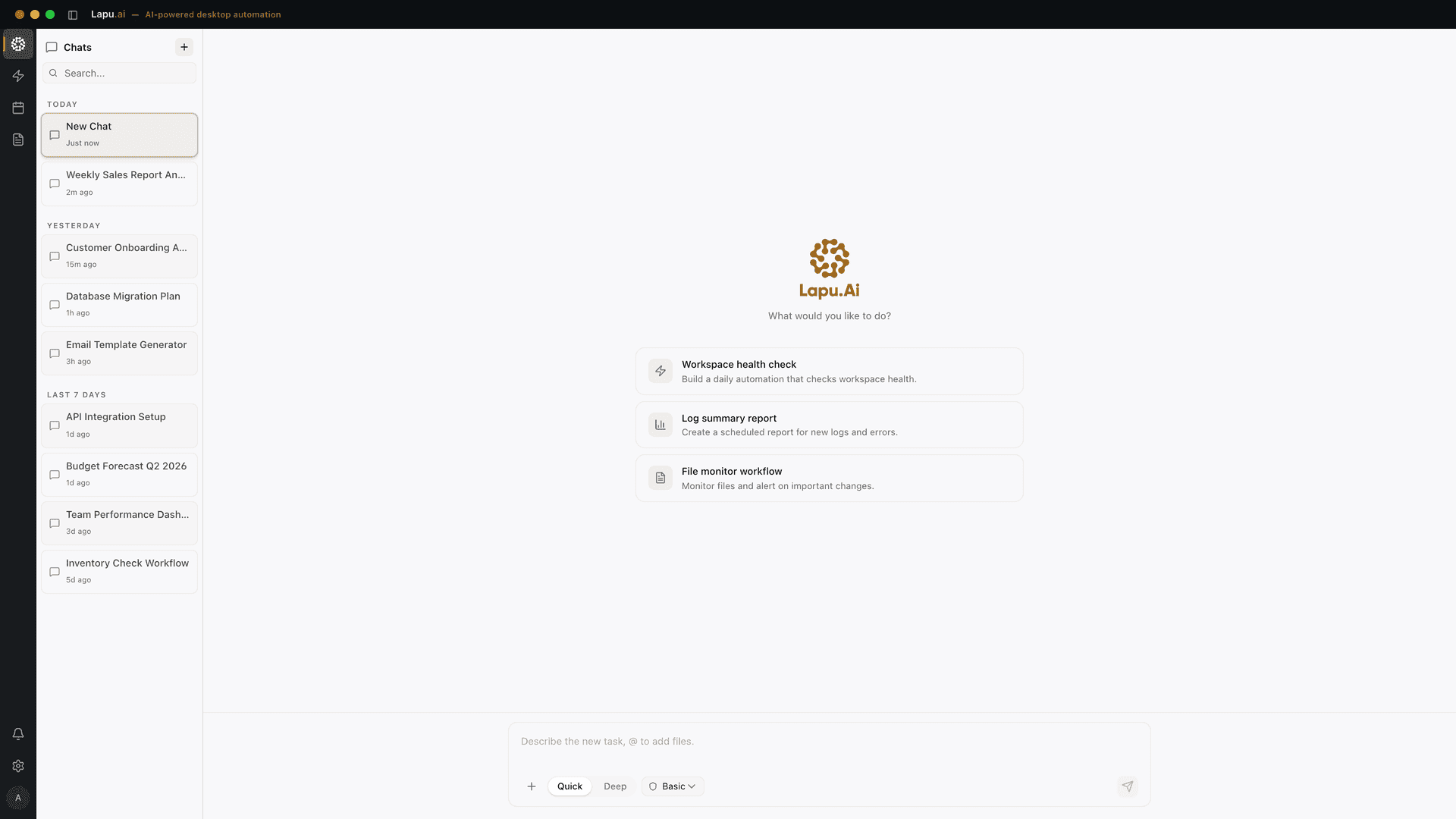
On a native desktop AI agent, that "something else" is the runtime around the model: the process that reads the user's filesystem with permission, the layer that executes shell commands the user approved, the bridge that drives accessibility APIs in other applications, and the log that records every action so the user can replay it. The model is the planner. The desktop runtime is the actor.
The implication is clean: a Mythos-class model improves the quality of the plan. It does not, by itself, change where the plan executes. If the plan executes in a remote sandbox, a bigger model writes a tighter plan for a remote sandbox. If the plan executes on the user's desktop, a bigger model writes a tighter plan for the desktop. The location is decided by the application, not by the model.
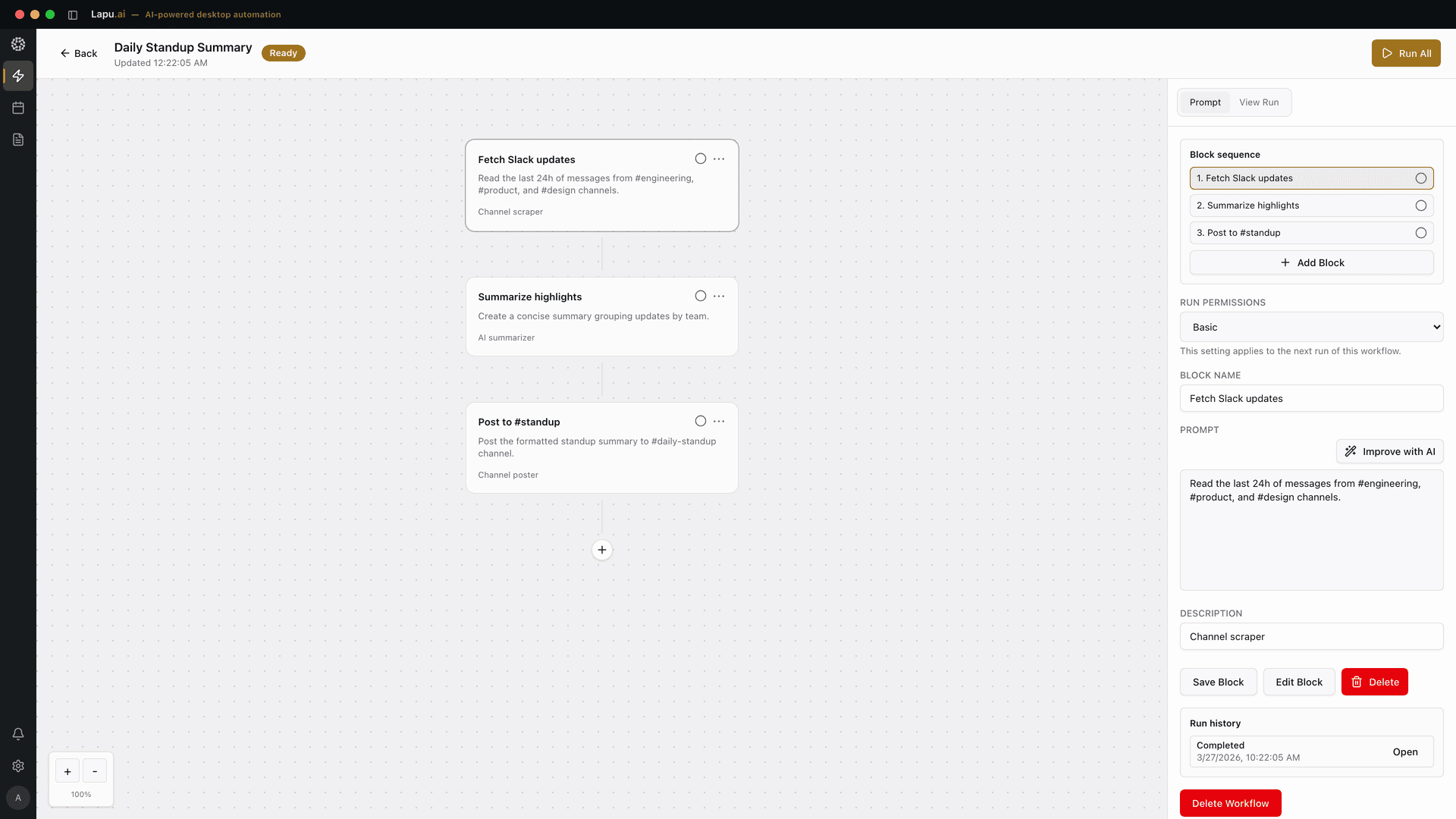
For a Lapu user, the practical effect of a Mythos-class model is fewer dead-end retries on long tasks. The agent loop is roughly:
- You ask. Plain-language description of a task.
- The model plans. Picks tools, breaks the task into steps, shows you the plan.
- You approve. Sensitive actions — writing a file, running a command, clicking into another app — require explicit confirmation.
- The runtime executes. Native desktop actions, real files, real shell.
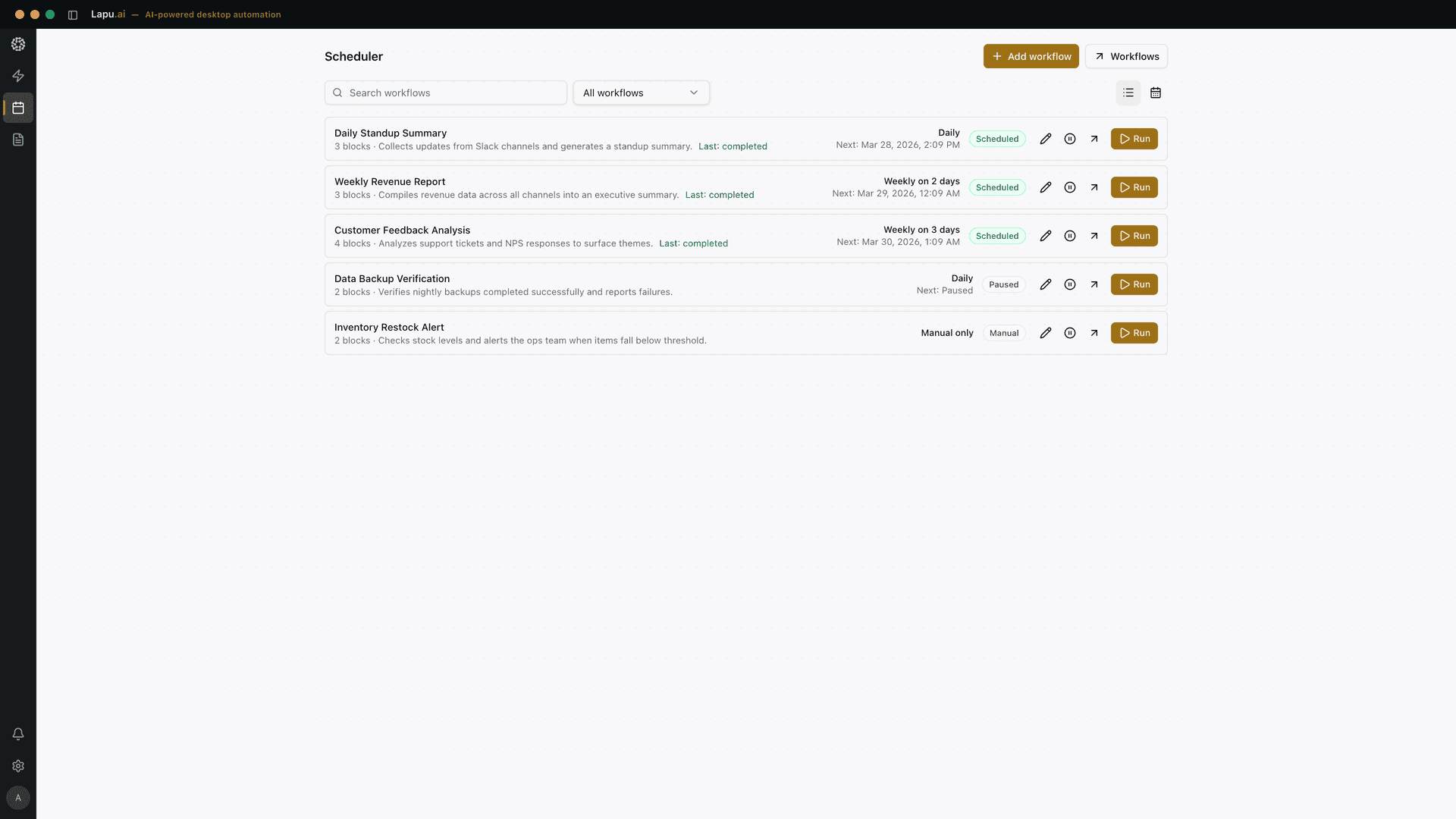
- The audit trail records. Every step is logged for up to 90 days.
A stronger model improves step 2. It does not change steps 1, 3, 4, or 5. Those steps are the product, and a desktop agent owns them regardless of which frontier model is on the other end.
What a Mythos-class model on the desktop looks like
The capabilities Anthropic highlighted in the announcement — software engineering depth, sustained multi-hour autonomous work, precise extraction from dense documents and figures — read like a list of things a desktop agent would actually want a planner to be good at. Each one cashes out on the desktop only if the runtime can act there.
| Mythos-class capability | What it changes on the desktop |
|---|---|
| Longer autonomous task runs | Fewer "the agent stalled at step 7" interruptions on multi-app workflows |
| Stronger code reasoning | Tighter plans for code review, refactors, and local script generation |
| Better vision on documents and screens | More reliable extraction from PDFs, screenshots, and accessibility trees |
| Improved long-context use | Larger codebases and longer audit logs stay in scope across a session |
None of these capabilities, on their own, grant access to your machine. A model that reads screenshots better still needs a runtime that captures the screen with permission, hands it to the model, parses the action it returns, and executes that action under a permission gate. That stack is what a native computer-use AI application is. It is also what a chat application is not.
Claude Desktop vs a desktop agent: the gap Mythos does not close
Claude Desktop is a chat application for Anthropic's models. It is one of the cleanest chat surfaces available and it is genuinely useful for thinking through a problem. It is also, by design, a conversation. It does not enumerate your filesystem, it does not drive other applications, and it does not maintain a long-lived audit log of actions it took on your computer — because it does not take actions on your computer.
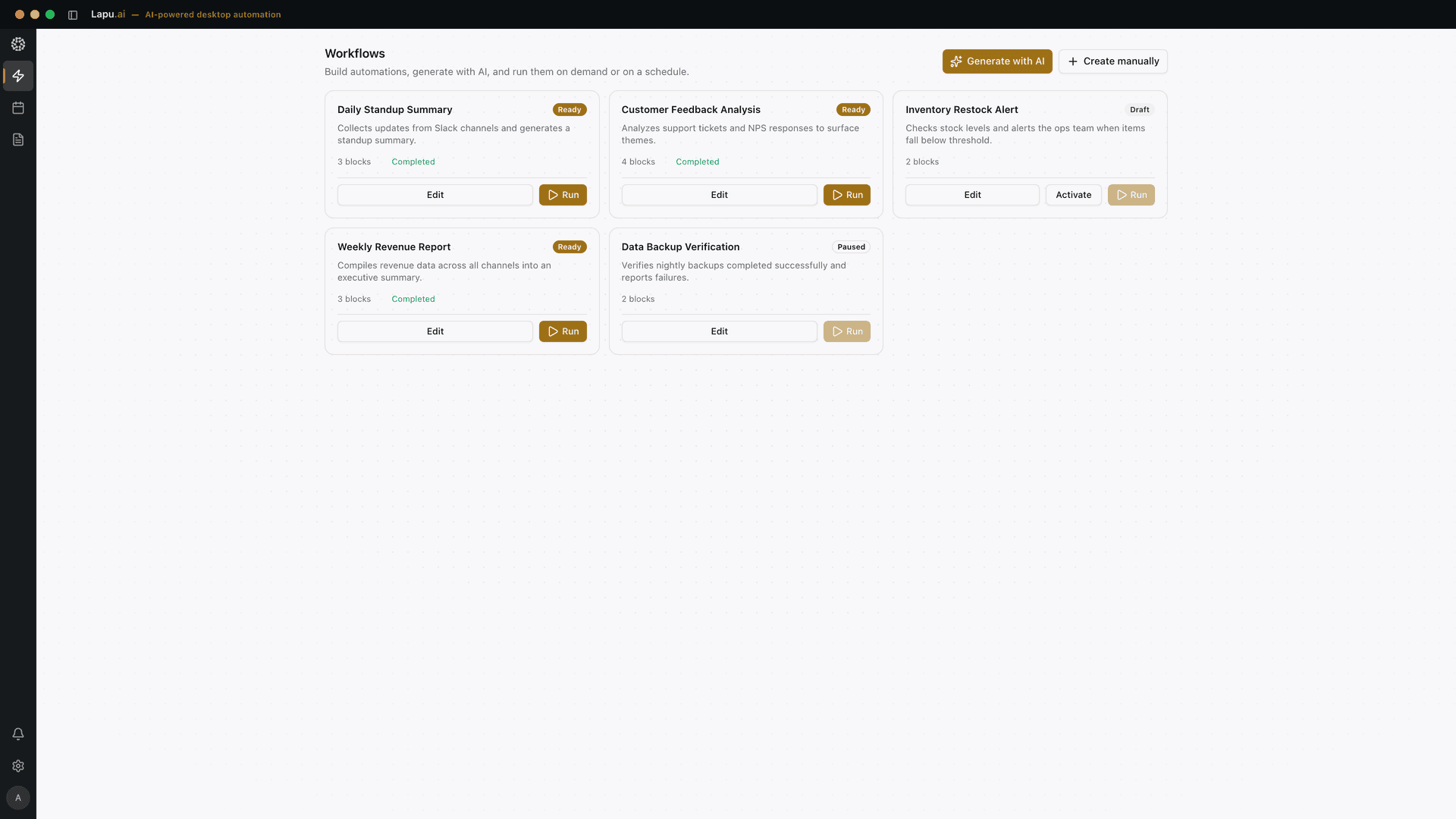
A desktop AI agent is the inverse: it is not optimized for the conversation, it is optimized for the execution. The conversation is a thin layer over a runtime that reads files, runs commands, automates other desktop apps through accessibility APIs, and logs each step.
A Mythos-class model in Claude Desktop is still a chat. The model is more capable. The surface is the same. Putting a Mythos-class model behind a desktop agent is what unlocks the capability on the desktop, because the agent has the runtime to act on what the model returns. The gap between "chat about my files" and "do this with my files" is not a model gap. It is a product gap.
For users who genuinely want to chat with Claude, Claude Desktop is the right place to be. For users who want a frontier model to do something on their computer — sort a folder, draft and send a batch of emails through Gmail, reconcile a spreadsheet against a PDF, scaffold a project across the terminal and editor — the chat surface alone does not get there.
How Lapu handles a stronger model without handing over the keys
Lapu was built on the assumption that the model would keep getting stronger. The product's invariants are therefore in the runtime, not the model:
- Frontier-model-agnostic. The agent uses whichever frontier model is best for a given task. When Mythos-class general access opens, Lapu adds it the way it has added every prior generation — as another option behind the same runtime. You do not bring API keys; routing is handled.
- Permissioned execution. The agent cannot read a file, run a command, or click a button in another app without a permission grant. Low-risk reads can be auto-approved per session. High-risk writes, deletes, and outbound network actions always require explicit confirmation. A more capable model does not change which actions are sensitive — see Lapu's permission model for the full breakdown.
- Replayable audit trail. Every action the agent takes is recorded — what it did, when, why, on what file or app — and retained for up to 90 days. A stronger model that picks better steps still leaves a complete, inspectable record of every step. Detail in our audit-trail explainer.
- Local-first context. Files stay on your machine. Relevant context is sent to the model provider to generate a response; the files themselves are not uploaded to a Lapu cloud. There is no Lapu cloud workspace.
In other words: the substrate that decides whether an AI on your desktop is safe to use does not move when the model upgrades. Permissions, isolation, and audit retention are the things that do not bend to model capability. They scale with the runtime.
That is why a Mythos-class model is good news for desktop agents specifically, and why it is comparatively neutral news for chat surfaces. A better planner is more value to a product that actually executes. If you want to see this end-to-end, download Lapu for macOS or Windows, or compare pricing tiers — the runtime is the same on every plan.
FAQ
- Is Claude Mythos 5 available in Lapu AI?
- Not yet. Anthropic announced Claude Mythos 5 on June 9, 2026 as a restricted release routed through Project Glasswing for a small group of cyberdefenders and infrastructure providers, with Claude Fable 5 as the public, safety-guarded version of the same underlying model. Lapu AI uses frontier models from multiple providers and will add any model that meaningfully improves task completion on the desktop — including Mythos-class models — once general access opens. The desktop runtime, permission gates, and audit trail do not change when the model does.
- What is the difference between Claude Mythos 5 and Claude Opus 4.8?
- Anthropic positions Mythos-class models as a tier above Opus in capability. The June 9 announcement describes Mythos 5 as state-of-the-art on most benchmarks of AI capability, with the strongest cybersecurity capabilities of any model Anthropic has tested. Fable 5 is the same underlying model with safeguards: when a user asks about high-risk domains such as biology, chemistry, or cybersecurity attack tradecraft, Fable 5 routes the response through Opus 4.8 instead. Anthropic reports this fallback fires on fewer than five percent of sessions on average.
- Does Claude Desktop run actions on my Mac or Windows machine?
- Claude Desktop is a chat surface. You can paste files into the conversation, but the application itself does not read your filesystem, run shell commands, or drive other desktop apps. A desktop AI agent like Lapu runs as a native application, reads files with permission, executes commands you approve, and keeps a full audit trail of what it did. A more capable model in the chat surface does not change that surface — it still does not act on your computer.
- Will a Mythos-class model make desktop agents safer or more dangerous?
- Both, on different axes. The model itself is more capable at planning multi-step tasks, which means fewer failed runs and tighter loops. It is also more capable at executing destructive sequences if you let it. The safety question on the desktop is not about the model — it is about the runtime around it. Permission gates that ask before deleting files, sandboxed processes that isolate the agent from the OS, and an audit trail that lets you replay every action are what keep a stronger model from doing more damage.
- How much does Claude Fable 5 cost compared to Mythos Preview?
- Anthropic priced Fable 5 and Mythos 5 at $10 per million input tokens and $50 per million output tokens — less than half the price of Mythos Preview, which costs Glasswing participants $25 per million input tokens and $125 per million output tokens. From June 9 through June 22, Fable 5 is included on Pro, Max, Team, and seat-based Enterprise plans at no extra cost, with credit-based pricing returning on June 23.
- Does a bigger model mean Lapu needs a new permission model?
- No. The permission tiers, audit retention, and process isolation in Lapu are designed around what an agent can do on the desktop — not around what any single model can reason about. Low-risk reads stay auto-approved, high-risk writes still require explicit confirmation, and every action is logged for up to 90 days. A Mythos-class model picks better steps, but it still has to ask before it touches your files.
Sources
- Claude Fable 5 and Claude Mythos 5 — Anthropic (2026-06-09) · accessed 2026-06-10
- Anthropic released Claude Fable 5, its most powerful model publicly — TechCrunch (2026-06-09) · accessed 2026-06-10
- Expanding Project Glasswing — Anthropic (2026-06-02) · accessed 2026-06-10
- Anthropic Launches Claude Fable 5, Its First Public Mythos-Class Model — MacRumors (2026-06-09) · accessed 2026-06-10