
Best Power Automate Desktop alternatives in 2026

Power Automate Desktop (PAD) ships free with Windows for attended, personal automation, and if you are a Microsoft 365 shop automating inside the Microsoft stack, it is usually the right default — deep Dataverse and Office integration, and much of it already paid for. People look for alternatives when the bill or the brittleness shows up: premium connectors and unattended bots sit behind paid licenses, cloud orchestration pulls flows off the desktop, and the recorder captures UI selectors that break when a legacy app's window or control tree shifts, forcing a developer to repair the flow. The five options below approach the problem differently — some code-first frameworks, some accessibility- or vision-driven agents that reason about the screen instead of replaying recorded selectors. See the Windows automation hub for how each fits.

Last verified: 2026-07-04

Download freeFree · macOS & Windows · No credit card
  • 1-click uninstall
  • Cancel anytime
  • Files never leave your computer
#1

Microsoft Power Automate Desktop

Power Automate Desktop is Microsoft's own RPA tool, and for the literal case this page describes — a Microsoft 365 shop automating inside the Microsoft stack — it is the honest default, not a compromise. It ships free with Windows 10 and 11 for attended desktop flows, records and replays UI steps across Windows apps, Excel, Outlook, and the browser, and integrates natively with SharePoint, Dataverse, and the wider Power Platform, so a flow can hand off to a cloud flow you already license. If your data and your other automations already live in M365, adding a second tool rarely beats the platform that is already there and already paid for. Where it costs you is outside that ecosystem: premium connectors and managed attended flows need a Premium license, unattended bots are charged per bot, and because the recorder captures UI selectors, a legacy app's UI change can break a flow and pull in a developer to repair it. It is the right pick when you are in the stack; the alternatives below matter when you are outside it or hitting its gates.

Pros

  • Free for attended desktop flows on Windows 10 and 11 — no license for personal, in-session automation
  • Deepest native integration with M365, SharePoint, Dataverse, and the Power Platform
  • Mature record-and-replay with a large action library and Microsoft support behind it
  • Cleanest hand-off to cloud orchestration you may already pay for inside Microsoft 365

Cons

  • Premium connectors and managed attended flows require a paid Premium license
  • Unattended RPA is charged per bot, which escalates as robot counts grow
  • Recorder relies on UI selectors that break when a legacy app's window or control tree changes

Best for: Microsoft 365 shops automating inside the Microsoft stack, where PAD is bundled and integrates natively

Learn more →
#2

Lapu AI

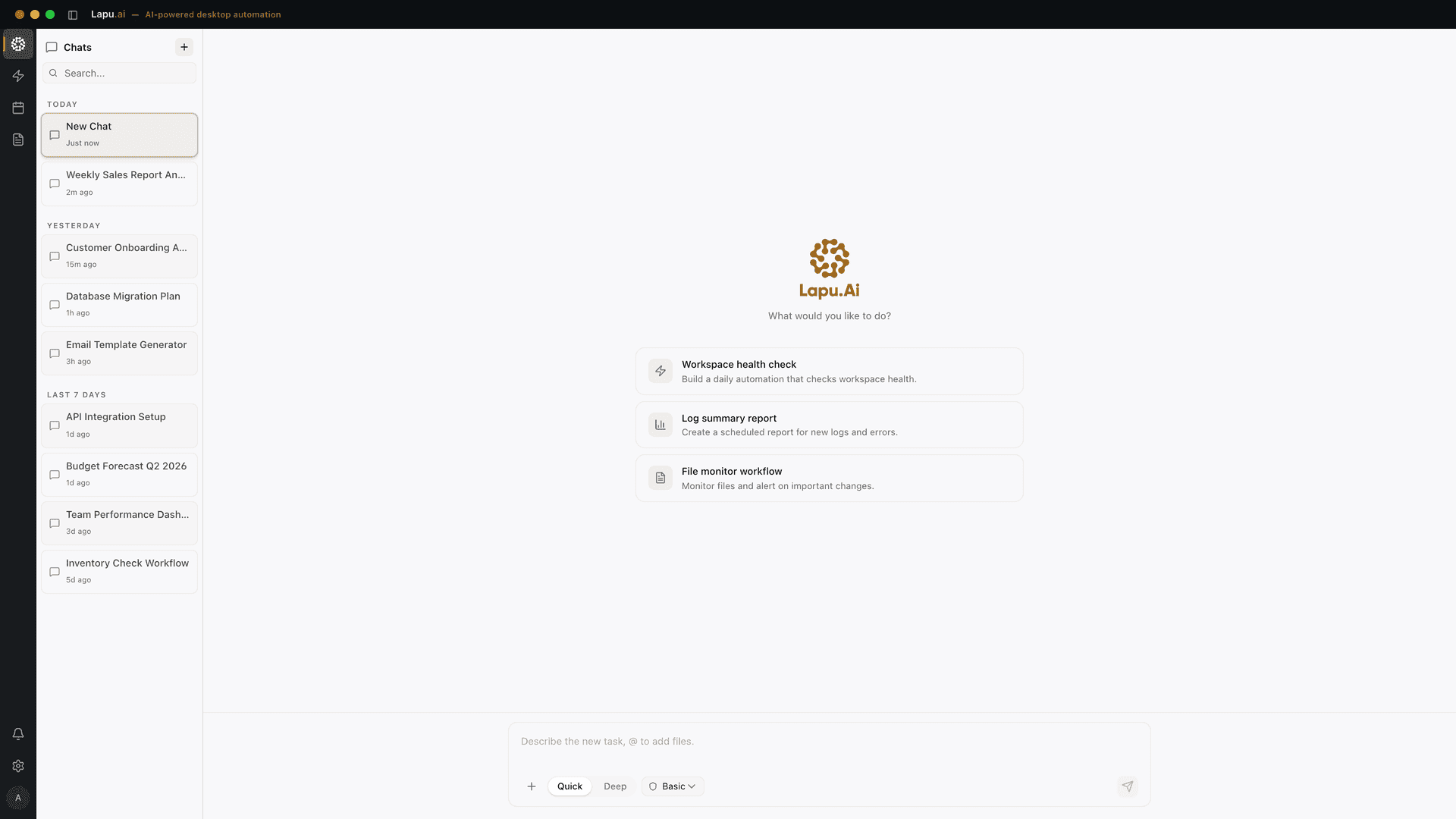
Lapu AI is a desktop AI agent for macOS and Windows that drives apps through the operating-system accessibility tree rather than replaying recorded selectors — it reasons about what is on screen the way you read it, so it works on legacy Windows line-of-business apps that expose no API, and it tolerates the everyday drift (a reordered field, a re-skinned screen) that breaks PAD's recorder and turns into a developer ticket. Three technical properties separate it from PAD: no per-bot license — it runs on one machine at a per-user price with no premium-connector gate and no API key to wire up, because frontier models are built in and routed automatically; local execution with an audit trail — files stay on your machine, only the minimal task context goes to the model, and every sensitive action prompts for approval and lands in a 90-day local action log; and it adapts when the UI changes instead of demanding a re-record. Because you describe the task in plain language, it also fits teams with no RPA developer on staff — a genuine audience-fit note, not the core of the pitch. The honest trade against PAD is scope: Lapu AI is not an enterprise orchestration platform with unattended bot fleets or a central console, and PAD's native M365 and Dataverse integration is deeper for workflows that live entirely inside Microsoft's cloud. See automating a legacy Windows app without an API for the approach, and how the permission model works.

Pros

  • Accessibility-tree reasoning, not recorded selectors — drives legacy no-API apps and survives UI changes
  • No per-bot license and no premium-connector gate: per-user pricing with built-in frontier models, no API key
  • Local execution plus a 90-day local audit trail and a permission prompt before each sensitive action
  • Plain-language tasking, so a team with no RPA developer can run it — download, sign in, free tier with no card

Cons

  • Not an enterprise RPA platform — no unattended bot fleets or central orchestration console
  • No Linux build; macOS 12+ and Windows 10+ only
  • Newer product with a shorter enterprise track record than Microsoft or UiPath
  • PAD's native M365 and Dataverse integration is deeper for fully in-stack workflows

Best for: Automating a legacy Windows app with no API locally, without a per-bot license, when the UI keeps changing

Learn more →
#3

AskUI

AskUI is a vision-based automation platform that sees the screen like a person, so it drives Citrix desktops, mainframes, SAP, and legacy ERP where selectors and source access do not exist — precisely the environments PAD's recorder struggles with. It ships as an open-source CLI and SDK on GitHub, runs on Windows, macOS, and Linux, and supports AskUI's own vision models, Anthropic, Google, or your own key, with cloud, self-hosted, or fully on-premise deployment. It is a developer framework rather than an app: engineers author and maintain automations in code, which is a real cost for teams without an automation engineer but a real advantage for those that want version control and CI. Where PAD leans on Microsoft's UI-automation stack, AskUI leans on vision, so it is more resilient when a legacy app's control tree is opaque.

Pros

  • Vision-based, so it automates Citrix, mainframe, and legacy ERP where selectors fail
  • Open-source SDK and CLI — version-controlled, testable, CI-friendly automations
  • Flexible model backend including on-premise inference for data residency
  • Cross-platform: Windows, macOS, Linux, plus mobile and HMI targets

Cons

  • A developer framework — assumes an engineer to write and maintain flows
  • Vision inference and enterprise deployment are custom-priced, not a public per-seat number
  • Heavier setup than a turnkey app before the first useful automation

Best for: Engineering teams automating Citrix, mainframe, or legacy ERP with a code-first framework

Learn more →
#4

Robocorp (Sema4.ai)

Robocorp is an open-source, Python-first automation stack now part of Sema4.ai, which acquired it in 2024 and folded it into a broader agent platform. Its philosophy is automation-as-code: instead of a visual recorder, you build robots in Python with the open-source RPA Framework, get real version control, tests, and libraries, and run them in Robocorp's Control Room for orchestration and scheduling. That makes it a strong PAD alternative for teams that already write Python and want their automations to behave like software rather than a recorded macro. The cost is the obvious one — it is aimed at developers, so a non-technical operator will not build a robot without help, and the platform's direction now points toward Sema4.ai's enterprise agent strategy.

Pros

  • Open-source, Python-first — automations are real, testable, version-controlled code
  • RPA Framework provides mature libraries for browsers, desktop, and documents
  • Control Room handles orchestration, scheduling, and cloud or on-prem workers
  • No brittle recorder — logic is explicit in code rather than captured selectors

Cons

  • Requires Python proficiency — not for non-technical users
  • Product direction now tied to Sema4.ai's broader agent platform strategy
  • More assembly than a turnkey desktop app; you own the engineering

Best for: Python-fluent teams that want automation-as-code with real version control and orchestration

Learn more →
#5

AutoHotkey

AutoHotkey (AHK) is a free, open-source Windows scripting language — GPLv2, no paid tiers, no feature gates — built for hotkeys, text expansion, and macro automation. It is small, fast, and runs out of the box, and with enough scripting it can fill forms, click through windows, drive the Windows API, and automate multi-step workflows across programs. For a specific, repeatable Windows task it is often the cheapest and most direct tool available, and there is a large community with scripts for almost everything. The honest limits: it is Windows-only, it is a scripting language rather than an AI agent, so you write and debug logic by hand, and complex GUI automation of modern apps is possible but fiddly compared with purpose-built RPA or a vision agent.

Pros

  • Completely free and open-source (GPLv2) with no premium gate of any kind
  • Small, fast, and immediate — excellent for hotkeys, text expansion, and fixed macros
  • Huge community library of existing scripts to adapt
  • Deep access to the Windows API for low-level control

Cons

  • You write and maintain scripts by hand — no AI, no plain-language tasking
  • Windows-only; no macOS or Linux
  • Brittle on complex or changing modern GUIs; not built for enterprise orchestration

Best for: Technical Windows users automating fixed, repeatable tasks for free

Learn more →

How to choose

Stay on Power Automate Desktop if you are a Microsoft 365 shop automating inside the Microsoft stack — PAD is bundled with Windows for attended use, integrates natively with M365 and Dataverse, and adds cloud orchestration you may already pay for; for that buyer it is the right default, premium gates and all, and the alternatives here matter most when you step outside that ecosystem or hit its paid gates. Choose Lapu AI when you need to automate a legacy Windows app with no API locally, without a per-bot license, and the app's UI keeps changing — it drives through the accessibility tree and reasons about the screen, so there is no recorded selector to repair. Choose AskUI if the target is Citrix, mainframe, or legacy ERP and you have engineers who want a code-first vision framework. Choose Robocorp (Sema4.ai) if your team writes Python and wants automation-as-code with real orchestration. Choose AutoHotkey if you are technical, on Windows, and want a free tool for a fixed, repeatable task.

Where Lapu AI fits

The technical wedge against Power Automate Desktop is how the two read a screen. PAD's recorder captures UI selectors, which is exactly what breaks when a legacy app's window or control tree shifts — repairing the flow usually pulls in a developer, and premium connectors and unattended runs pull you into paid licenses. Lapu AI drives the app through the operating-system accessibility tree and reasons about what is on screen, so it tolerates the everyday drift that breaks a recorder, needs no premium-connector gate and no API key (frontier models are built in), runs on one machine at a per-user price with no per-bot license, and keeps execution local — files stay put, only minimal task context goes to the model, and every action is permission-gated and written to a 90-day local audit log. Because tasking is plain-language, a team with no RPA developer can also run it — an audience fit, not the core of the difference. Honest limits: Lapu AI is not an enterprise orchestration platform, so it has no unattended bot fleets, no central Control Room, and no Linux build, and PAD's native M365 and Dataverse integration is deeper for workflows that live entirely inside Microsoft's cloud. If you are all-in on Microsoft and automating within that stack, PAD is the better default. Lapu AI is the pick when you need to automate a legacy Windows app with no API, locally, without a per-bot license, and without a brittle recorder to maintain.

FAQ

Is Power Automate Desktop free?
For attended, personal automation, yes — Power Automate Desktop is included free with Windows 10 and Windows 11, and you can build and run flows manually. The paid lines appear when you go further: premium connectors (Salesforce, SAP, custom) and attended desktop flows in a managed environment need a Power Automate Premium license, and unattended RPA — bots that run without a person present — is a separate per-bot charge. That free-then-paid ladder is a common reason people look for alternatives once they outgrow attended, in-ecosystem use.
What is the best Power Automate Desktop alternative for a non-technical user?
Lapu AI is the closest fit, and the reason is technical before it is about audience. PAD's visual recorder relies on UI selectors that break when a legacy app's window or control tree changes, and repairing them usually needs a developer. Lapu AI instead drives the app through the operating-system accessibility tree and reasons about the screen, so there is no selector to maintain, no premium-connector gate, and no API key — and it tolerates the everyday UI drift that breaks a recorder. Because you task it in plain language, it also happens not to need an RPA developer, which is what makes it usable by a non-technical operator. AskUI and Robocorp are developer-oriented and AutoHotkey is a scripting language, so none of them close that gap the same way.
Why do people move off Power Automate Desktop?
Three recurring reasons. Cost: premium connectors and unattended bots sit behind paid licenses, so the free attended tier stops being enough. Cloud pull: the platform steers flows toward cloud orchestration and Dataverse, which is fine inside Microsoft 365 but not if you want everything local. And brittleness: the recorder captures UI selectors that fail when an application's window or control tree changes, so a legacy-app flow can break on an update and need a developer to repair. Alternatives that avoid recorded selectors — vision or accessibility-driven agents — sidestep that last problem.
When is Power Automate Desktop still the right choice?
When you are a Microsoft shop already standardized on Microsoft 365. PAD is bundled with Windows for attended use, integrates natively with Office apps, SharePoint, and Dataverse, and connects to the cloud orchestration many organizations already license. If your automations live inside the Microsoft ecosystem and you want them to stay there, PAD's integration depth and the fact that it is already paid for often make it the pragmatic pick over adding another tool. The alternatives here matter most when you are outside that ecosystem or hitting its premium gates.
Which alternative handles Citrix and legacy ERP best?
AskUI. Its vision agents automate Citrix sessions, mainframes, SAP, and AS/400 by recognizing what is on screen, with nothing installed on the remote host — which is exactly where PAD's selector-based recorder struggles, because a streamed Citrix app arrives as an image with no control tree to target. AskUI is a developer framework, so it assumes engineers, but for hard legacy and virtualized environments it is the strongest fit on this list. You can see the head-to-head on the Lapu AI vs AskUI comparison.
Is there a free and open-source Power Automate Desktop alternative?
Two here. AutoHotkey is fully free and open-source under GPLv2 with no paid tiers — a Windows scripting language ideal for fixed, repeatable tasks if you are comfortable writing scripts. Robocorp's RPA Framework is open-source and Python-first, giving you automation-as-code with real version control, though its orchestration platform and the broader Sema4.ai product around it move toward paid enterprise tiers. Lapu AI is not open-source; it trades that for a turnkey app with built-in models and per-action permissioning that a non-technical user can run on day one.
How does Lapu AI's pricing compare to Power Automate?
Lapu AI has flat published plans: Free with no card, Premium $20/mo, Pro $60/mo, and Max $100/mo, with custom Teams and Enterprise pricing, and no premium-connector or per-bot gate. Power Automate is free for attended desktop use on Windows but adds a Premium license for premium connectors and managed attended flows, plus separate per-bot pricing for unattended RPA. The comparison depends on your usage: PAD can be effectively free inside M365 for simple attended work, while Lapu AI's flat plans avoid the connector-by-connector and bot-by-bot escalation that PAD and enterprise RPA tools introduce as you scale.
Can Lapu AI run unattended like Power Automate bots?
Not in the enterprise sense. Lapu AI is a desktop agent that works in your session with per-action approval and can schedule saved workflows, but it is not an unattended bot platform with a central orchestration console managing fleets of robots on remote machines. If unattended, headless RPA at scale is the requirement, Power Automate's per-bot plans or UiPath's Orchestrator are built for that. Lapu AI is built for a person automating their own desktop work with a permission prompt and a local audit trail on each step.

Sources

  1. Power Automate Pricing | Microsoft Power Platform (Premium $15/user, Process $150/bot, Hosted Process $215/bot)
  2. AskUI Vision Agent SDK (vision-first, Windows/macOS/Linux/Android, choose Anthropic/Google/AskUI models) | GitHub
  3. What's the Best Automation Software for Windows? (Citrix VDI, legacy enterprise apps where selectors fail) | AskUI
  4. Sema4.ai Raises $30.5 Million and Acquires Robocorp (2024) | PR Newswire
  5. AutoHotkey - Wikipedia (GPLv2 license, Windows-only)
  6. The Real Cost of RPA: recorded selectors break on UI changes, driving maintenance cost | Kognitos

Related

Try Lapu AI free

Desktop AI agent for macOS and Windows. No credit card required.

  • 1-click uninstall
  • Cancel anytime
  • Files never leave your computer
Lapu AI agent chat with conversation, tool calls, and execution log

Automate the work between you and outcomes

Lapu AI handles the repetitive work between you and outcomes. One desktop agent, zero tab-switching. Available now on macOS and Windows.

  • 1-click uninstall
  • Cancel anytime
  • Files never leave your computer

Free to start. Cancel in 1 click. Files stay on your machine.

Lapu AI agent chat with conversation, tool calls, and execution log