On device AI runs the model on your own computer instead of a remote server. In 2026 that is no longer an experiment — a 3-billion-parameter model fits in a couple of gigabytes after 2-bit quantization, runs at a usable token rate on Apple Silicon and modern AI PCs, and ships on every new Mac. This post explains what on device AI actually means in 2026, where it already works, where the cloud still wins, and how a desktop AI agent puts the two together.
What on device AI actually means in 2026
On device AI means the model that generates the answer runs on hardware you own. There is no API call to a vendor, no prompt sitting in someone else's logs, and no network round trip on the critical path. The forward pass happens on your CPU, GPU, or neural processing unit (NPU); the only thing that crosses the network is whatever you choose to upload separately.
That definition sounds obvious, but it is worth being strict about it because the marketing language has blurred. A "private AI" product can mean a model that runs on your laptop, a model that runs in a tenant-isolated cloud, or a hosted model that promises not to retain your data. They are not the same risk profile. On device is the narrowest and strongest version: the inference happens on the device, full stop.
Three properties follow from that:
- Nothing is uploaded by architecture. Not by policy, by architecture. There is no network call to attack, log, or breach.
- Latency is dominated by your hardware, not the internet. First-token latency on a quantized 3B model on Apple Silicon is in the tens of milliseconds, not the seconds of a cold cloud call.
- The bill is your electricity, not a per-token charge. That changes how teams use the model — you can afford to call it for the small stuff.
The trade is quality. A 3B model running on your laptop will not match Claude or GPT on hard reasoning. For the long tail of small jobs that fill a workday, it does not have to.
What changed since the 2024 on-device wave
The 2024 conversation was dominated by demos: phones running stripped-down models, a few extensions doing on-device autocomplete, and a lot of slideware about "AI PCs." 2026 is when the engineering caught up to the promise.
Three concrete shifts:
Architectures designed for the edge. Models like Llama 3.2 3B, Gemma 3, Phi-4 mini, and Qwen2.5 1.5B are not compressed cloud models. They are architectures designed from the start for memory-bandwidth-limited hardware. Mobile NPUs see 50–90 GB/s of memory bandwidth where data-center GPUs see 2–3 TB/s; the design discipline shifted to "minimize how many bytes of weights have to move per generated token" (Edge AI and Vision Alliance, 2026).
| Hardware class | Memory bandwidth |
|---|---|
| Consumer / mobile NPU | 50–90 GB/s |
| Data-center GPU | 2–3 TB/s |
Aggressive quantization that actually preserves quality. Apple's on-device foundation model is a ~3-billion-parameter network compressed to 2 bits per weight using Quantization-Aware-Training with learnable weight clipping, plus 4-bit embeddings and 8-bit KV cache. The interleaved attention architecture and a 5:3 KV-cache split reduce memory use by 37.5% with no quality regression on Apple's own benchmarks (Apple Machine Learning Research, 2025). Two years ago that compression ratio shipped only as a research curiosity. Today it ships on every new Mac.
Frameworks that hide the hardware. Apple's Foundation Models framework lets a developer call the on-device model in a few lines of Swift with no API key, no model download, and no quantization tuning. LM Studio and Ollama do the cross-platform version of the same thing on Windows and Linux. On-device AI stopped being a bring-your-own-CUDA project.
The net result: in 2026 a competent desktop AI app can assume a small local model is available, the way it assumes a font rendering engine or a sandboxed filesystem.
Where on device AI already wins
The honest list of jobs where a 1B–3B on-device model is the right tool:
- Classification and routing. "Is this an invoice, a contract, or a meeting note?" "Which folder does this screenshot belong in?" "Should this prompt be answered locally or sent to a frontier model?" Cheap, fast, no upload, no per-token bill.
- Summarization of one document. Email thread, meeting transcript, single PDF — a 3B model handles these competently with the right prompt.
- Formatting and extraction. Pulling structured fields out of plain text, converting Markdown to JSON, drafting a commit message from a diff.
- Voice transcription and TTS. Whisper-class models are on-device on Apple Silicon and modern x86 NPUs.
- Autocomplete and ambient features. Notification summaries, writing suggestions, smart replies — the kind of work that justifies a model running constantly but cannot justify a constant cloud bill.
- Anything offline. Air travel, secure rooms, customer site with no Wi-Fi. The model that runs without a network is the only one that exists in those rooms.
That list covers most of what a desktop assistant does on a normal day. It is also exactly the work that has no business being uploaded to a third party.
Where the cloud still wins
Equally honest list of where on-device AI in 2026 falls short:
- Frontier reasoning. Multi-step planning, hard math, anything that benefits from very large parameter counts. The gap between a 3B local model and Claude or GPT on a 50-step coding task is still wide.
- Very long context. A 200,000-token transcript or a whole-repo question still needs the parallel attention throughput of a data-center GPU.
- Heavy multimodal work. Image generation, video understanding, audio modeling — the leading open models exist, but running them at usable speed needs a workstation, not a laptop.
- Latest knowledge. A model frozen on your disk does not know what happened yesterday. Web-connected models can.
The pattern is clear: the harder and longer the reasoning, the more the cloud wins. The smaller and more repetitive the task, the more on-device wins. The trick is having both available and knowing which to call.
The hybrid pattern most 2026 desktop products use
Production desktop AI in 2026 almost always looks like this:
- The app holds your files, your history, and your permissions locally. None of that is uploaded.
- A small on-device model handles routing — deciding what kind of task this is, which tool or model should answer.
- Cheap and private work (classification, summarization of one item, formatting) is done locally.
- The hard prompts — multi-step reasoning, very long context — are sent to a frontier hosted model with only the minimum context the task needs.
- Everything the agent does is logged in a local audit trail.
This is the same pattern Apple uses with Apple Intelligence: on-device first, Private Cloud Compute for harder work, the file system as the home of your data. It is also the pattern MIT Technology Review's recent piece on AI and data sovereignty describes as the trajectory for enterprises that need to "establish genuine control over models and data estates rather than depending on cloud-based large language models" (MIT Technology Review, 2026).
The architectural punchline: in 2026 you do not pick "local or cloud." You pick a product that knows which is which.
What this means for a desktop AI agent
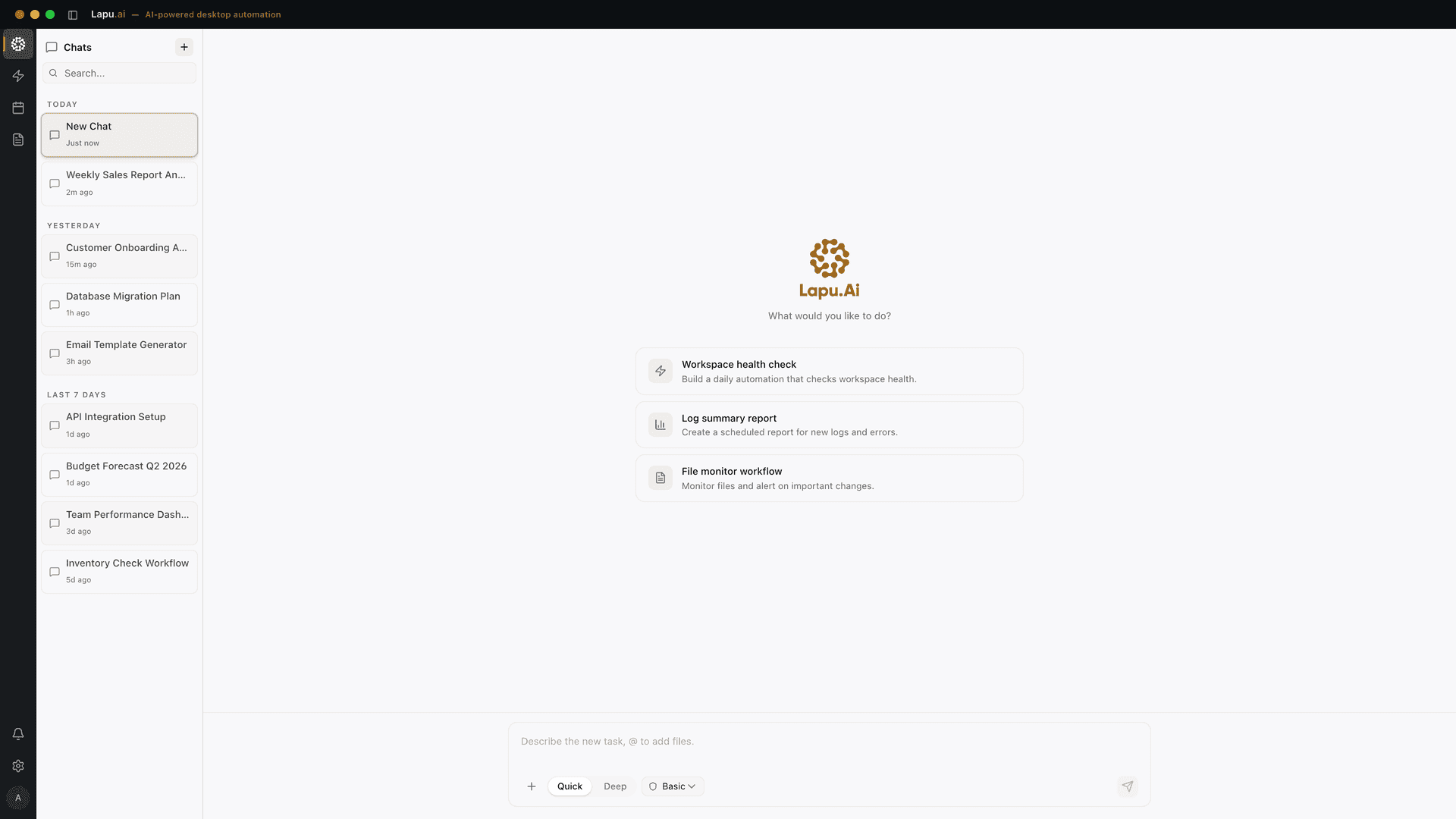
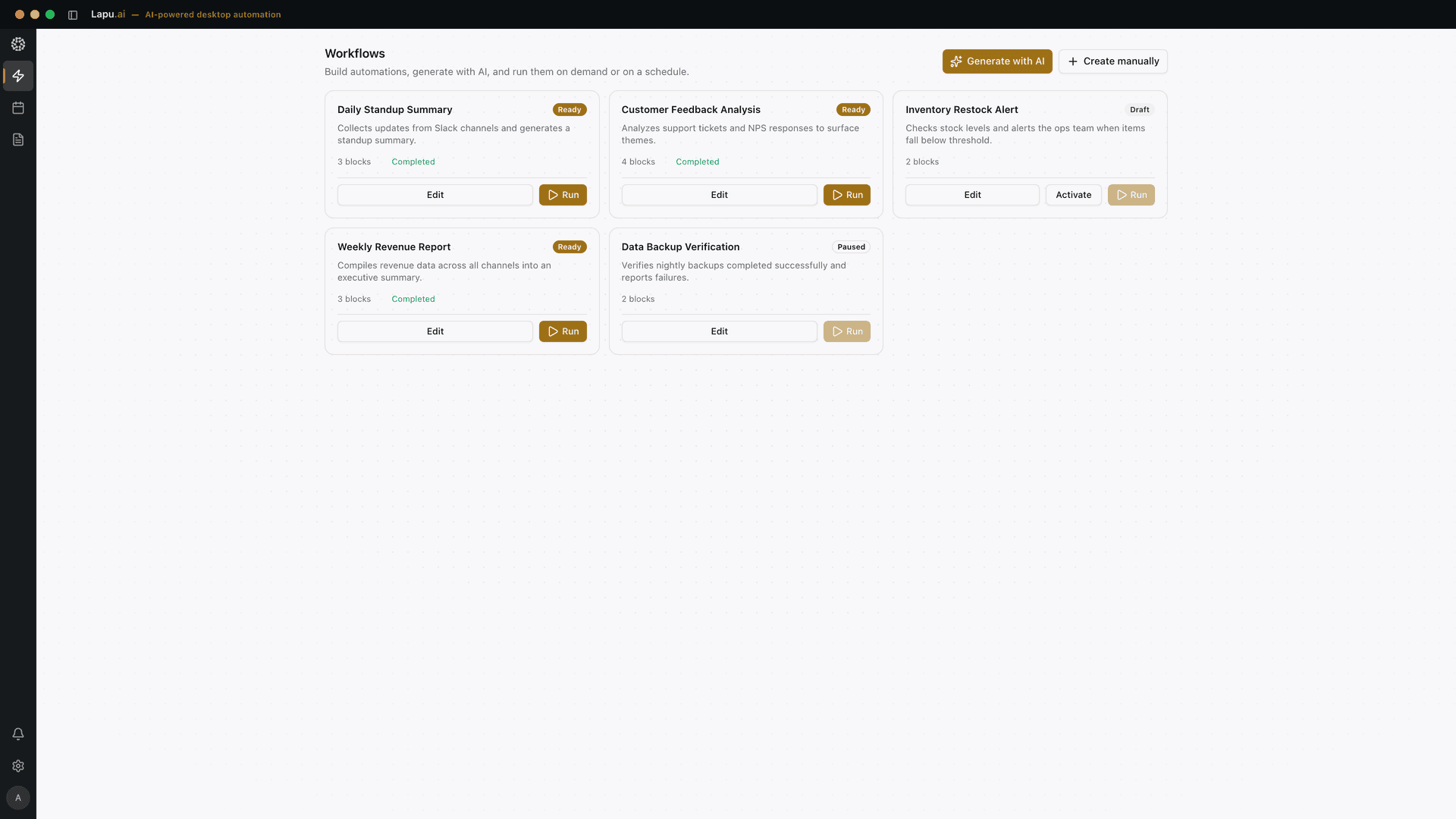
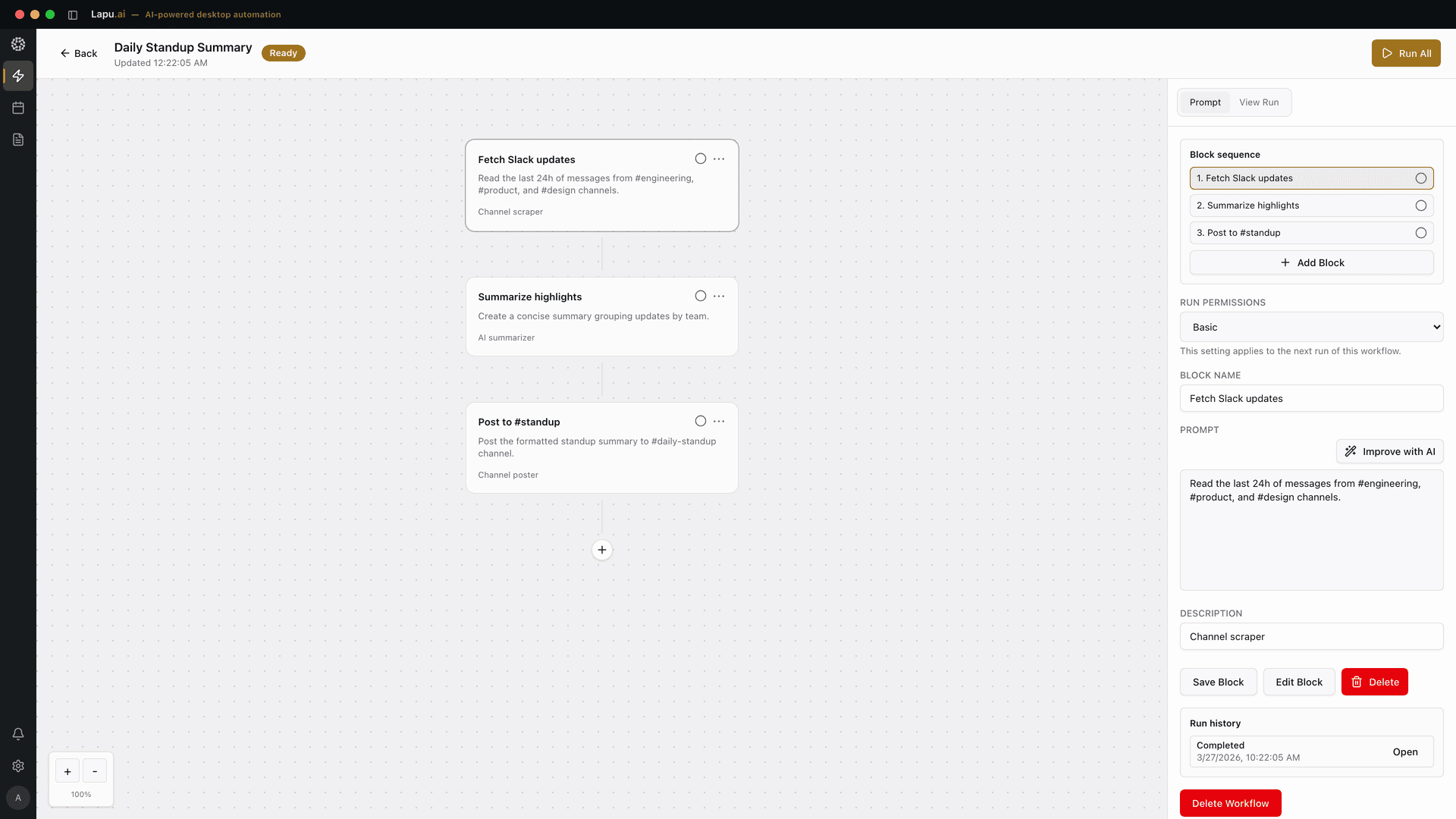
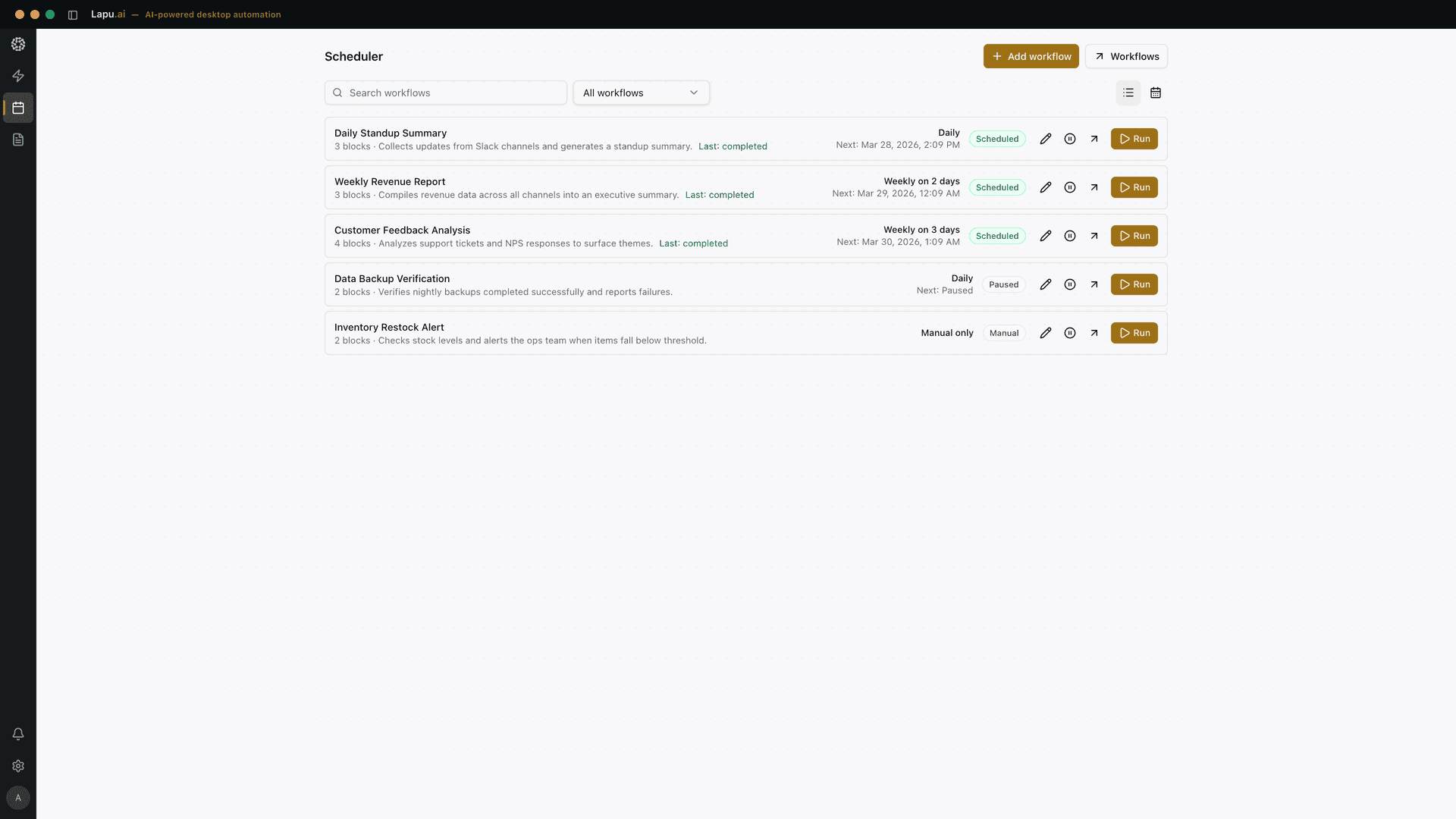
A desktop AI agent is the natural home for this hybrid model, because it already has what cloud agents do not: direct access to your files, your applications, and your operating system. Adding on-device inference does not change the agent's job. It changes which model the agent calls for each step. For the runtime side of that story — what the macOS and Windows app actually does at the platform layer — see the desktop hub.
For Lapu AI the practical translation is:
- Your files stay on your macOS or Windows disk. Lapu does not upload them.
- Lapu can be configured to call an on-device model (via the Apple Foundation Models framework, LM Studio, or Ollama) for routing, classification, and summarization of a single item.
- For the steps that need frontier reasoning — a multi-file refactor, a 50-page contract analysis — Lapu calls the hosted model you have configured, sending only the prompt and the minimum context.
- The audit trail records which model was called for which step, what context was sent, and what came back, so the local-first claim is verifiable rather than promised.
That is the architecture that survives the buyer's question "but where does my data actually go." On a local-first AI desktop agent, the answer is "your files do not move; only the minimum text the model needed is what crossed the network, and the log shows you exactly what that was."
How to pick an on-device model for real work
Three honest decision criteria, in order:
Memory budget first. A quantized 3B model needs about 2 GB of RAM at 2-bit weights, 4 GB at 4-bit, 6 GB at 8-bit. A 7B model roughly doubles each tier. If you have 16 GB total system memory and a heavy browser, plan on a 3B model at 4-bit being your ceiling without thrashing.
Task fit second. For routing and formatting, almost any 1B–3B instruction-tuned model will do. For summarization that has to be good, Gemma 3 4B and Llama 3.2 3B are the safer choices in mid-2026. For coding-shaped work, Qwen2.5-Coder variants are competitive with much larger general models on the specific tasks they were trained on.
Runner third. On Apple Silicon, use the system Foundation Models framework when you can — it is free, signed, and tuned for the chip. Anywhere else, LM Studio and Ollama are the practical defaults. They expose an OpenAI-compatible HTTP endpoint at localhost, which means any agent that supports the OpenAI API can be pointed at a local model without code changes.
Then test on your real data. The benchmark scores published with a model and the behaviour you see on your own prompts can diverge sharply. The 30-minute test on real documents is worth more than any leaderboard. For workflows that touch sensitive files — invoices, contracts, source code — pair the test with an audit trail so you can actually see what was sent and what stayed put. If you want to skip the manual setup and try the hybrid pattern end-to-end, download Lapu AI and point it at a folder.
FAQ
- What does 'on device AI' actually mean?
- On device AI means the model that produces the answer runs on hardware you own — your laptop, phone, or desktop — instead of a remote server. The full forward pass, including any tokenization, attention, and decoding, happens on your CPU, GPU, or NPU. Your prompt and any context you give the model do not leave the device, because there is no network call to make. The shorthand is useful but slightly fuzzy in practice: a 'local-first' product can still be on-device for some operations and call a cloud model for others. The strict definition is 'no network round trip for inference.'
- Is on-device AI the same as local-first AI?
- Closely related, not identical. On-device AI is about where the model runs. Local-first AI is about where your data lives and how the application is architected — your files, history, and configuration stay on your machine, and the network is optional rather than mandatory. A local-first desktop agent can call a cloud model and still be local-first, as long as your raw files do not get uploaded. A pure on-device app runs everything locally including the model. Most serious 2026 products are local-first with optional on-device inference, not strictly one or the other.
- How big a model can I actually run on a laptop in 2026?
- On a 16 GB Apple Silicon MacBook or a comparable AI PC, a quantized 3B model fits comfortably in memory and runs at roughly 20 to 60 tokens per second depending on quantization, context length, and what else is open. With 32 GB of unified memory you can fit a quantized 7B to 14B model with usable speed. The binding constraint is memory bandwidth, not raw compute — generating each token requires streaming the full model weights through memory, and consumer hardware offers 50–90 GB/s versus a data-center GPU's 2–3 TB/s ([Edge AI and Vision Alliance, 2026](https://www.edge-ai-vision.com/2026/01/on-device-llms-in-2026-what-changed-what-matters-whats-next/)).
- Will on-device AI replace frontier cloud models?
- Not for the hardest work. As of mid-2026 the gap on long-context reasoning, multi-step coding, and the more difficult multimodal tasks is still real — a frontier hosted model wins those by a wide margin. What on-device AI has done is take the long tail off the cloud's plate: classification, formatting, summarization, autocomplete, voice transcription, ambient features, and routing. That is most of what a desktop assistant does on any given day. The 2026 architecture for serious desktop work is not on-device vs cloud; it is a local model handling the routine and a frontier model called only when the prompt actually needs it.
- Does on-device AI mean my data is safe?
- Safer than uploading it, yes. Private from your own software, no. On-device inference removes the cloud-provider risk — your prompt does not appear in someone else's logs, retention policies, or training pipeline. It does not remove the local-software risk: any app on your machine can still read whatever the OS lets it read, and a desktop agent that touches your files needs the same permission discipline a human contractor would. The serious questions to ask any on-device tool are which folders it can read, what it can execute, and whether it logs what it did. Those questions are independent of whether the model itself runs locally.
- Why do desktop AI agents care about on-device AI specifically?
- A desktop AI agent already has the files, the apps, and the audit trail on the machine. Adding on-device inference closes the last loop — the model that decides what to do next can also live on the device, so a useful task can run end-to-end with the network off. In practice few teams run everything locally. The realistic pattern is a small on-device model for routing and the easy steps, a frontier cloud model for the hard reasoning, and the agent (with your files and your permission log) staying local in either case. That is the architecture Lapu AI is built on.
- What is the simplest way to try on-device AI today?
- On a recent Apple Silicon Mac, the foundation model that ships with macOS is already on your disk; tools like apfel and any app built on the Foundation Models framework can call it without an API key. On Windows and Linux, LM Studio and Ollama are the standard one-click runners — install, pull a 3B model like Llama 3.2 3B or Gemma 3 4B, and you have a local endpoint that any app can hit at localhost. A desktop AI agent like Lapu AI can be pointed at that endpoint for the on-device step of a hybrid workflow.
Sources
- Updates to Apple's On-Device and Server Foundation Language Models — Apple Machine Learning Research (2025-06-09) · accessed 2026-06-02
- On-Device LLMs in 2026: What Changed, What Matters, What's Next — Vikas Chandra and Raghuraman Krishnamoorthi (Edge AI and Vision Alliance) (2026-01-28) · accessed 2026-06-02
- Establishing AI and data sovereignty in the age of autonomous systems — MIT Technology Review Insights (2026-05-14) · accessed 2026-06-02