
Lapu AI for Researchers
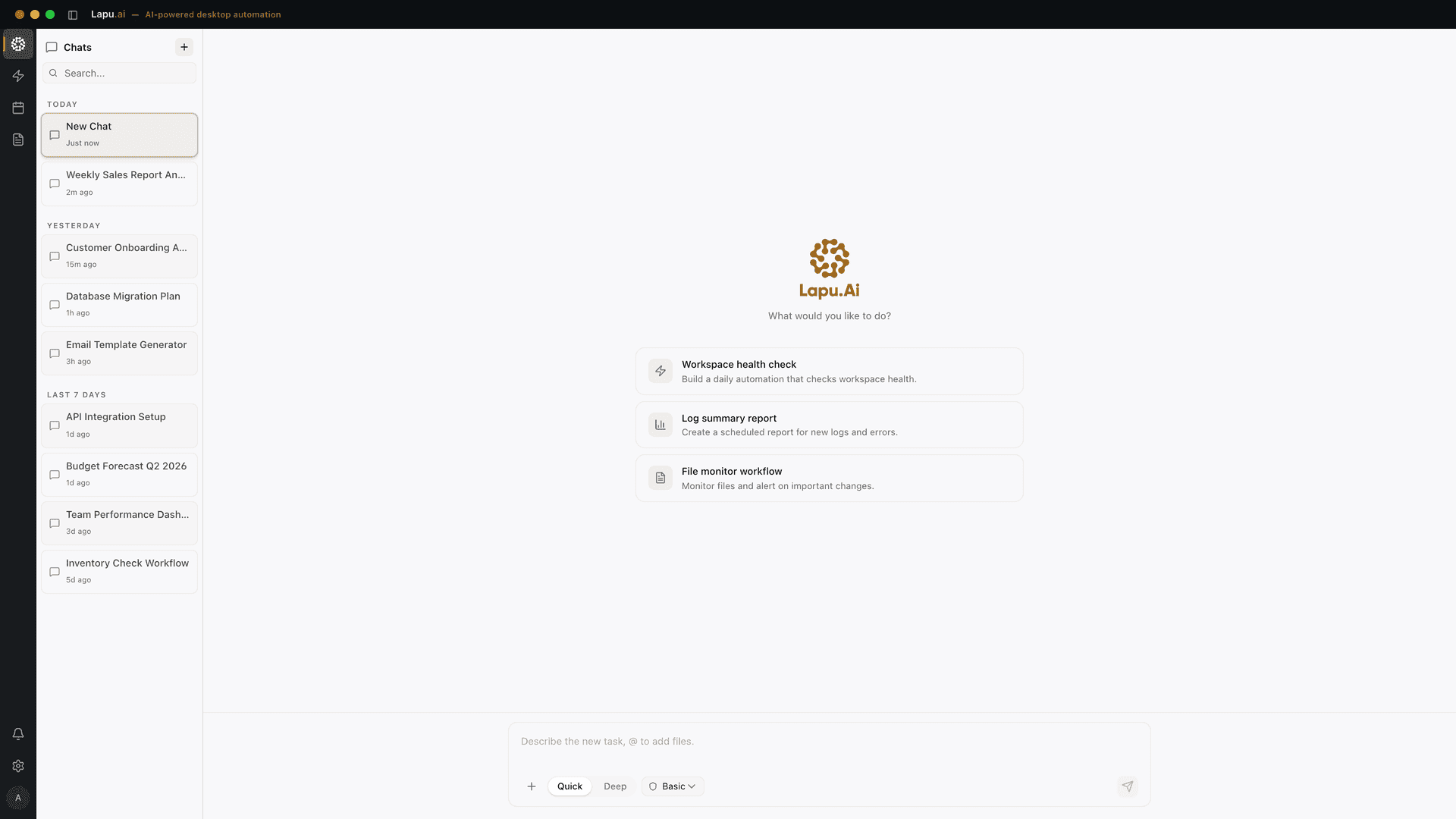
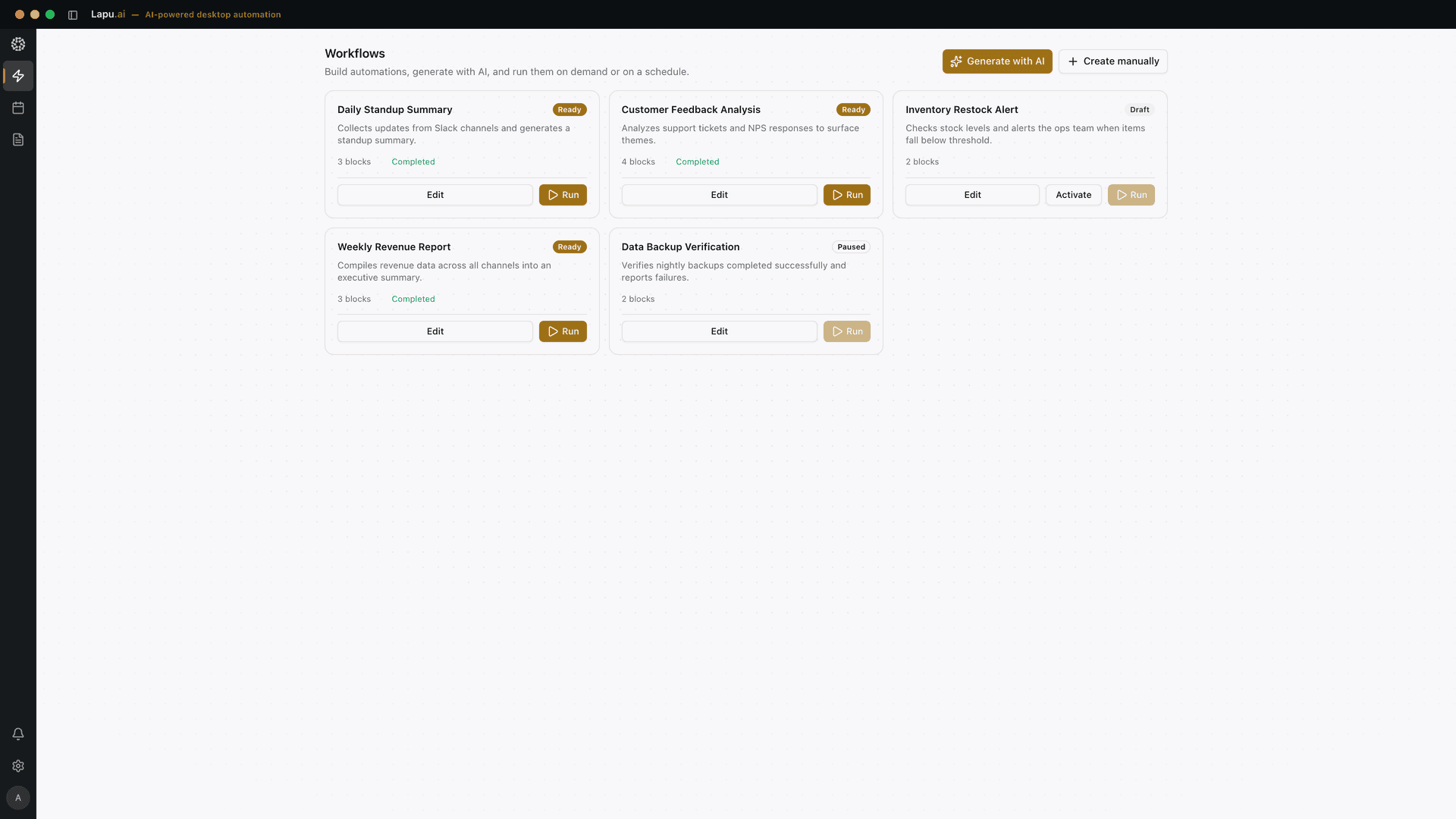
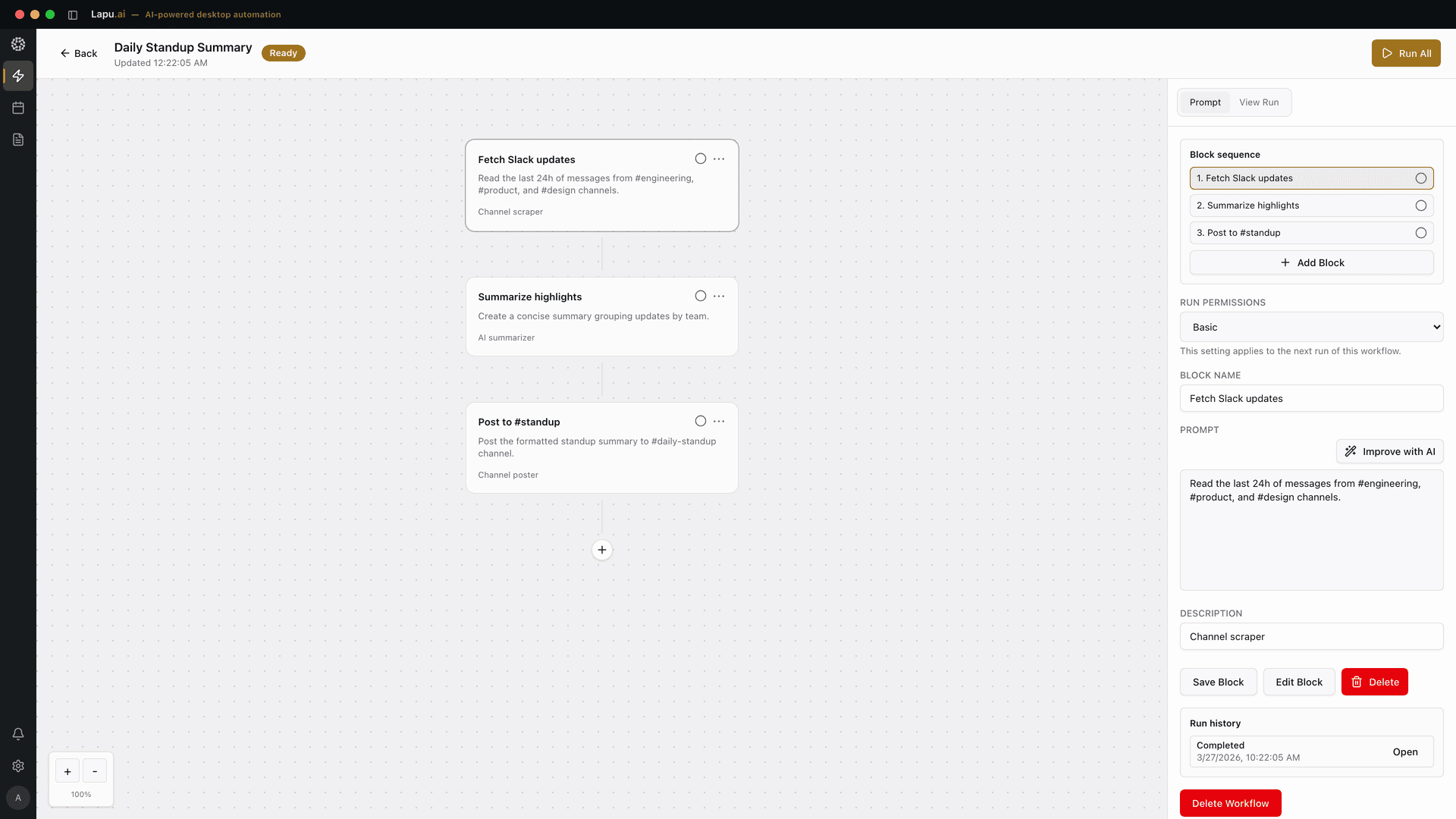
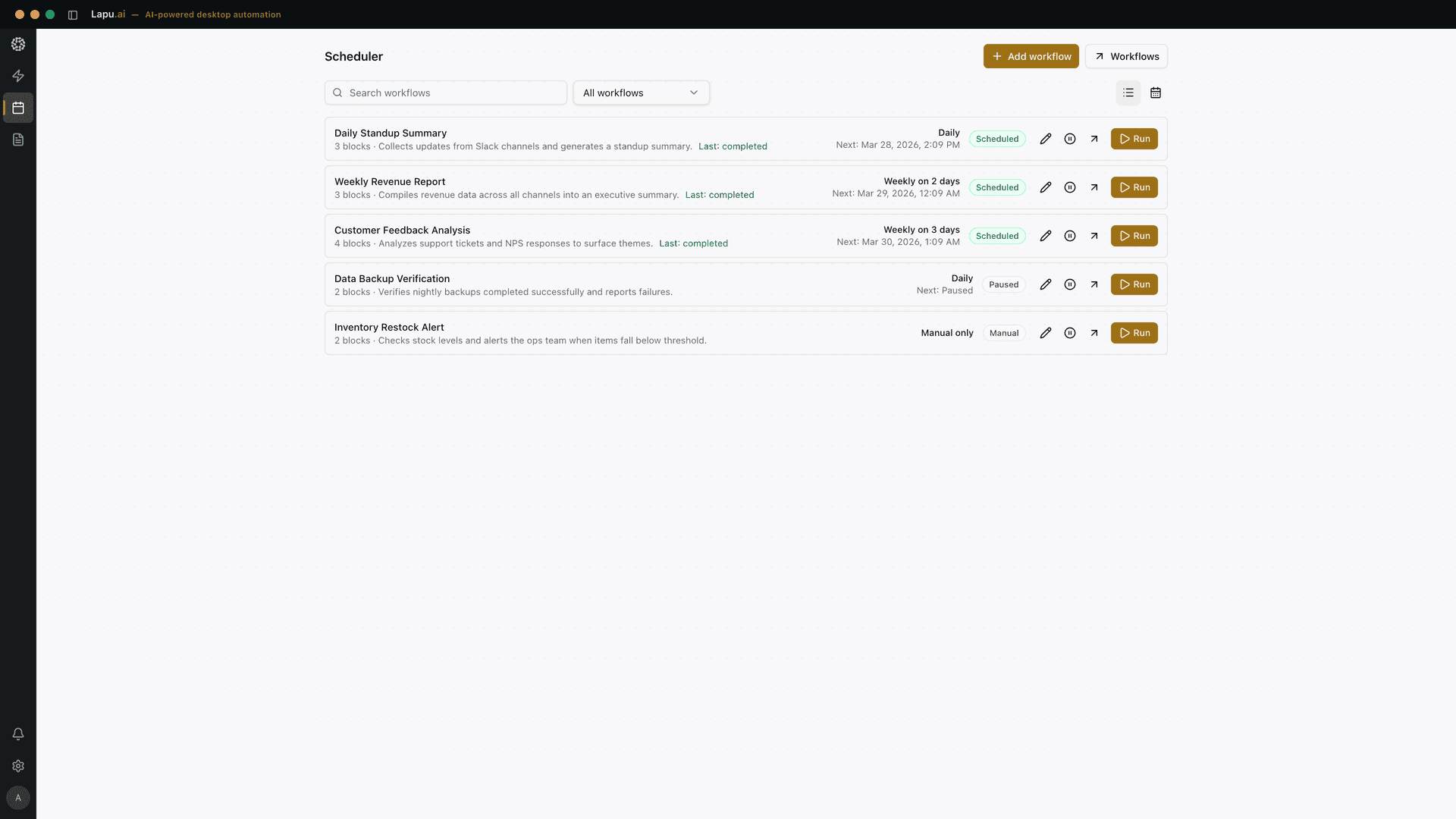
Researchers spend most of the week on the work around the research — literature search, screening, data extraction, transcription, coding, reference cleanup, methodology write-ups — not on the analysis the field will actually cite. A 2025 paper in JMIR AI notes that AI-supported tools can cut the manual workload of a systematic review by 50–75%, and recent practical reports describe abstract screening dropping from 8–12 weeks to 2–3 weeks once a model is in the loop. Lapu AI is a desktop AI agent for researchers: it opens the PDFs in your reading folder, drives Zotero and Word and NVivo the way you would, runs Python in your venv for the data work, writes the citations in the style your journal requires, and keeps a per-task audit trail of every screened paper and every extracted field — all locally on macOS or Windows, so the corpus, the interviews, and the unpublished draft never leave your machine.
- 1-click uninstall
- Cancel anytime
- Files never leave your computer
Pain points Lapu AI addresses
- Spending six to eighteen months on a systematic review because abstract screening alone takes 8–12 weeks of human eyes, and most of those eyes belong to the PI who could have been writing
- Re-running the same literature search every three months because the field moves, the saved Boolean expression broke in the new database UI, and the export-to-Zotero step still requires babysitting one click at a time
- Manual transcription and line-by-line coding of qualitative interviews — a small study of twelve interviews easily produces hundreds of pages of transcript, and coding even one pass is slow, error-prone, and impossible to delegate without retraining the coder
- Cloud chat assistants cannot see the IRB-protected interview audio on your disk, the de-identified patient data in your finance-restricted folder, or the unpublished manuscript in the SharePoint your lab admin set to local-sync-only — so the very datasets that would benefit most from automation are the ones that have to be processed by hand
- Reference cleanup for a journal submission: the EndNote library has duplicates, the citation style the journal requires is the third one this year, three DOIs resolve to redirects, and the bibliography order does not match the in-text citations after the last reorganization
- Extracting structured data from a PDF table — sample sizes, effect sizes, follow-up windows — across 80 included studies, by copying numbers into a spreadsheet cell by cell, with the inevitable transposition error that breaks the meta-analysis a week later
- Documenting the methodology for transparency (PRISMA, PRISMA-trAIce, COREQ) — every search string, every inclusion criterion, every tool prompt, every reviewer disagreement — and producing a flow diagram and a per-stage count for the supplementary materials
Top tasks for Researchers
1. Screen titles and abstracts against the inclusion criteria
You exported 1,840 records from PubMed, Scopus, and Web of Science into a single .ris file. The inclusion criteria are written in the protocol. Lapu AI deduplicates the file in your local Zotero, ranks each record against the inclusion criteria, and writes a per-record include/exclude/uncertain call with a one-line reason — so a second reviewer can adjudicate the borderline cases in a fraction of the time.
"Read the combined search export at ~/research/sr-2026/exports/pubmed-scopus-wos-2026-05.ris and the inclusion criteria at ~/research/sr-2026/protocol/inclusion.md. Import into the local Zotero collection 'sr-2026/screening' and deduplicate. For each record, classify as include / exclude / uncertain against the criteria with a one-line reason citing the abstract phrase you used. Write the output to ~/research/sr-2026/screening/round-1.csv with columns: record_id, title, decision, reason, abstract_phrase. Stop and ask before excluding anything where the reason is weaker than 'matches an exclusion rule verbatim'."2. Extract structured data from included studies into a meta-analysis sheet
You have 62 full-text PDFs in your included folder. The data-extraction sheet has 18 columns — study ID, design, population, intervention, sample size, follow-up, effect estimate, 95% CI, risk-of-bias domains. Lapu AI opens each PDF locally, finds the values, writes them into the Excel template in the same row, and flags every cell where it had to interpret rather than copy.
"For every PDF in ~/research/sr-2026/included/, open the file locally, extract the 18 fields defined in ~/research/sr-2026/extraction/schema.md, and write the row into ~/research/sr-2026/extraction/data.xlsx. Highlight any cell yellow where you had to interpret (e.g. effect size computed from raw counts, follow-up window estimated from a figure). For every extracted number, also save the page number and the verbatim source sentence to ~/research/sr-2026/extraction/audit.csv so a second reviewer can verify in one click."3. Transcribe and pre-code a qualitative interview corpus
You have twelve 60-minute audio interviews in a study folder, the IRB requires the audio to stay on the encrypted disk, and the codebook has 24 codes. Lapu AI runs the transcription against a local model, drops the transcripts into NVivo with speaker turns preserved, applies a first-pass code against the codebook with the supporting quote, and writes a per-interview memo of emergent themes.
"Read the audio files in ~/research/qual-2026/interviews/. Transcribe each one locally (no cloud upload — the IRB approval is on file at ~/research/qual-2026/irb/approval.pdf), keeping speaker turns and timestamps. Open ~/research/qual-2026/nvivo/study.nvp in NVivo, import the transcripts, and apply a first-pass code from the codebook at ~/research/qual-2026/codebook.md. For each code, save the supporting quote with timestamp. Then write a per-interview memo at ~/research/qual-2026/memos/<participant_id>.md listing themes that recurred but are not in the codebook yet."4. Run the analysis script and refresh the figures for the next draft
The reviewer comments came back asking you to re-run the regression with a different covariate set and update Figures 2 and 3. Lapu AI activates your local Python venv, runs the updated script against the clean dataset, regenerates the figures at the journal's resolution, and writes the diff against the previous run so you can see exactly what moved.
"Activate the venv at ~/research/paper-2026/venv. Run ~/research/paper-2026/scripts/regression.py with the covariate set in ~/research/paper-2026/configs/r2-covariates.yaml against the cleaned dataset at ~/research/paper-2026/data/clean.parquet. Save the new model summary to ~/research/paper-2026/results/r2/summary.txt and regenerate Figures 2 and 3 at 600 DPI into ~/research/paper-2026/figures/r2/. Write a one-page diff at ~/research/paper-2026/results/r2/diff-vs-r1.md showing every coefficient change with the 95% CI overlap."5. Reformat the manuscript and the bibliography to the target journal
You are submitting to a journal that wants Vancouver style, double-spaced lines, figures at the end, and a structured abstract under 250 words. The manuscript is currently in APA with figures inline. Lapu AI walks the document in Word, swaps the citation style in Zotero, reflows the figures, rewrites the abstract within the word limit while preserving the claims, and produces a clean PDF ready for upload.
"Open ~/research/paper-2026/draft/v7.docx in Word. Switch the Zotero citation style for this document to Vancouver and refresh every citation and the bibliography. Set the paragraph spacing to double, move all figures and tables to after the references section with the captions intact, and rewrite the abstract to a structured 250-word version (Background, Methods, Results, Conclusion) without dropping any numeric result. Save as draft/v7-jama-submission.docx and export a PDF to draft/v7-jama-submission.pdf."6. Produce a PRISMA-trAIce-compliant methods appendix for the AI-assisted steps
The journal now requires PRISMA-trAIce-style transparency for every AI step in the review. Lapu AI reads its own audit log of which screening prompts it ran, which model versions it called, where a human reviewer overrode it, and writes the appendix table the supplementary materials need.
"Read the audit trail at ~/research/sr-2026/.lapu/audit.jsonl for every screening, extraction, and reformatting step run by the agent in this project. Produce a PRISMA-trAIce-style supplementary appendix at ~/research/sr-2026/manuscript/supp/prisma-traice-appendix.md that lists, per stage: the tool, the model version, the exact prompt, the human verification approach, and the disagreement rate vs the second reviewer. Format the appendix table to match the journal's supplementary materials template at ~/research/sr-2026/manuscript/supp/template.docx."
Related use cases
FAQ
- Will Lapu AI upload our interview audio or unpublished data to a third-party cloud?
- No. Lapu AI is a desktop-native agent — the interview audio, the de-identified dataset, the included PDFs, and the unpublished draft stay on your machine. Only the specific context needed for a given step is sent to the model provider through Lapu AI infrastructure. There is no Lapu AI cloud holding your corpus and no background sync of your research folder. For IRB-protected or finance-restricted paths you can mark a directory off-limits so the agent refuses to read it even when a prompt asks. That is the gap that blocks most cloud AI tools from touching the data researchers actually work with.
- How is Lapu AI different from Elicit, Consensus, Scite, or Web of Science Research Assistant?
- Those tools are excellent search-and-summary surfaces over a hosted paper corpus — you go to their website, ask a question, and read the answer. They do not open the PDFs on your disk, drive Zotero or Word or NVivo on your desktop, run the Python analysis in your venv, or rewrite the bibliography to the target journal in your actual manuscript. Lapu AI is a desktop AI agent that takes the next step: it does the multi-app, file-on-disk, IRB-bounded work that wraps the search. Use both: a hosted search tool to find the literature, Lapu AI to run the review around it.
- Can Lapu AI screen abstracts against my protocol without hallucinating an inclusion call?
- It runs the screening as a first pass with a one-line reason and the verbatim abstract phrase it cited, then writes every record into a CSV your second reviewer adjudicates. The PRISMA-trAIce checklist published in JMIR AI in late 2025 codifies exactly this pattern — AI accelerates, a human verifies, and the workflow is reported transparently. Lapu AI keeps an audit log of every screening decision, the prompt used, and the model version called, so the methods appendix writes itself.
- Does Lapu AI work with Zotero, EndNote, NVivo, MAXQDA, and Word on the desktop?
- Yes. Because Lapu AI drives the desktop app the way you would — clicking menus, choosing styles, typing into the right field — it works with Zotero, EndNote, NVivo, MAXQDA, Word, Excel, and the other research applications that run on macOS or Windows. For Zotero specifically, the agent can also read and write the local SQLite library directly when no UI click is required, which is faster for batch operations like reformatting a bibliography to a new style or deduplicating a large import.
- Can Lapu AI run a Python or R analysis against my local dataset?
- Yes. The agent activates the venv or conda environment you point it at, runs the script, captures stdout and any generated figures, and writes the diff against the previous run. The dataset stays on your disk; the environment is yours; the audit log records the exact command, the script hash, and the result paths. For reproducibility, the agent can be asked to commit the script and the result summary to a local git repo at the end of each run, so the supplementary materials reference a concrete commit, not an undated 'analysis script available on request'.
- Can Lapu AI keep an audit trail of every screened paper and extracted field for transparency?
- Yes. Every screening decision, every data-extraction cell write, every file read, every prompt sent, and every model version called is recorded in a local audit trail with timestamps and the originating instruction. The log retains up to 90 days by default and can be exported as CSV or JSON. The transparency the PRISMA-trAIce extension asks for — tool, version, prompt, human verification — falls out of the log directly. Most research teams under IRB or research-integrity review run the agent in a mode that requires explicit confirmation for any data export, with the audit log as the artifact they show their methods reviewer.
- Can a reusable skill — say, the abstract-screening pass — be shared with co-authors and RAs?
- Yes. A skill in Lapu AI is a reusable prompt plus the tool permissions and file paths it needs. The skill definition can be shared with a co-author or a research assistant; when they run it, the agent uses their own machine, their own database access, and their own paths. The team gets a consistent screening ritual, with the audit log on each machine showing who screened what, without the corpus ever mixing in a shared cloud workspace. Most labs encode their search, their screening pass, and their extraction template as skills inside the first two weeks.
- Will Lapu AI replace my reference manager — Zotero, EndNote, Mendeley?
- No. Lapu AI is an agent layer on top of the tools you already use, not a replacement reference manager. It drives Zotero and EndNote and Mendeley the way you do, imports your search exports, deduplicates, reformats to the target style, and resolves the broken DOIs. The library still lives in your reference manager and the citation style still comes from the CSL repository. The piece Lapu AI takes off your plate is the repetitive cross-app workflow that wraps every submission and every revision.
Lapu AI for Researchers
Free to start. See exactly how Lapu AI works for Researchers before you download.
- 1-click uninstall
- Cancel anytime
- Files never leave your computer
Automate the work between you and outcomes
Lapu AI handles the repetitive work between you and outcomes. One desktop agent, zero tab-switching. Available now on macOS and Windows.
- 1-click uninstall
- Cancel anytime
- Files never leave your computer
Free to start. Cancel in 1 click. Files stay on your machine.