
The best AI agent for Excel Automation in 2026
Opens your local .xlsx, cleans data, writes formulas, builds pivots, saves back, macOS or Windows, permissioned.
- 1-click uninstall
- Cancel anytime
- Files never leave your computer
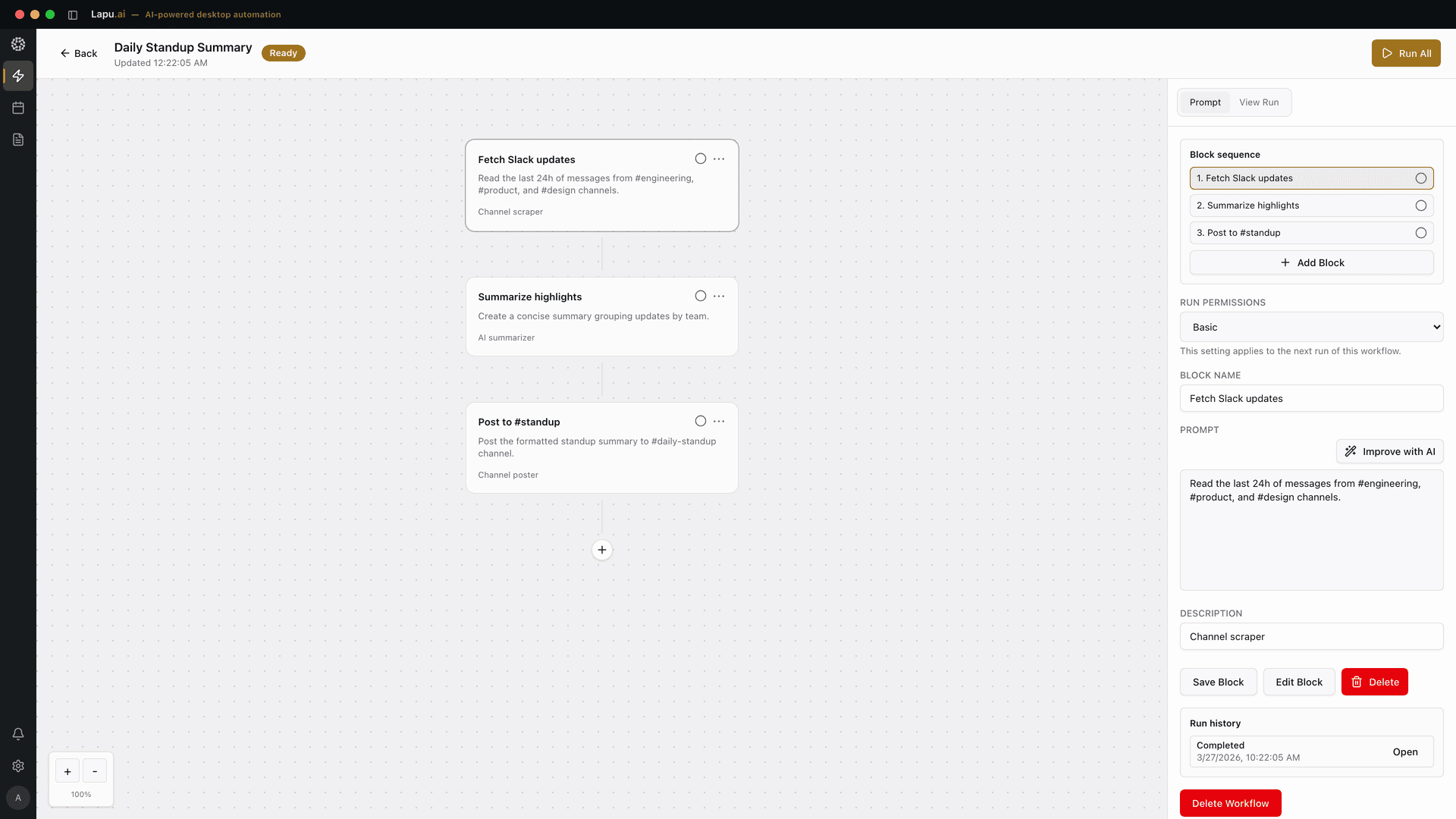

What Excel Automation means
Excel automation is the work of getting AI to handle the repetitive spreadsheet jobs a person would otherwise do by hand in Excel: open an .xlsx file, clean the data, write a formula, fill it down 50,000 rows, build a pivot, generate a chart, format the table, and save it back. The category splits cleanly along one axis. Does the tool work on the actual Excel file on your machine, or only on a copy in someone else's cloud. Microsoft Copilot in Excel works with supported workbooks stored in OneDrive or SharePoint. Microsoft says AutoSave is no longer mandatory for cloud workbooks as of July 2026, correcting the previous requirement stated here. Office Scripts are cloud-based but now run in Excel for the web, Windows, and Mac, while Power Automate can call them in unattended flows. VBA remains desktop-centric and is available in Excel for both Windows and Mac. Spreadsheet add-ins take a different approach: Numerous.ai exposes an =AI() function inside Excel and Google Sheets for formula-driven work in cells, rather than desktop workflows that open and coordinate files across applications. A desktop AI agent like Lapu AI sits in the gap: it opens your .xlsx where it actually lives on disk, drives Excel (or any spreadsheet) the way a person would, asks permission before destructive actions, and writes back to the same file. Concrete jobs a good Excel-automation agent should handle: dedupe a 50,000-row contact list and save it back as a new sheet; rewrite a hand-rolled monthly report into a Power Query refresh; convert a folder of PDF invoices into a clean Excel table; build a pivot from a fresh export and email the chart to the team; explain what a 200-character nested IF formula is doing and rewrite it as a LET; copy values across a workbook of 30 tabs while preserving formulas and number formats.
What to look for
- Works on the actual .xlsx file on your disk (opens it, edits it, saves it back), without requiring you to upload the workbook to OneDrive, SharePoint, or a third-party cloud. The buyer test: does the AI feature stay enabled when AutoSave is off and the file lives in ~/Downloads?
- Drives Excel as an application, not just a single cell (opens workbooks, switches sheets, creates pivots, applies formats, runs Power Query refreshes, exports to PDF), so a one-prompt request like 'clean column C, build a pivot by region, save as Q2-clean.xlsx' executes end to end without leaving the agent
- Permission-gated for any destructive action (overwriting a file, deleting rows, running a VBA macro, sending the file by email), with a visible preview of the change before it applies and an audit trail of every cell that was rewritten
- Handles real Excel messiness: merged headers, multi-tab workbooks, sheet protections, named ranges, formulas you do not want to silently overwrite with values, and number formats that differ across regions, rather than flattening everything to plain text on read
- Cross-platform: runs against Excel on both macOS and Windows with the same prompts and the same workflows, so a Mac analyst and a Windows ops lead can share the same skill library
- Writes the cleanup or analysis as an inspectable plan first (formulas it will add, columns it will delete, sheets it will create), not as opaque magic, so the user can correct the plan before any cell is touched, and can re-run the same plan on next month's export
Top tools compared
1. Lapu AI
High fitBuilt for desktop-native Excel automation on the file where it actually lives. Open an .xlsx in ~/Downloads, describe the job in plain English ('dedupe by email, normalize the Date column to ISO, build a pivot by region, save as Q2-clean.xlsx'), and the agent reads the workbook, drafts the plan (which columns it would change, which formulas it would write, which sheets it would create), waits for approval, then executes against the real file. Works the same on macOS and Windows, against the Excel you already have installed, with no requirement that the file be saved to OneDrive or that AutoSave be on. Every destructive action (overwriting a workbook, deleting rows, running a macro, sending the result by email) is gated by an explicit permission prompt the first time the workflow runs. The audit trail records every formula written, every range rewritten, and every file saved so a job can be replayed or rolled back. Bridges well to other formats: see the PDF-to-Excel guide for the common job of turning a folder of PDF invoices into a clean .xlsx without uploading anything. Where it shines: messy one-off cleanup; recurring monthly reports where the data shape drifts; jobs that span Excel plus the rest of your desktop (the agent can also read the source PDF, send the result on Slack, or commit the file to git). Where it is weaker: it is not a centrally-administered RPA platform with 24/7 unattended Excel bots, for that scale of orchestration, Power Automate or UiPath are the right shape.
Learn more →2. Microsoft Copilot in Excel
Medium fitMicrosoft's first-party AI in Excel, included in the Microsoft 365 Copilot license. Strong at the in-cell jobs people most often ask Excel to do: explain a formula in plain English, generate a formula from a description, suggest a chart, summarize a table, highlight or sort data, and propose pivots. Where it shines: any team already paying for Microsoft 365 Copilot whose Excel work lives in OneDrive or SharePoint with AutoSave on; the integration is deep, the latency is low, and it knows the workbook context natively. Where it falls short for this task: it requires AutoSave with the file saved in OneDrive or SharePoint, and the Copilot button is greyed out on a local-disk file. That is a hard wall for the very common case of a one-off .xlsx in Downloads, a workbook with confidential data the team has not approved to sync to OneDrive, or a Mac analyst who does not want every spreadsheet round-tripping through Microsoft's cloud. It also does not drive Excel as an application across multiple files. It is scoped to assisting inside the currently open workbook.
Learn more →3. Microsoft Office Scripts + Power Automate
Medium fitMicrosoft's modern replacement for Excel VBA: write or record TypeScript that runs against the Excel JavaScript API, then trigger it from a button, a Power Automate flow, or (until script scheduling returns) a Power Automate schedule. Cross-platform in the sense that scripts run inside Excel for the web on any device. Where it shines: stable, predictable repeating Excel jobs, turning a daily CSV into a formatted, pivot-bearing report; running the same cleanup on every weekly export; chaining Excel with the rest of the Power Platform (Outlook, SharePoint, Dataverse). Where it falls short for this task: Office Scripts targets Excel for the web specifically (scripts are stored in OneDrive and run in the cloud), so a workbook that sits on the local disk and is never uploaded is out of scope. It is also a coding tool, not an agent: the script does not adapt when the source file's columns drift; you go back to the editor. Power Automate Desktop adds Windows-only RPA on top of this stack, but the unattended desktop tier is per-bot priced ($150/bot/month historically), and the macOS audience is unsupported on the desktop-RPA side.
Learn more →4. Bricks
Medium fitBrowser-based AI spreadsheet that takes uploaded data and generates dashboards, charts, and reports from a natural-language prompt, a Notion-style document around a Google-Sheets-like grid. Where it shines: turning a clean CSV or .xlsx into a polished visual deliverable (dashboards, charts, slide-shaped reports) without designing them by hand; teams whose Excel work ends in a presentation rather than a refreshed model. Where it falls short for this task: Bricks is a cloud product. You upload the file to clean it or visualize it, which is a non-starter for sensitive data with no third-party processor agreement, and the output is a Bricks document rather than a refreshed copy of the original .xlsx your downstream tools depend on. It is also visualization-first; deep Excel-specific automation (Power Query refreshes, formula rewrites, macro execution) is not the job it is built for.
Learn more →5. Numerous.ai
Medium fitLightweight Excel and Google Sheets add-in that exposes ChatGPT as a spreadsheet function: write =NUM.AI("summarize this review", A2) in a cell, drag it down, and the formula runs for every row. Pricing starts around $10/month. Where it shines: bulk per-row AI work inside an existing Excel workflow, categorize 5,000 support tickets, extract sentiment from product reviews, write product descriptions from a SKU table, generate a formula from a plain-English description. Where it falls short for this task: it is a cell-level tool, not an agent. It does not open files, build pivots across sheets, run Power Query, fix merged headers, or save the workbook back under a different name; everything happens inside a single =AI call. For multi-step Excel automation across an entire workbook, you still need a person (or a real agent) driving Excel. Excellent complement to Lapu or to a built-in Copilot; not a replacement.
Learn more →
Why Lapu AI is built for Excel Automation
Lapu AI is the rare Excel-automation tool that meets the buyer where their .xlsx actually lives, on the disk, not in OneDrive. Microsoft Copilot in Excel is the obvious first answer for in-cell help, but the moment the file is local (no AutoSave, no OneDrive sync) the Copilot button is greyed out; the very files most people work on every day fail the precondition. Office Scripts and Power Automate fix the recurring-job problem but live in the cloud and target Excel for the web. Bricks and Numerous.ai each cover one slice (visualization, per-cell prompts), but neither drives Excel as an application across a multi-step workflow. Lapu AI is a desktop agent: it opens the workbook where it sits, reads the actual sheet structure, drafts a plan that lists the formulas it would write and the columns it would change, waits for approval, then runs against the real file. The same agent that cleans the spreadsheet can read the upstream PDF, send the result on Slack, and commit the cleaned file to git, see the PDF-to-Excel walkthrough for the canonical cross-app version of that job, and the file-organization step-by-step for the broader pattern of cross-app desktop automation. A practical decision framework: if your team already pays for Microsoft 365 Copilot and every workbook lives in OneDrive with AutoSave on, Copilot in Excel is excellent and you should use it. If you need a deterministic, scheduled Excel job that always runs against a known table shape, write an Office Script and trigger it with Power Automate. If your problem is a one-off messy .xlsx on your Mac or Windows machine, a confidential workbook your team has not approved to sync to the cloud, or a multi-step job that spans Excel plus a PDF plus a Slack post. That is what Lapu AI is built for. Most Excel jobs start with a related task: see the data-cleanup workflow on this page for the dedupe-and-normalize step that precedes every pivot, the best AI agent for invoice processing for turning a folder of PDF invoices into a clean Excel table, and the best AI agent for form filling when the clean spreadsheet feeds an onboarding or vendor form downstream.
FAQ
- Why can't Microsoft Copilot in Excel automate my local .xlsx file?
- Copilot in Excel requires the workbook to be saved in OneDrive or SharePoint with AutoSave enabled. Microsoft confirms this in their Q&A: on a file sitting on a local drive, the Copilot button is greyed out regardless of the license. For workbooks that live in ~/Downloads, on an external drive, or in a synced folder for a different cloud (Dropbox, Google Drive), Copilot in Excel does not engage. Lapu AI was built for that case. It drives the Excel you already have installed, against the file where it actually lives, without forcing it through Microsoft's cloud. For the broader Copilot-versus-widget-versus-agent decision, see the Excel workflow guidance on this page.
- Does Lapu AI need Microsoft 365 Copilot or Office Scripts to automate Excel?
- No. Lapu AI drives the Excel application directly through the OS (on macOS via Excel's AppleScript and accessibility surface, on Windows via UI Automation and the COM bridge), so a standard Excel install is enough. You do not need a Microsoft 365 Copilot license, you do not need OneDrive, and you do not need Office Scripts enabled in your tenant. Lapu calls its own AI model layer to plan the job; the Excel side is a normal automation surface. If you have Microsoft 365 Copilot too, the two complement each other: Copilot for in-cell formula help, Lapu for cross-file, cross-app workflows on the desktop.
- Can Lapu AI handle multi-tab workbooks with merged headers and protected sheets?
- Yes. Before any change the agent inspects each tab: detects the data region, identifies whether the top rows are merged headers or a header band, notes which sheets are protected, and reads which named ranges and formulas exist. The plan it presents calls those out explicitly: which sheets it would touch, which merged-header cells it would flatten (and to what convention), which protected sheets it would skip or ask you to unlock, which formulas it would preserve and which it would rewrite. Nothing is silently flattened, and a workbook that fails the check (a sheet protected with a password Lapu does not have) is reported back as a blocker rather than partially executed.
- Will Lapu AI break formulas, named ranges, or number formats when it saves the file?
- By default it preserves them. When the agent writes back to an .xlsx file it keeps existing formulas, named ranges, conditional formatting, and number formats intact. If a transformation would change a value that a formula depends on, the preview flags the formula so you can decide whether to recalculate, leave it in place, or convert the cell to a static value. If you explicitly ask the agent to rewrite a formula (for example, replace a 200-character nested IF with a LET) it shows you the rewritten formula before applying it, and the audit trail records both the original and the rewrite.
- Can the agent automate Excel jobs that span more than one file or more than one app?
- Yes: this is the case the desktop-agent shape exists for. A single Lapu workflow can open a folder of PDF invoices, extract the line items into a new .xlsx, run a Power Query refresh against an existing model, build a pivot, export a chart to PNG, paste it into a Slack message, and commit the cleaned file to a git repository, all on your machine, with permission prompts at each destructive step. For the specific PDF-to-Excel job, see the PDF to Excel on the desktop walkthrough. Copilot in Excel and Office Scripts both stop at the workbook boundary; Lapu does not.
- Does Excel automation with Lapu AI work on macOS, or only Windows?
- Both. Lapu AI runs on macOS 12+ and Windows 10+ with the same prompts, the same workflow library, and the same permission model. The platform-specific layers differ (AppleScript and accessibility APIs on macOS, UI Automation and the COM bridge on Windows), but the agent presents one interface and most Excel workflows port across platforms unchanged. The genuine exceptions are platform-specific Excel features (running a VBA macro through COM on Windows, AppleScript-driven Numbers conversion on macOS); the agent flags those when a workflow includes them so you know up front.
- How does this compare to Numerous.ai and other =AI-cell add-ins?
- Numerous.ai and similar add-ins (Excel Formula Bot, Sheet+, AI Office Bot) live inside a single cell. Write =NUM.AI("categorize this review", A2), drag it down, and the prompt runs per row. That is great for bulk per-row AI work inside a sheet you already have open. Lapu AI works at the workflow level: it opens the file, plans the multi-step job (clean, dedupe, pivot, format, save), executes against the workbook, and can chain to other apps. The two are complementary, many users keep a per-cell add-in for one-off categorization or summarization inside a sheet, and use Lapu for the cross-file, multi-step automation around it.
- Is it safe to let an AI agent edit my Excel files?
- Lapu AI is built around three answers to that question. First, every destructive action (overwriting a workbook, deleting rows, running a macro, sending the file by email) is gated by an explicit permission prompt the first time a workflow runs, and you can promote a step to auto-approve once you trust it. Second, the agent shows the plan before any cell is touched, so you correct it ahead of the change rather than after. Third, every cell that gets rewritten is recorded in an audit trail you can replay or roll back. See the permission model post for the full explanation. For the same question framed against cloud chatbots that upload your file, the answer is different: Lapu does not upload the workbook for storage. Relevant cell values and instructions still pass through Lapu AI infrastructure to hosted model providers for reasoning. Lapu AI does not currently offer a fully offline model path.
- Can the agent extract data from PDF invoices straight into Excel without uploading the file?
- Yes. The same desktop agent that drives Excel can run a local PDF parser on disk and write the result into your workbook row by row. The PDF and .xlsx remain local files rather than cloud-workspace copies, while relevant extracted context is sent to hosted model providers for reasoning. See how to extract data from PDF with AI on your desktop for the parser-and-model stack, the per-document-type tactics (tables, invoices, scans), and the audit-trail story. The Excel write side then follows the workflow on this page.
- What is an Excel AI agent, and how does it compare to the best Excel AI tools like Copilot or =AI() add-ins?
- An Excel AI agent is software that drives Excel as an application, opens the .xlsx where it lives on disk, plans a multi-step job (dedupe, formula rewrite, pivot, AI PDF to Excel extraction, formatted export), waits for approval, and writes back to the same workbook. The best Excel AI tools in 2026 split into three shapes. In-cell AI add-ins (Numerous.ai, Excel Formula Bot) expose ChatGPT as a =AI() function: great for per-row summarize or categorize inside one open sheet, useless for anything that spans files or opens a PDF. Cloud Copilots (Microsoft 365 Copilot in Excel) sit inside the Excel window and do in-cell rewrites, formula help, and pivots, but only when AutoSave is on and the workbook is stored in OneDrive or SharePoint, so a local .xlsx in Downloads is silently out of scope. A desktop Excel AI agent (Lapu AI) sits outside Excel and drives it: it reads the workbook on your Mac or Windows disk, handles AI PDF-to-Excel jobs on local files, sends only the relevant extracted context for hosted reasoning, and saves the result back where it started. Pick a =AI() add-in for one-off cell prompts, Copilot in Excel when the workbook already lives in OneDrive with AutoSave on, and a desktop Excel AI agent when the file is local, the job includes AI PDF to Excel extraction, or the workflow crosses more than one app.
- What are Excel automation tools?
- Excel automation tools are software that repeat spreadsheet work such as cleaning rows, writing formulas, refreshing pivots, formatting tables, and saving reports. Macros and Office Scripts suit fixed jobs, in-cell AI add-ins handle repeated prompts, and a desktop agent can coordinate the whole workbook. See the practical ways to use AI in Excel before choosing a tool shape.
- What does automation in Excel include beyond formulas?
- Automation in Excel includes every repeatable step around a workbook, not only formula generation: opening the right file, validating headers, cleaning data, updating pivots, formatting the output, and saving a reviewed copy. If inconsistent rows are the first blocker, start with the the data-cleanup workflow before automating the later reporting steps.
- How does Excel workflow automation connect spreadsheets to other apps?
- Excel workflow automation treats the workbook as one stage in a larger desktop job. An agent can read source files, write validated rows into Excel, refresh the report, and pass the result to another app after approval. A common example is extracting PDF invoices into Excel before routing the finished workbook to the team.
- What does data cleanup automation do before Excel analysis?
- Data cleanup automation prepares a workbook before analysis by standardizing dates, trimming stray spaces, deduplicating records, flagging missing values, and preserving formulas. A desktop agent can apply those rules to a reviewed copy, record each change, and then continue into pivots, reports, or data entry automation without moving the workbook to another service.
Related
- Best AI agent for Data Entry Automation →
- Best AI agent for Desktop Task Automation →
- Best AI agent for Document Automation →
- Best AI agent for File Organization →
- Best AI agent for Form Filling →
- Best AI agent for Invoice Automation →
- More best-for guides →
- See Lapu AI use cases →
- Compare with alternatives →
- Pricing →
Try Lapu AI free
Built for Excel Automation. Free download: see exactly what the app looks like first.
- 1-click uninstall
- Cancel anytime
- Files never leave your computer

Automate the work between you and outcomes
Lapu AI handles the repetitive work between you and outcomes. One desktop agent, zero tab-switching. Available now on macOS and Windows.
- 1-click uninstall
- Cancel anytime
- Files never leave your computer
Free to start. Cancel in 1 click. Files stay on your machine.