
Lapu AI for Data Analysts
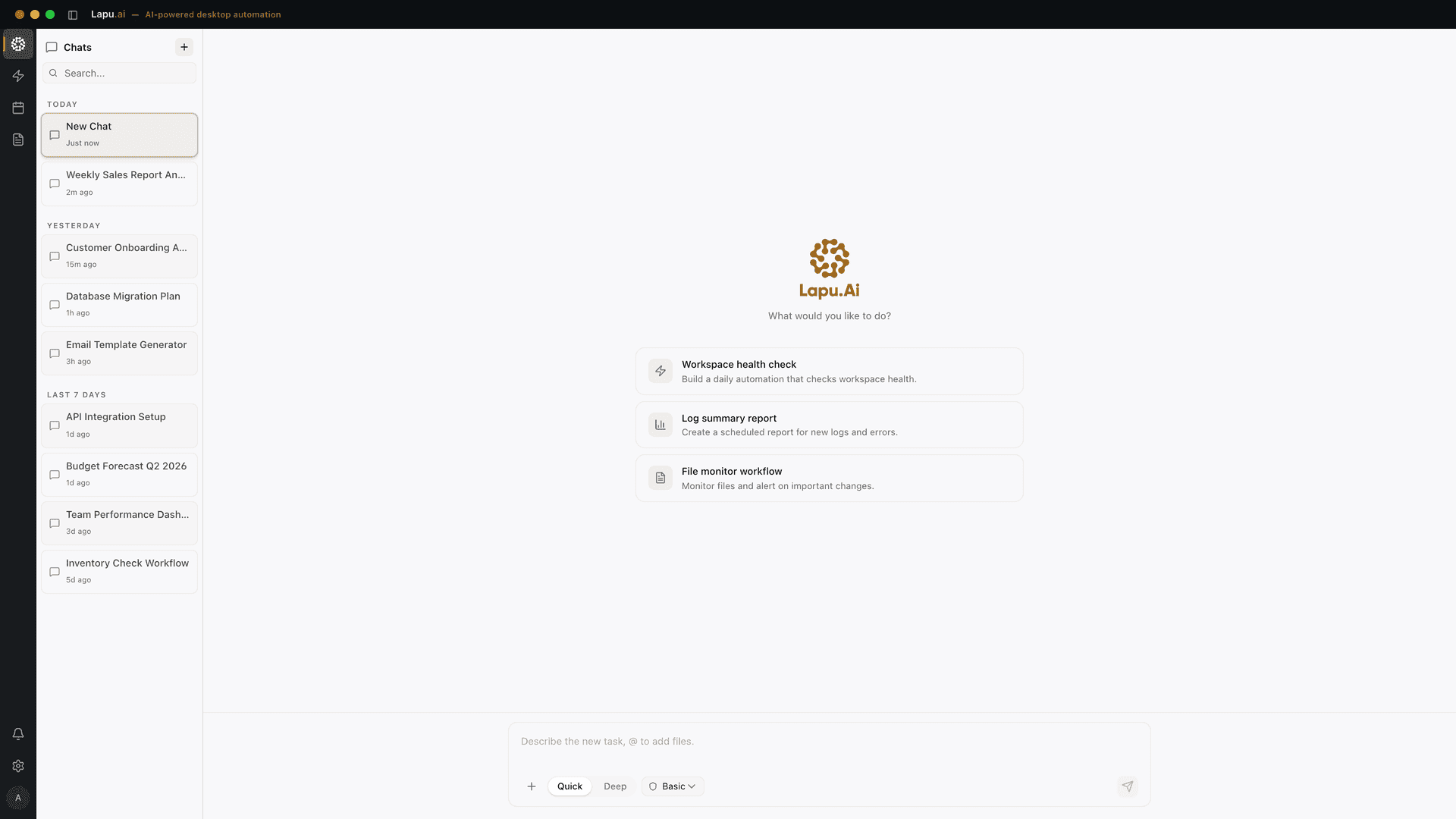
Data analysts spend more of the week on data wrangling and stakeholder reporting than on analysis. A widely cited industry estimate puts data cleaning and preparation at 50–80% of the working hours, with only the remaining slice left for the modeling and narrative the business actually wants. Lapu AI is a desktop AI agent for analysts: it reads the CSV exports on your disk, runs the SQL pulls against your warehouse, cleans the file in Python or Excel, refreshes the Tableau or Power BI dashboard the way you would click through it, and drafts the email or Slack summary your stakeholder will read — all locally on macOS or Windows, with permissioned execution and a per-task audit trail.
- 1-click uninstall
- Cancel anytime
- Files never leave your computer
Pain points Lapu AI addresses
- Spending 50–80% of the week on data cleaning, joining, and reshaping before the actual analysis can even start — and the cleanup is the part the business never sees but always assumes is free
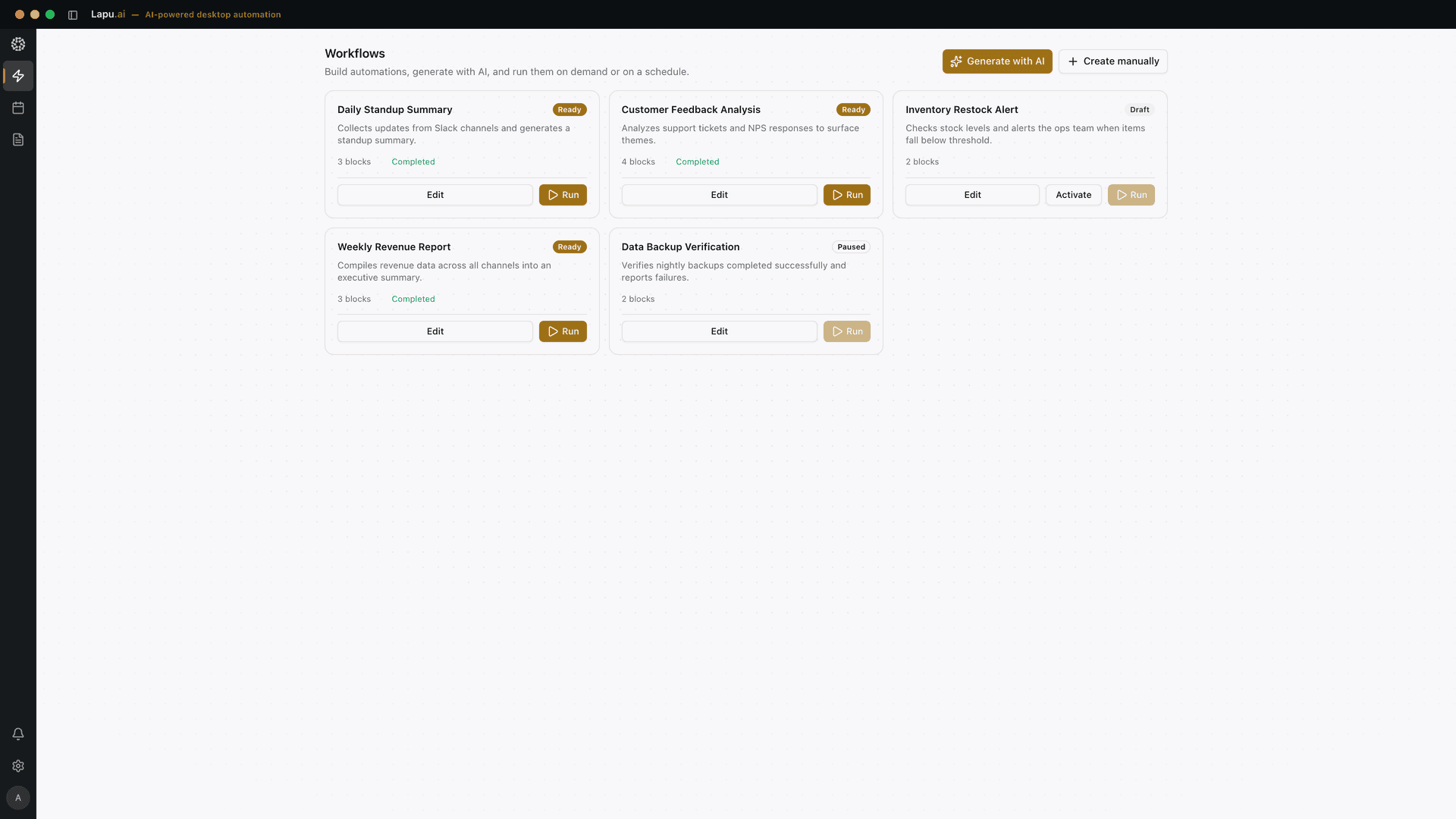
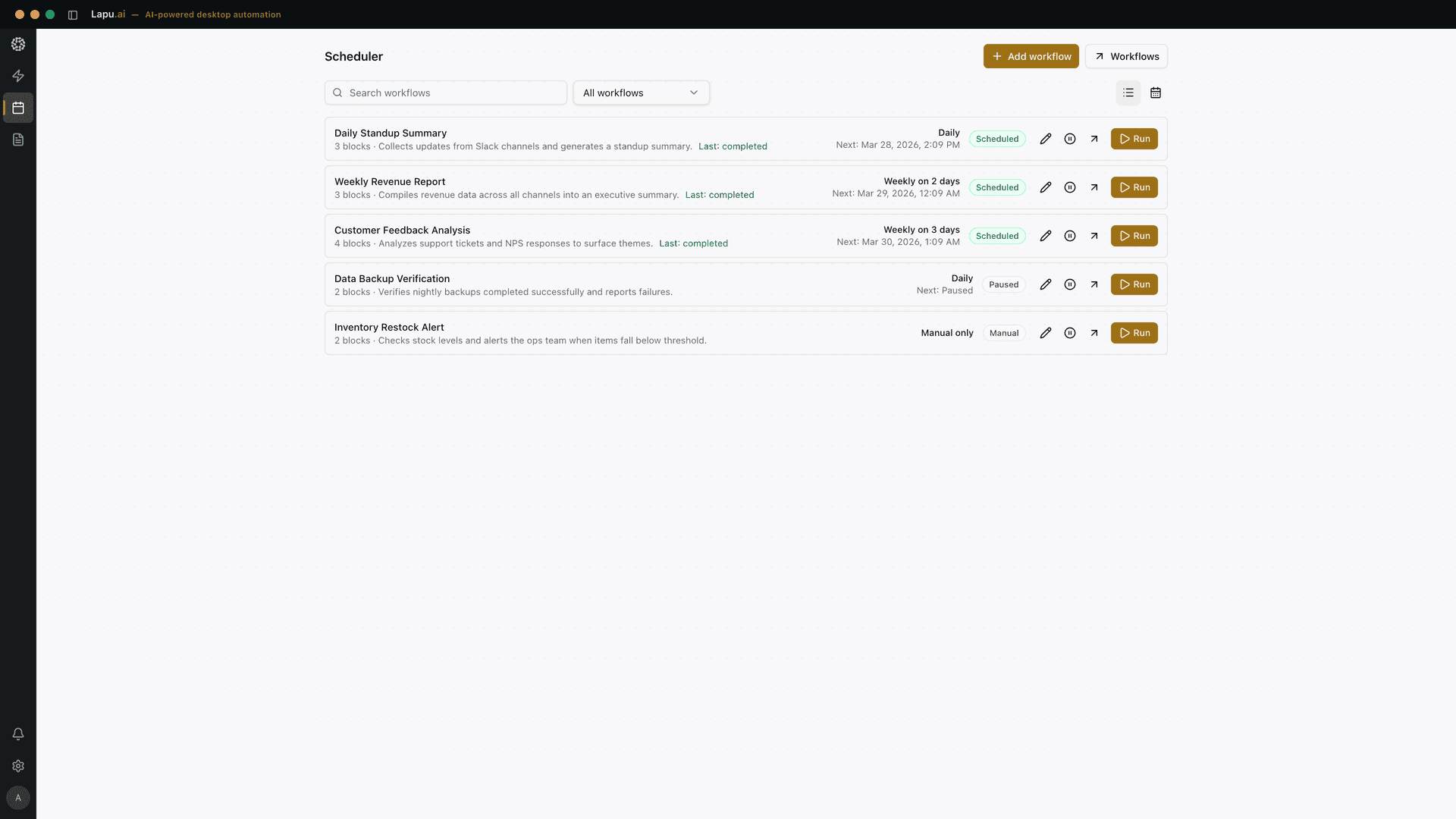
- Re-running the same weekly SQL pull, dropping it into the same Excel template, refreshing the same dashboard, and emailing the same six-line summary — a repeat workflow that consumes a full day every week but is too brittle to hand to a non-technical teammate
- Stakeholders asking 'can you just send me the number?' for ad-hoc questions that require pulling from three sources, deduping, and reconciling — each takes thirty minutes but they arrive five at a time
- Cloud chat assistants cannot see the warehouse credentials in your local config, the CSV in your Downloads folder, or the Tableau Desktop file you have open — so the work that actually pays the bills cannot be offloaded to ChatGPT or Claude
- Uploading the raw customer export to a third-party AI tool is a non-starter on PII, HIPAA, or finance grounds — so the very datasets that would benefit most from automation are the ones that have to be processed by hand
- Reconciling two systems that should agree but never do — Salesforce closed-won vs the warehouse fact table, GA4 sessions vs the product analytics tool — and writing the same diff report every quarter
- Documenting the dataset, the join keys, and the assumptions every time you hand a deliverable to finance or product, because the SQL is in your editor and the rationale is in your head
Top tasks for Data Analysts
1. Run the weekly KPI refresh end to end
Every Monday you pull the same SQL against the warehouse, drop the result into the same Excel template, refresh the same Tableau workbook, and post a six-line summary in Slack. Lapu AI executes the saved query against your local warehouse connection, writes the result into the template in place, refreshes the workbook, and drafts the summary so you only have to approve and post.
"Run the saved SQL in ~/analytics/queries/weekly-kpis.sql against the prod warehouse using the connection profile in ~/.dbt/profiles.yml. Save the result as ~/analytics/exports/kpis-2026-W22.csv. Open ~/analytics/templates/weekly-kpis.xlsx, refresh the Pivot tables against the new CSV, and save as kpis-2026-W22.xlsx. Then draft a six-line Slack summary comparing the week-over-week change for the top five metrics — show me before posting to #data."2. Clean a messy CSV before it touches a model
The marketing team dropped a 240k-row export into the shared drive with mixed date formats, inconsistent country codes, and rows where the email column got shifted one column right. Lapu AI runs the cleanup as a deterministic Python script in your local venv, writes a profile of what changed, and saves a clean parquet alongside the original.
"Read ~/Downloads/mkt-export-2026-05.csv. Profile every column: nulls, dtype, distinct values, suspicious shifts. Standardize country codes to ISO-3166-alpha2, parse all date columns to ISO-8601 UTC, and drop or repair rows where the email column does not look like an email. Run this as a script in ~/analytics/venv, save the cleaned file as mkt-export-2026-05.clean.parquet, and write a one-page diff report listing every transformation you applied."3. Reconcile two sources that should agree but never do
Finance says Q2 revenue was $4.18M; the warehouse fact_orders rolls up to $4.21M. You get to find the $30k delta. Lapu AI joins the two extracts on order ID, writes the row-level diff, groups by likely cause (refunds, currency, multi-period revenue), and saves a one-page reconciliation memo.
"Read ~/analytics/exports/finance-q2-rev.xlsx and ~/analytics/exports/fact-orders-q2.csv. Join on order_id. List every row where the two amounts disagree by more than $25. Group the diffs by suspected cause: refund timing, currency conversion, multi-period revenue recognition, missing rows on either side. Save the row-level diff to recon-q2.xlsx and write a one-page memo to recon-q2-memo.md that I can forward to finance."4. Refresh a Tableau or Power BI dashboard from a new extract
The board asks for a dashboard refresh by 9am. The extract refreshed overnight failed because a column was renamed upstream. Lapu AI opens the dashboard, rewires the broken field to the new column, re-extracts, and screenshots each tab so you can verify before you publish.
"Open ~/analytics/dashboards/board-kpis.twbx in Tableau Desktop. The extract failed overnight because the field 'revenue_usd' was renamed to 'revenue_amount_usd' in the source. Rewire every visualization that references the old field to the new one, refresh the extract from the source connection, and save screenshots of each of the six tabs to ~/analytics/dashboards/board-kpis-2026-W22/ so I can scan them before publishing."5. Answer an ad-hoc stakeholder question end to end
Head of Sales pings: 'How many net-new logos closed in EMEA in May, by segment, and which AE owned each?' Lapu AI writes the SQL against the warehouse, runs it, formats the result as a small Excel table, and drafts the Slack reply with the caveats about the segment definition.
"Answer this Slack question: 'Net-new logos closed in EMEA in May 2026, broken out by segment, with the owning AE.' Write the SQL against the dim_account and fact_closed_won tables, run it, format the result as a 3-column table in a new sheet of ~/analytics/scratch/may-emea-logos.xlsx, and draft a Slack reply that includes the row count, the segment definition we use, and the date filter so Sales does not re-litigate it next week."6. Document the model and the assumptions before handing off
You are about to send finance the headline number, and you know the next question will be 'what's in it?' Lapu AI reads the SQL, the dbt model, and your local notebook, then writes a one-page methodology doc with the join graph, the filters applied, and the known caveats.
"Read the dbt model at ~/analytics/dbt/models/marts/finance/revenue_recognized.sql, the upstream sources it references, and the analysis notebook at ~/analytics/notebooks/q2-revenue.ipynb. Produce a one-page methodology document at ~/analytics/docs/q2-revenue-methodology.md that lists the source tables, the join keys, every filter in plain English, the revenue recognition rule applied, and the known caveats (multi-currency, contract amendments, ramped deals). Format so I can paste it under the headline number in the finance memo."
Related use cases
FAQ
- Will Lapu AI upload our raw customer data to a third-party cloud?
- No. Lapu AI is a desktop-native agent — the CSV, the warehouse extract, and the dashboard file stay on your machine. Only the specific context needed for a given step is sent to the model provider through Lapu AI infrastructure. There is no Lapu AI cloud holding your data and no background sync of your analytics folder. For especially sensitive paths (a PII export, a finance close folder) you can mark a directory off-limits so the agent refuses to read it even when a prompt asks. That is the gap that blocks most cloud AI tools from touching the warehouse exports analysts actually work with.
- Can Lapu AI run SQL against our warehouse the way a notebook does?
- Yes, through the same connection profile your local tooling already uses — dbt profiles.yml, a SQLAlchemy URL in an env file, a DuckDB file on disk, or an ODBC driver to Snowflake, BigQuery, Redshift, or Postgres. The agent runs the query with your identity and your permissions, writes the result wherever you say, and records the query plus the row count in the audit log. The credential never leaves your machine; the agent reads it from the same config file your terminal does.
- Does Lapu AI work with Tableau Desktop, Power BI Desktop, and Excel?
- Yes. Because Lapu AI drives the desktop app the way you would — clicking, typing, choosing menu items — it works with Tableau Desktop, Power BI Desktop, Excel, and any other analytics application that runs on macOS or Windows. For Excel specifically, the agent can also read and write the file directly through the local file system when no UI click is required, which is faster for batch transforms. The audit trail captures every cell write and every menu action so you can replay what the agent did.
- How is Lapu AI different from a notebook copilot like a Jupyter or VS Code AI assistant?
- Notebook copilots are excellent inside the notebook — they help you write the SQL, the pandas, or the chart code. They stop at the notebook boundary. Lapu AI runs across the whole analyst workflow: it executes the query, opens the Excel file, refreshes the Tableau workbook, drafts the Slack summary, and saves the methodology doc — the multi-app loop the notebook copilot was never built for. Use both: the copilot for the cell, Lapu AI for the surrounding ritual.
- Can Lapu AI keep an audit trail of every query and file touch for compliance?
- Yes. Every SQL execution, file read, file write, shell command, and app click is recorded in a local audit trail with timestamps, the prompt that triggered it, the connection used, and the row count returned. The log retains up to 90 days by default and can be exported as CSV or JSON for an audit. Analytics teams working under SOX, HIPAA, or GDPR typically run the agent in a mode that requires explicit confirmation for any data export or external send, with the audit log as the artifact they show security.
- What happens when a column name changes upstream and breaks every saved query?
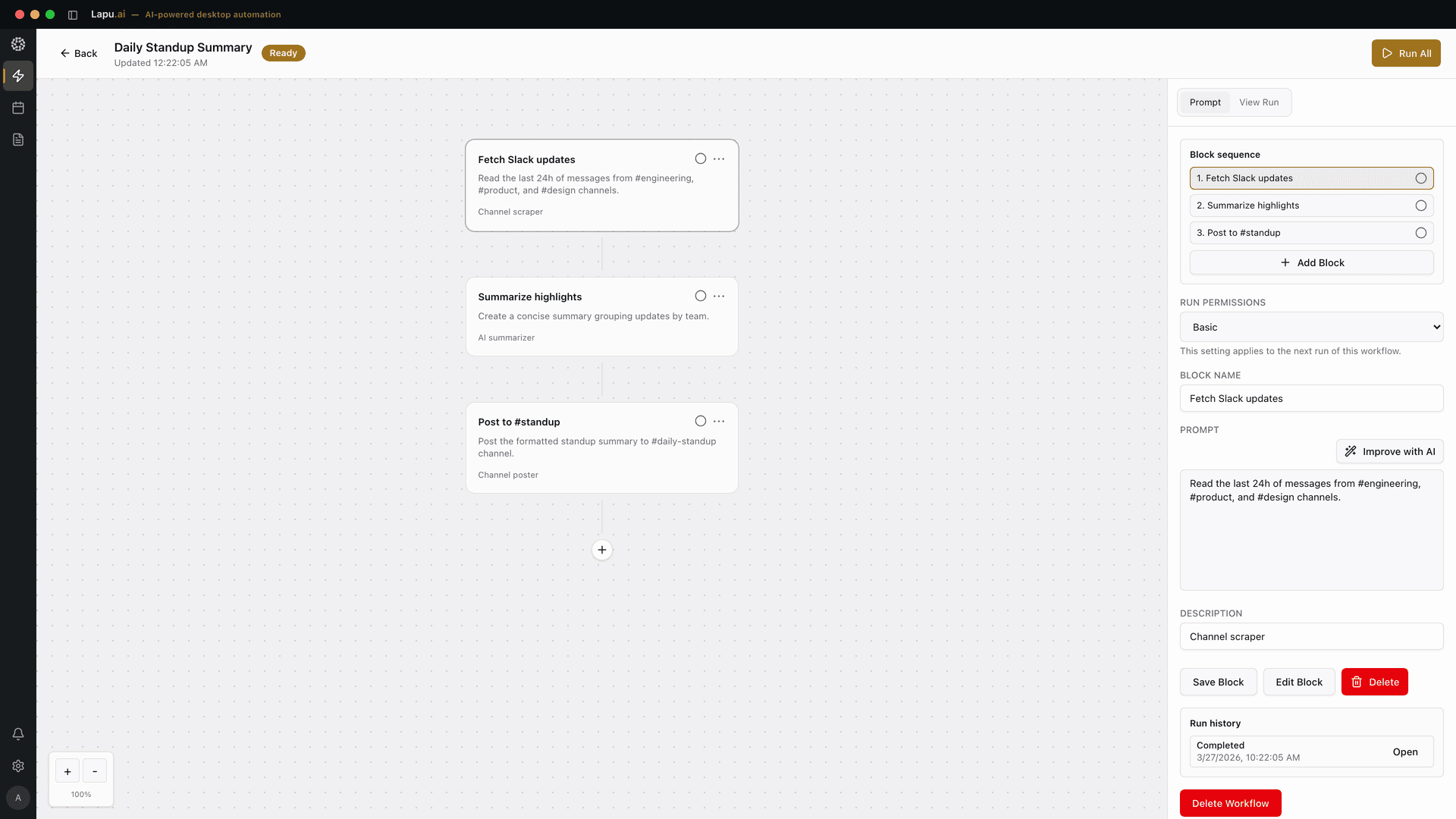
- You point the agent at the offending dashboard, workbook, or notebook and the broken column name, and it walks the references for you — rewires the visualization, the join, the calculated field, and re-runs the refresh. Because the agent sees the same UI you see, it does not depend on a brittle screen-scraping script. For larger schema changes you run the fix-up once with your supervision; the steps land in the audit trail and the next run is one-shot.
- Can a skill we build — say, the weekly KPI refresh — be shared across the analytics team?
- Yes. A skill in Lapu AI is a reusable prompt plus the tool permissions and file paths it needs. The skill definition can be shared with a teammate; when they run it, the agent uses their own machine, their own warehouse credentials, and their own file paths. The team gets a consistent ritual without the data ever mixing in a shared cloud workspace. Most analytics teams encode their weekly refresh, their monthly board pull, and their ad-hoc reconciliation as skills within the first two weeks.
- Will Lapu AI replace our BI tool — Tableau, Power BI, Looker?
- No. Lapu AI is an agent layer on top of the tools you already use, not a replacement BI surface. It drives Tableau Desktop, Power BI Desktop, and the Looker web app the way you do, refreshes extracts, and produces the screenshots and summaries that surround the dashboard. The dashboards still live in your BI tool and your stakeholders still consume them there. The piece Lapu AI takes off your plate is the repetitive cross-app workflow that wraps every dashboard refresh.
Lapu AI for Data Analysts
Free to start. See exactly how Lapu AI works for Data Analysts before you download.
- 1-click uninstall
- Cancel anytime
- Files never leave your computer
Automate the work between you and outcomes
Lapu AI handles the repetitive work between you and outcomes. One desktop agent, zero tab-switching. Available now on macOS and Windows.
- 1-click uninstall
- Cancel anytime
- Files never leave your computer
Free to start. Cancel in 1 click. Files stay on your machine.