Lapu AI for Operators
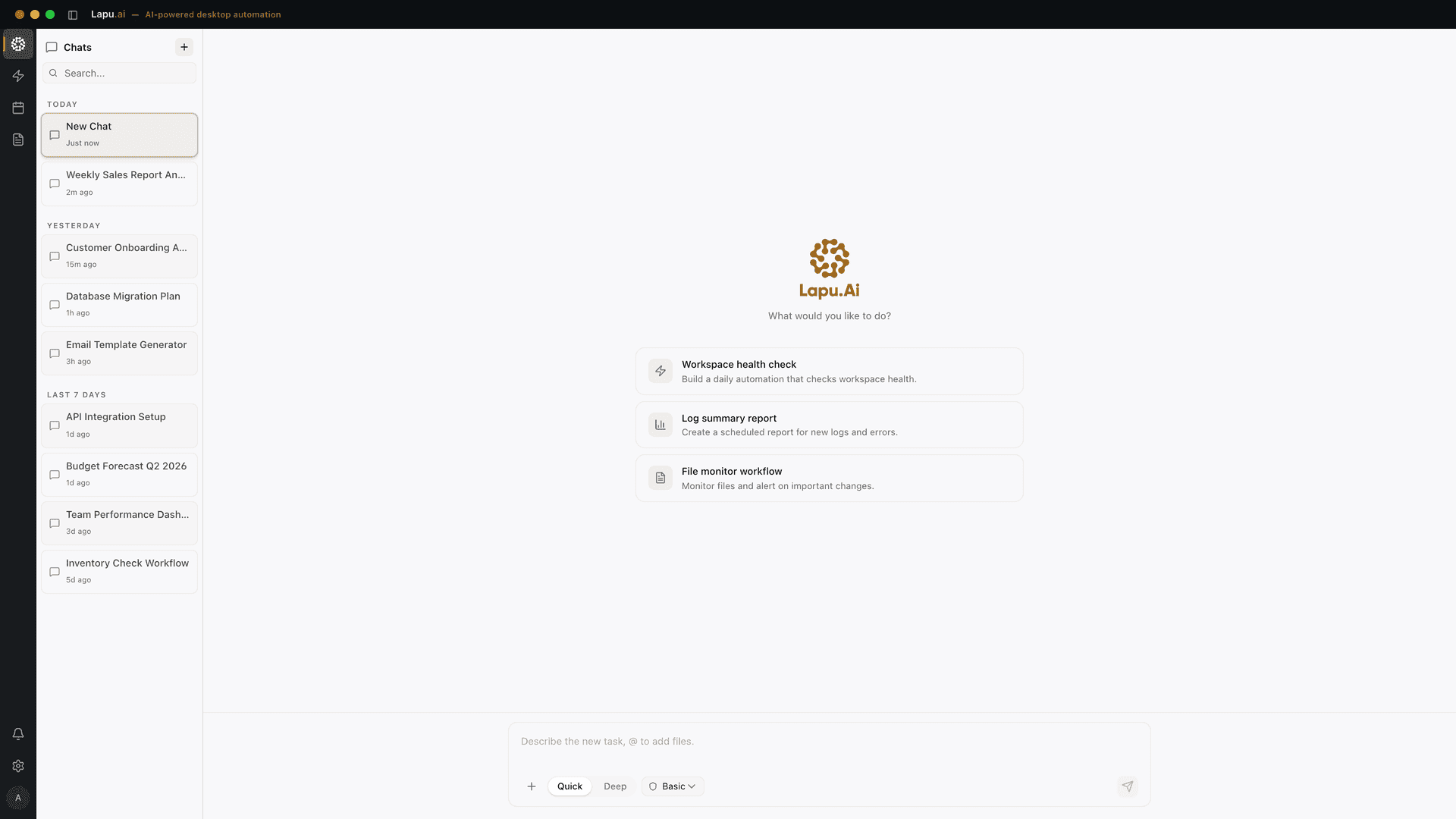
Operators — chiefs of staff, business ops, biz-ops generalists, RevOps and people-ops leads — are the human glue between sales, finance, product, and the CEO. The job is mostly recurring reports, cross-app workflows, and SOPs that depend on files and exports that live on your laptop. Lapu AI is a desktop AI agent that reads those local files, drives the apps you already use on macOS or Windows, and stitches the multi-app workflow together with permissioned execution and a per-task audit trail — so the weekly business review, the new-hire onboarding ritual, and the Friday board prep get done without a Zapier surface area.
Pain points Lapu AI addresses
- Rebuilding the same weekly business review every Monday — pulling the CRM export, reconciling it against the finance close, dropping the numbers into the deck, writing the narrative — when the structure has not changed in six months
- Stitching cross-app workflows by hand because the real work crosses Salesforce, NetSuite, a spreadsheet on someone's desktop, a Google Doc the CFO last edited from a phone, and a Notion page nobody owns — and no single SaaS sees all of them
- Manual data entry between tools produces a 1–4% error rate per ten thousand entries, which is exactly where the painful end-of-quarter discrepancies come from
- Approvals and handoffs sitting in someone's inbox for days with no owner — purchase requests, vendor onboarding, contract redlines — because the SOP lives in a PDF in a shared drive that nobody reads
- Maintaining SOPs that go stale within a quarter because the tool changed, the team changed, or the process changed, and there is no realistic way to rewrite eleven documents every quarter by hand
- Triaging an exec's inbox, calendar, and Slack each morning to produce a clean daily brief — currently a 45-minute manual ritual that cannot be outsourced to a cloud assistant because half of the context lives in files on the laptop
Top tasks for Operators
1. Run the weekly business review end to end
Monday morning. The WBR deck needs new revenue numbers from the CRM export, pipeline movement from the sales sheet, burn-and-runway from the finance file, and a written narrative that matches last week's tone. Lapu AI reads the four source files on your disk, updates the deck template in place, and drafts the narrative before you walk into the meeting.
"Read the CRM export at ~/ops/exports/crm-2026-W20.csv, the pipeline sheet at ~/ops/pipeline.xlsx, and the finance close at ~/ops/finance/may-close.xlsx. Update the metric tiles in ~/ops/wbr/template.pptx with this week's numbers, save as wbr-2026-W20.pptx, and draft the executive narrative section following the structure of last week's deck in the same folder."2. Run the new-hire onboarding workflow across five tools
A new hire starts Monday. The onboarding SOP touches five tools — HRIS, the email provider's admin console, the SSO directory, GitHub, and the equipment tracker. Lapu AI walks the checklist, clicks through each admin panel using the same UI you would, and produces a per-step audit log so People Ops can prove every account was provisioned correctly.
"Onboard the new hire from ~/ops/onboarding/2026-05-18-jane-doe.yaml. Create the email account, add to the SSO directory in the engineering group, send the GitHub org invite, file the equipment request in the tracker, and add their start-date row to the new-hires Notion database. Pause before any irreversible action and show me the audit log when done."3. Reconcile two systems that should agree but never do
Salesforce says the deal closed at $84,000; NetSuite booked $79,500; the spreadsheet the AE updates has $84k MRR but no contract length. Lapu AI pulls both exports, joins them on opportunity ID, and writes a one-page reconciliation report flagging every row that disagrees and the most likely reason.
"Read the Salesforce closed-won export at ~/ops/exports/sfdc-cw-may.csv and the NetSuite revenue report at ~/ops/exports/netsuite-rev-may.xlsx. Join on opportunity ID. Write a reconciliation report listing every row where Salesforce and NetSuite disagree by more than $50, the discrepancy amount, and the likely cause (currency, discount, ramp, multi-year amortization). Save it to ~/ops/reports/."4. Triage the exec inbox before the morning standup
The CEO has 130 unread emails and 9 Slack DMs from overnight. You produce the daily brief by 8:45. Lapu AI reads everything from the last 14 hours, groups by topic, lifts out anything that needs a same-day response, and drafts replies for items where the answer is already in your shared notes.
"Read the CEO inbox and Slack DMs from the last 14 hours. Group by topic. Surface the 5 items that need a same-day reply, draft a response for each using the past-replies folder ~/ops/voice/ as voice reference, and flag legal, fundraising, or HR-sensitive items separately so I handle them in person."5. Refresh an SOP from a recording of the actual process
The vendor-onboarding SOP was written eight months ago and the procurement portal has changed twice since. You re-record yourself doing the process once. Lapu AI watches the screen recording, reads the existing SOP, and produces an updated version with new screenshots, current button labels, and a redlined change log.
"Read the existing SOP at ~/ops/sops/vendor-onboarding.md and the new screen recording at ~/ops/recordings/2026-05-18-vendor-onboarding.mov. Produce an updated SOP that matches the recording, with fresh screenshots from the video saved alongside the doc, and a redlined change log at the bottom so I can review what changed."6. Track action items out of every meeting and chase the owners
After every leadership meeting, action items get lost in someone's notes app. Lapu AI reads the transcript, extracts owner-tagged action items, drops them into the team's Linear or Asana project with due dates, and chases owners in Slack who have not closed an item by Friday.
"Read the leadership meeting transcript at ~/ops/meetings/2026-05-18-leadership.txt. Extract every action item with an owner and a due date. Create a Linear issue in the LEAD project for each one, assign to the named owner, and on Friday at 3pm draft a Slack DM to anyone whose issue is still open."
Related use cases
FAQ
- Is Lapu AI a Zapier or n8n replacement for operators?
- It overlaps with the kinds of workflows you would build in Zapier or n8n, but the model is different. Zapier and n8n connect cloud APIs together and run in their cloud; Lapu AI runs on your laptop and drives whatever desktop or web app you use, the way you would. That matters for operators because half of the real ops work touches files on your disk, an export that is not in any API, or a desktop app like Excel or PowerPoint. Use Zapier for clean API-to-API triggers; use Lapu AI for the multi-step rituals that cross into your own machine.
- How is Lapu AI different from an AI chief of staff tool like Motion, Clockwise, or alfred_?
- AI chief-of-staff tools focus on calendar, inbox, and daily brief — the personal-productivity surface around one executive. Lapu AI is broader: it does inbox triage too, but it also reads the CRM export, updates the WBR deck, reconciles two finance files, walks an onboarding SOP across five admin panels, and writes the action-item recap into Linear. It is the agent for the team's ops work, not just the exec's calendar.
- Can Lapu AI keep an audit trail of every action for SOX or compliance review?
- Yes. Every file read, file write, shell command, and app click is recorded in a local audit trail with timestamps, the prompt that triggered it, and the permission grant that allowed it. The log retains up to 90 days by default and can be exported as a CSV or JSON for a compliance review. For sensitive workflows — financial close, new-hire provisioning, vendor onboarding — operators typically run the agent in a mode where every state-changing action requires explicit confirmation, and the audit log is the artifact they show finance or security after the fact.
- Does Lapu AI require an IT rollout or admin access to use across a team?
- Not to start. Each operator installs the desktop app on their own macOS or Windows machine and runs workflows under their own identity, with their own permissions, against their own files. There is no shared Lapu AI workspace that mixes one operator's CRM export with another's. For teams that want central policy — shared SOPs, an approved skills library, audit-log retention longer than 90 days — there is an enterprise tier that adds those controls without changing the local-first execution model.
- Can Lapu AI handle workflows that depend on a CSV export, a desktop app, and a web app in one task?
- Yes, that is the core case Lapu AI is built for. The agent reads the CSV on your disk, opens Excel or Numbers if a desktop step needs it, drives a web app the way a human does, and chains the whole sequence into a single task with one approval boundary. That is the gap traditional iPaaS tools leave — they connect APIs but cannot touch the file on your laptop or click a button in a desktop app that has no API.
- Will Lapu AI send our internal data — CRM exports, finance files, board materials — to a third-party cloud?
- Files stay on your machine. Lapu AI is a desktop-native agent — the source data is read locally and only the specific context needed for the current step is sent to model providers through Lapu AI infrastructure. There is no Lapu AI cloud storing CRM exports, no background sync of your finance folder, and no remote indexer copying board materials. For especially sensitive folders you can mark a path as off-limits so the agent refuses to read it even when a prompt asks.
- Can a skill we build be shared across the ops team without sharing the underlying files?
- Yes. A skill in Lapu AI is a reusable prompt plus the tool permissions and file paths it needs. The skill definition can be shared with a teammate; when they run it, the agent uses their own machine, their own files, and their own permissions. That means the team gets a consistent workflow without the operations data ever mixing in a shared cloud workspace.
- What happens when a tool we depend on — Salesforce, NetSuite, the procurement portal — changes its UI?
- Because Lapu AI drives the app the way a human does rather than via a brittle screen-scraping script, small UI changes usually do not break the workflow — the model sees the new layout the same way you would and adapts. For larger redesigns where labels or flows have moved, you re-run the skill once with your supervision, the agent learns the new path from your confirmations, and the updated workflow is captured in the audit trail so the next run is one-shot again.
Automate the work between you and outcomes
Lapu AI handles the repetitive work between you and outcomes. One desktop agent, zero tab-switching. Available now on macOS and Windows.
- 1-click uninstall
- Cancel anytime
- Files never leave your computer
Free to start. Cancel in 1 click. Files stay on your machine.