The best AI agent for Codebase Q&A in 2026
Codebase Q&A is the work of getting straight answers about a real repository — where is this function called from, what is the auth flow, which migrations touch the orders table, why does this test fail only on CI. The questions are not 'write me a feature' or 'generate a function'; they are 'help me understand the code I already have'. AI tools for codebase Q&A fall into three rough camps. The first runs in the cloud and indexes the repository on a vendor server — Sourcegraph Cody, GitHub Copilot Chat with workspace context, and the various 'chat with your codebase' SaaS products. The second lives inside an editor and reasons about whichever files you open — Cursor, Claude Code in the IDE, Continue. The third runs as a desktop agent against your local working tree, reads files where they already live, and answers with line-anchored references — Lapu AI, and CLI agents like Aider and Codex CLI used in Q&A mode. The right tool depends on how big the repo is, whether the source is allowed to leave the developer's machine, and whether you want a one-shot answer or a follow-up loop that runs your tests and verifies its own claims. Concrete questions a good codebase-Q&A agent should handle without ceremony: 'list every caller of `chargeCustomer` and tell me which ones are wrapped in a retry', 'walk me through how a request gets from `POST /api/orders` to a row in the `orders` table', 'find every place in the repo where we read `process.env` without a fallback', 'explain why `tests/integration/billing.test.ts` is flaky', 'summarise the diff between this branch and `main` in one paragraph', and 'find any TODO comment older than 12 months whose author has left the company'.
What to look for
- Reads the *whole repo*, not just the file you have open — answers like 'this function is called from three places' must be grounded in the entire working tree, not the editor tab
- Resolves references across files and languages — a TypeScript caller of a Python helper called via a subprocess must still show up; a SQL identifier referenced from a string template must still surface in 'who reads this column'
- Keeps source on the user's machine by default — for private repos, regulated work, or paranoid teams, the answer to 'where is my code while you are answering' must be 'on your laptop', not 'in our cloud index'
- Cites its work — every answer should point at specific files and line ranges the user can open; an answer without file paths is a guess in a confident voice
- Can run code to verify a claim — 'this test is flaky because of a race in the database setup' is a stronger answer if the agent ran the test, captured the output, and quoted the failing assertion, not just inferred from the source
- Stays current without a re-index cycle — if you switch branches or commit a change, the next question should reflect the new state immediately, not the snapshot from the last nightly re-index
Top tools compared
1. Lapu AI
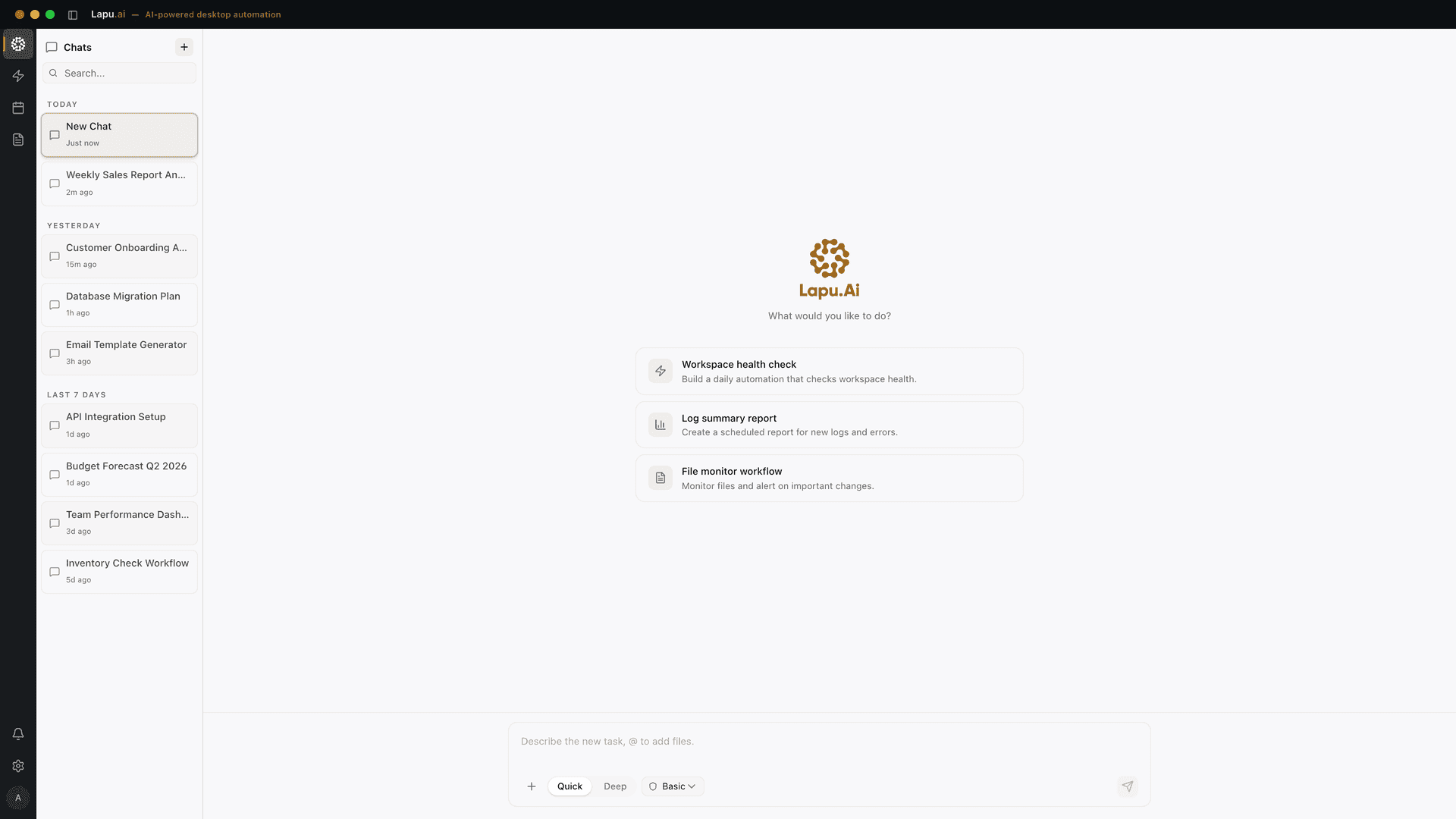
High fitDesktop AI agent for macOS and Windows that reads your repository where it already lives, runs your real test suite and linters, and answers codebase questions with file-and-line citations. Built around three properties that matter for Q&A on private code: the working tree never leaves the laptop (only the minimum context the model needs to reason about a specific question is sent across the network); every file read, every shell command, and every byte range sent to the model is recorded in a local audit trail; and the loop can verify its own claims by running the project's actual tests and grep/ripgrep commands rather than guessing from source alone. Free tier covers solo and side-project use; Pro and Max unlock larger model budgets and team features. Where it shines: questions about a private repo where the team policy is 'source does not leave the machine'; flaky-test triage where the agent can run the test and read the output; cross-file reference questions where the answer depends on knowing what callers do, not just what the function does; and security-style sweeps ('find every place we shell out to `exec` without sanitising input') that the agent can run as scripted searches and then explain. Where it is weaker than a hosted index for this task: it does not maintain a shared, pre-built index across a 10-million-line monorepo for many users — the trade-off is local sovereignty for breadth at organisational scale.
Learn more →2. Sourcegraph Cody
Medium fitSourcegraph's AI coding assistant built on top of Sourcegraph's code-search index. Cody Pro is $9 per user per month; Cody Enterprise starts in the higher tier and is usually bundled with the Sourcegraph search platform itself. Where it shines: large multi-repo codebases at organisations that already pay for Sourcegraph search — Cody inherits the multi-repo, cross-language code-graph index, so questions like 'find every caller of `chargeCustomer` across these forty services' work without per-developer reindexing. Reviews and posts often cite Cody as the strongest tool for navigating very large codebases. Where it is weaker for this task: the index, and therefore the answer path, runs on Sourcegraph's infrastructure (Enterprise self-hosting changes that for the largest customers); the model still sees the relevant code chunks during reasoning, so 'source never leaves the developer's machine' is not the trust model on offer. The enterprise price point — typically $49 per user per month for the model layer on top of search — is also a step up from the editor-coupled alternatives.
Learn more →3. Cursor
Medium fitAI-first code editor (a VS Code fork) with deep codebase context features — `@codebase` queries, repository chat, agentic refactors. Cursor Pro is $20 per month; Business and Ultra tiers add team controls and higher usage caps. Where it shines: developers who live in an editor and want one tool that both writes and answers questions, with the same chat thread carrying context through 'explain this' and 'now change it' turns. The `@codebase` feature lets you ask broad questions while reasoning over the whole repository, with the editor as the rendering surface for the answer. Where it is weaker for this task: Cursor sends code to its own infrastructure for indexing and inference (Privacy Mode for paid plans limits training and retention, but the request path is still vendor cloud); it is editor-coupled, so a question that should be answered without booting an IDE — for example, from a terminal during a Slack thread — is less ergonomic. And it is a paid editor, so the Q&A capability is bundled into a tool you also have to use for writing.
Learn more →4. GitHub Copilot Chat
Medium fitMicrosoft's chat-style AI assistant, included in Copilot plans (Copilot Free has a small monthly cap; Copilot Pro is $10 per month; Copilot Business is $19 per user per month; Copilot Enterprise is $39 per user per month with workspace-level repository indexing). Where it shines: GitHub-native teams who already pay for Copilot — Copilot Chat answers questions inline in VS Code, JetBrains IDEs, and the GitHub.com web UI, with `@workspace` and `@github` skills that pull repo context. The Enterprise tier adds a repository-level index for cross-file questions across the whole repo. Where it is weaker for this task: chat-style answers tend to be paragraph prose rather than line-anchored citations, so 'show me the file and line' often requires a follow-up; the request path is GitHub/Microsoft cloud (with policy controls but not the local-first trust model); and `@workspace` context coverage on the lower tiers is narrower than the full-repo answers you get from a dedicated index like Sourcegraph or a local agent that reads the working tree.
Learn more →5. Aider
Medium fitOpen-source AI pair-programming CLI that runs in the terminal. Free; works with hosted models (Claude, GPT-4o, DeepSeek, o-series) or fully local ones via Ollama or any OpenAI-compatible endpoint. Where it shines: technical users who want a terminal-native Q&A tool with a clean git history (every AI edit is committed with a descriptive message), and the option to run completely offline by pairing Aider with a local model. Aider builds a repo-map and uses it to ground answers across files, so 'what does this caller do' questions work even on medium-sized repos. Where it is weaker for this task: Aider's frame is pair programming, so the Q&A UX is a conversational REPL rather than structured line-anchored output; there is no GUI permission gate for filesystem and shell actions (the gate is a terminal prompt, which is fine for engineers but unfriendly to non-CLI users); and the repo-map is built per-session, so the first question on a large repo waits for the map to build.
Learn more →6. Claude Code
Medium fitAnthropic's official agentic CLI, paired with Claude Opus 4.7 by default. Bundled with Claude Pro and Max plans (Pro is $20 per month; Max tiers add larger weekly limits). Where it shines: agentic Q&A loops where the model reads files, runs tests, and verifies its own claims — Claude Code can answer 'why is this test failing' by actually running the test and reading the output, not by guessing from source. The CLI is local: it operates against the working tree, not a vendor index. Where it is weaker for this task as a standalone Q&A tool: it is a CLI, not a GUI, so non-terminal users will find a desktop GUI more accessible; the permission gate is text-mode, and the audit trail is implicit in the terminal scrollback rather than a structured log; and the model call is still to Anthropic's cloud, with the same architectural trade-off as any hosted frontier model — minimal context is sent, but not zero.
Learn more →
Why Lapu AI is built for Codebase Q&A
Lapu AI is the right agent for codebase Q&A when the repository is private, the questions are operational (not 'generate a feature'), and the answer needs to cite specific files rather than wave at the right neighborhood. The agent runs natively on macOS or Windows, reads your repository on the machine where it already lives, and grounds every answer in file paths and line ranges the user can open. When a question requires running code to verify the answer — 'is this test flaky because of a race in setup?' — the agent runs the test, captures the output, and quotes the failing assertion rather than inferring from source alone. A practical decision framework: if you work in a 10-million-line monorepo at an organisation that already pays for Sourcegraph and wants a shared multi-repo index for every developer, Sourcegraph Cody is the right layer and Lapu AI is complementary rather than competitive — Cody answers 'across the org', Lapu answers 'on this machine, on this branch'. If your team lives in Cursor and Q&A is one of several things the editor does for you, Cursor is fine and adding a desktop tool buys little. If your concern is 'source code never leaves the developer's machine' as a policy — regulated work, paranoid teams, private repos with sensitive data — or you want a desktop GUI with an explicit permission gate and a structured audit trail of every command the agent ran, Lapu AI is the right shape. Many teams pair Lapu AI for individual-developer codebase Q&A with a hosted PR-side reviewer like CodeRabbit or Copilot for the pull-request layer; the two cover different windows of the workflow.
FAQ
- Does Lapu AI upload my code to answer questions about it?
- No. The repository stays on your machine; Lapu AI reads it locally. When the model needs to reason about a specific question, only the minimum context — the files referenced by the question and the small slice of context the model needs to answer — is sent to the model endpoint. The audit trail records exactly which files, which byte ranges, and which prompt were sent for each answer, so a security review later has a real record to inspect.
- How does this compare to Sourcegraph Cody for codebase Q&A?
- Sourcegraph Cody is built on Sourcegraph's multi-repo code-graph index and shines at 'across the organisation' questions on very large monorepos. Lapu AI is built on the developer's local working tree and shines at 'on this machine, on this branch, including uncommitted changes' questions. Cody's index is hosted in Sourcegraph's infrastructure; Lapu's index is the working tree on your laptop. Many teams use both layers.
- Can Lapu AI answer questions about uncommitted changes?
- Yes — that is one of the main reasons a desktop agent is the right shape for codebase Q&A. The agent reads the working tree, including modified-but-not-staged files and staged-but-not-committed hunks, so questions like 'what does my current branch change about the auth flow' or 'are any of my uncommitted edits missing a test' have a real answer. Hosted PR-side tools cannot see this state — by definition they only see what has been pushed.
- Does it run my tests to verify its answers?
- Only after you approve. The first time the agent wants to run `npm test`, `pytest`, `cargo test`, or any shell command, you see the exact command, the working directory, and a one-sentence rationale; nothing executes until you approve. You can pre-approve a class of commands for a session if you trust the plan, but there is no silent execution. When the agent uses a test run to ground an answer, the answer quotes the relevant section of the output and links to the file under test.
- What about asking questions across multiple repositories?
- Lapu AI can point at any local directory and answer questions against it, so a developer who has cloned three or four related repos can ask cross-repo questions by giving the agent the parent directory. For a 'shared index across the entire engineering org' workflow, a dedicated multi-repo platform like Sourcegraph is the better layer; Lapu is the better layer for the questions an individual developer actually asks day-to-day on the machine in front of them.
- How does this compare to a CLI agent like Aider or Claude Code for codebase Q&A?
- Aider and Claude Code are excellent for terminal-native engineers who already live in the shell. Lapu AI covers the same ground with a desktop GUI: a visible permission preview before each action, a structured audit trail rather than terminal scrollback, and a cross-platform install on both macOS and Windows. If you are a CLI-first user, Aider and Claude Code are reasonable; if you also want a GUI and a non-terminal user on your team, Lapu is the friendlier shape for the same local-first outcome.
- Does it work on Windows?
- Yes. Lapu AI runs natively on macOS 12 and later (Apple Silicon) and Windows 10 or 11 with the same codebase-Q&A features. Project commands work via the standard shell on each platform — `bash` or `zsh` on macOS, PowerShell or `cmd` on Windows — and the permission gate, audit trail, and local-first behaviour are identical across both.
Related
Automate the work between you and outcomes
Lapu AI handles the repetitive work between you and outcomes. One desktop agent, zero tab-switching. Available now on macOS and Windows.
- 1-click uninstall
- Cancel anytime
- Files never leave your computer
Free to start. Cancel in 1 click. Files stay on your machine.