
Lapu AI for Developers
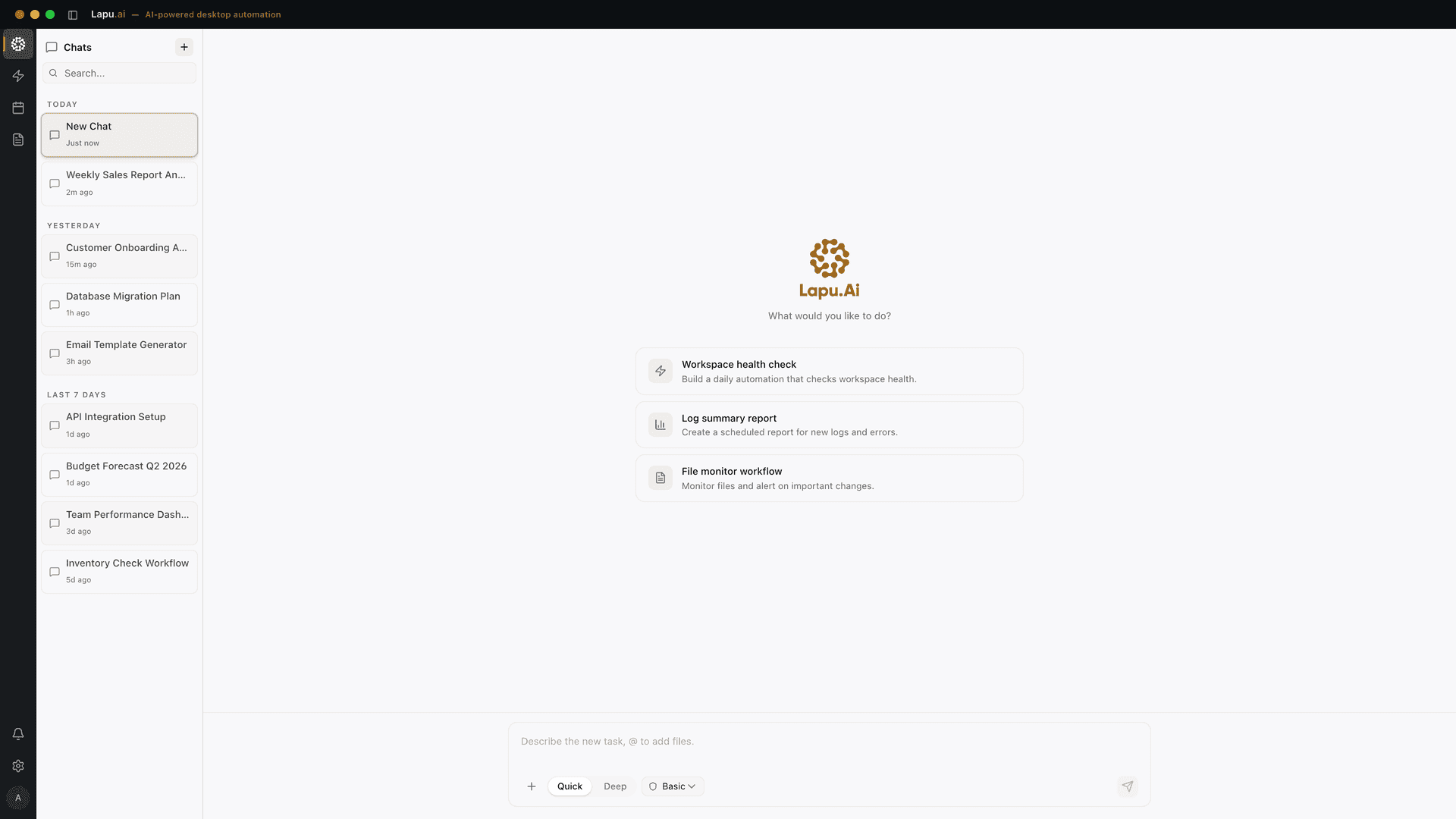
Developers spend hours on work that is not writing code: organizing files, scaffolding projects, running builds, searching codebases, drafting changelogs, replying in Slack about a stack trace. Lapu AI is a desktop agent that handles those multi-step tasks across your terminal, editor, file system, and apps — with explicit permission at every sensitive step and an audit trail of every command it ran.
- 1-click uninstall
- Cancel anytime
- Files never leave your computer
Pain points Lapu AI addresses
- Context-switching between editor, terminal, browser, docs, and Slack to complete a single ticket — the cost is focus, not seconds
- Repetitive project setup (folders, configs, lint, CI, env files) that should take 30 seconds but takes 30 minutes per repo
- Codebase-wide search where grep and sed are not enough: usages of a symbol across imports, JSX props, dynamic strings, and tests
- Manually drafting release notes, changelogs, and PR descriptions from `git log` and Linear tickets
- Cleaning up disk-eating artifacts — node_modules, .next caches, stale local branches, untagged Docker images
- Reading a stack trace from `logs/`, finding the offending file, and reproducing the bug locally before a fix is even possible
- Triaging a flaky test by re-running it 20 times and bisecting which commit introduced the flake
- Keeping dependencies current across a monorepo without breaking the lockfile or six downstream packages
Top tasks for Developers
1. Code review of recent commits
Pre-merge sanity check on a teammate's PR. Lapu AI reads the diff, runs the test suite, runs the linter, summarizes risk areas (auth, payments, migrations), and produces review notes you can paste into GitHub. It will flag missing tests, suspicious type assertions, and any new env vars introduced.
"Review the last 5 commits on this branch, run the test suite, run `npm run lint`, and summarize any risk areas, missing tests, or new env vars I need to add to Vercel."2. Scaffold a new project
Bootstrap a Next.js + TypeScript + Tailwind + Vitest + Playwright project with CI and folder structure that matches your team's conventions. Lapu AI runs the installers, edits the configs, writes a minimal smoke test, initializes git, and makes the first commit — pausing only for the GitHub repo creation step.
"Create a new Next.js project with TypeScript, Tailwind 4, Vitest, Playwright, and a GitHub Actions CI pipeline. Add a Dependabot config, initialize git, and make the first commit."3. Codebase-wide search and refactor
Find every usage of a deprecated function across 30+ files — including dynamic string usages grep would miss — propose a structured replacement, edit each file, and run the affected tests after each change. If a test fails, Lapu AI stops and shows you the diff before continuing.
"Find every usage of `legacyFetch` across this repo, replace it with `fetchWithRetry` from `lib/http.ts`, and run `vitest related` after each file change. Stop and show me the diff if any test fails."4. Read a stack trace, find the file, propose a fix
Paste a production stack trace from Sentry or `logs/app.log`. Lapu AI walks the frames, opens each file at the right line, reads adjacent context, identifies the most likely root cause, drafts a fix on a new branch, and runs the failing test that would have caught it. You approve the patch before commit.
"Read the stack trace in `logs/incident-4821.txt`, find the failing function, write the failing test that reproduces it, then propose a fix on branch `fix/incident-4821`."5. Generate release notes from git
Draft user-facing release notes from the commit log between two tags, grouped by conventional-commit type (feat/fix/chore/docs). Lapu AI excludes internal-only refactors, links each entry to the PR, and writes both a Markdown changelog and a shorter Slack-ready summary.
"Read commits between `v1.4.0` and `v1.5.0`, group them by feat/fix/chore, exclude pure-internal refactors, and write both a CHANGELOG.md entry and a 5-bullet Slack summary."6. Clean up build artifacts and stale branches
Reclaim disk space and prune stale work. Lapu AI lists candidates with size, age, and last-commit info, then waits for per-item approval before deleting. Safe by default: nothing is removed without an explicit confirmation.
"Find all `node_modules` folders deeper than 2 levels, all `.next` and `.cache` directories, and local git branches merged into `main` older than 30 days. Show me the list with sizes, then delete with my approval."
Related use cases
FAQ
- Does Lapu AI work with my IDE?
- Lapu AI runs alongside your IDE — VS Code, Cursor, JetBrains, Zed, Neovim. It can open files in your editor, read them, run shell commands, and trigger your build/test pipeline. It does not replace your editor or your inline code completion.
- Is Lapu AI a replacement for Cursor or GitHub Copilot?
- No, and you should not pick one over the other. Cursor and Copilot focus on in-editor code generation and autocomplete inside a single file or repo. Lapu AI focuses on multi-step tasks that span files, terminal, git, and apps — refactors across 30 files, drafting release notes, triaging logs, scaffolding new projects. Many developers run both side by side.
- When should I NOT use Lapu AI?
- If your task is greenfield code generation inside a single file — for example, writing a new React component from scratch with autocomplete — use Cursor or Copilot, not Lapu AI. If you want a fully autonomous remote coding agent that spins up its own VM and works for hours unsupervised, Devin or Codex agents are a better fit. Lapu AI is best when the task crosses files, apps, or a permission boundary your editor can't reach.
- Can Lapu AI commit to git?
- Yes — git operations are shell commands the agent runs with your permission. You can pre-approve read-only commands like `git status`, `git log`, and `git diff` while still requiring explicit confirmation for `git commit`, `git push`, and any destructive command like `git reset --hard` or `git push --force`.
- How does Lapu AI handle private code and secrets?
- Files stay on your machine. Only the relevant context for a given task is sent to AI model providers via Lapu AI infrastructure. There is no Lapu AI cloud storing your repo. You can mark paths like `.env*`, `id_rsa`, and `secrets/` as off-limits so Lapu AI will refuse to read them even when a prompt asks.
- Can Lapu AI run my CI locally?
- Yes. Lapu AI can execute the same shell commands your CI runs — `npm run typecheck`, `npm test`, `npm run build`, `playwright test` — in the same environment, so you can validate changes before pushing and avoid the 6-minute round-trip on GitHub Actions.
- Does Lapu AI keep an audit trail?
- Every shell command, file read, file write, and tool call is logged locally with a timestamp and the prompt that triggered it. You can replay any task to see exactly what the agent did, and the log is grep-able if you need to figure out which run touched a file.
Lapu AI for Developers
Free to start. See exactly how Lapu AI works for Developers before you download.
- 1-click uninstall
- Cancel anytime
- Files never leave your computer
Automate the work between you and outcomes
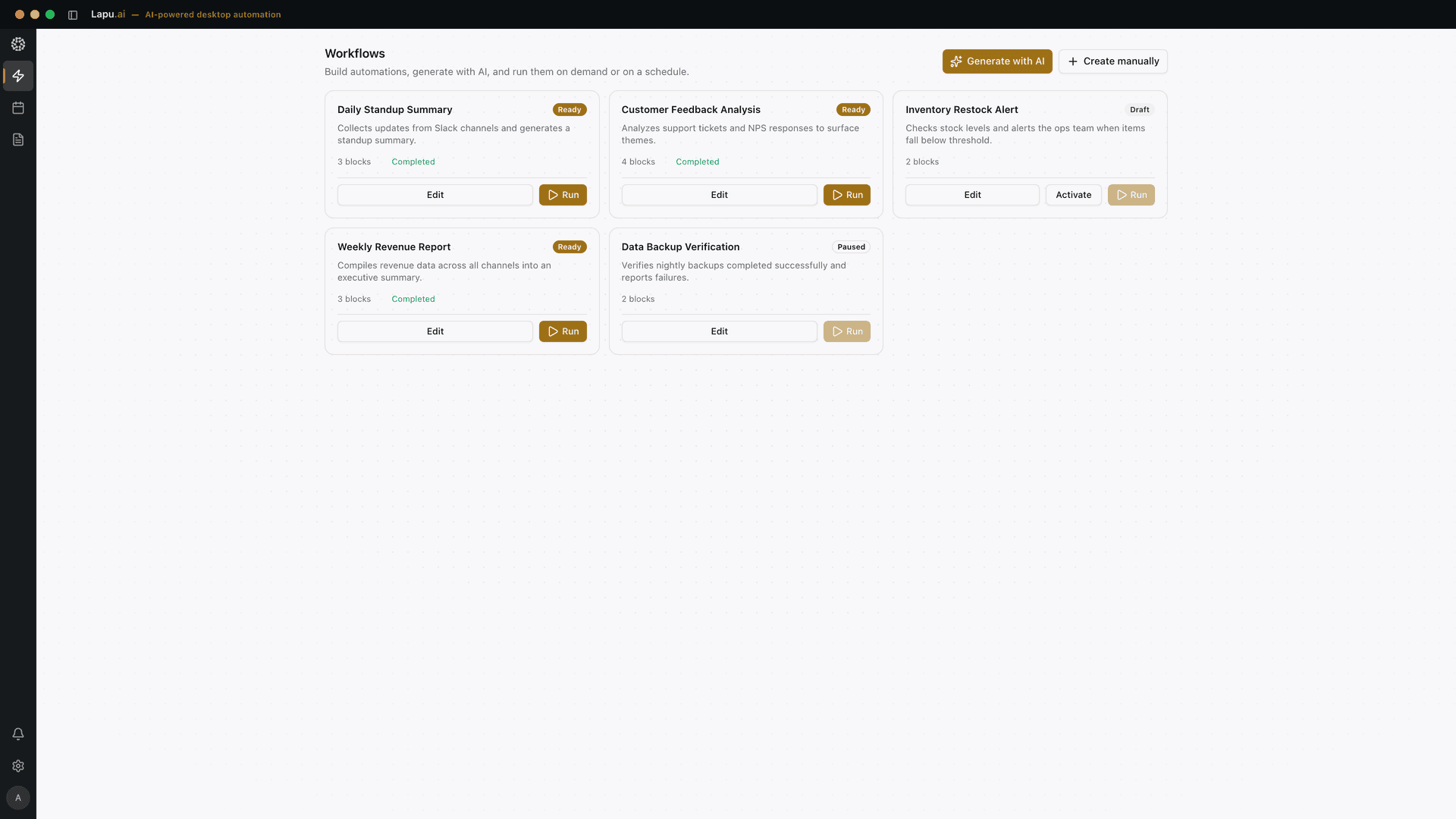
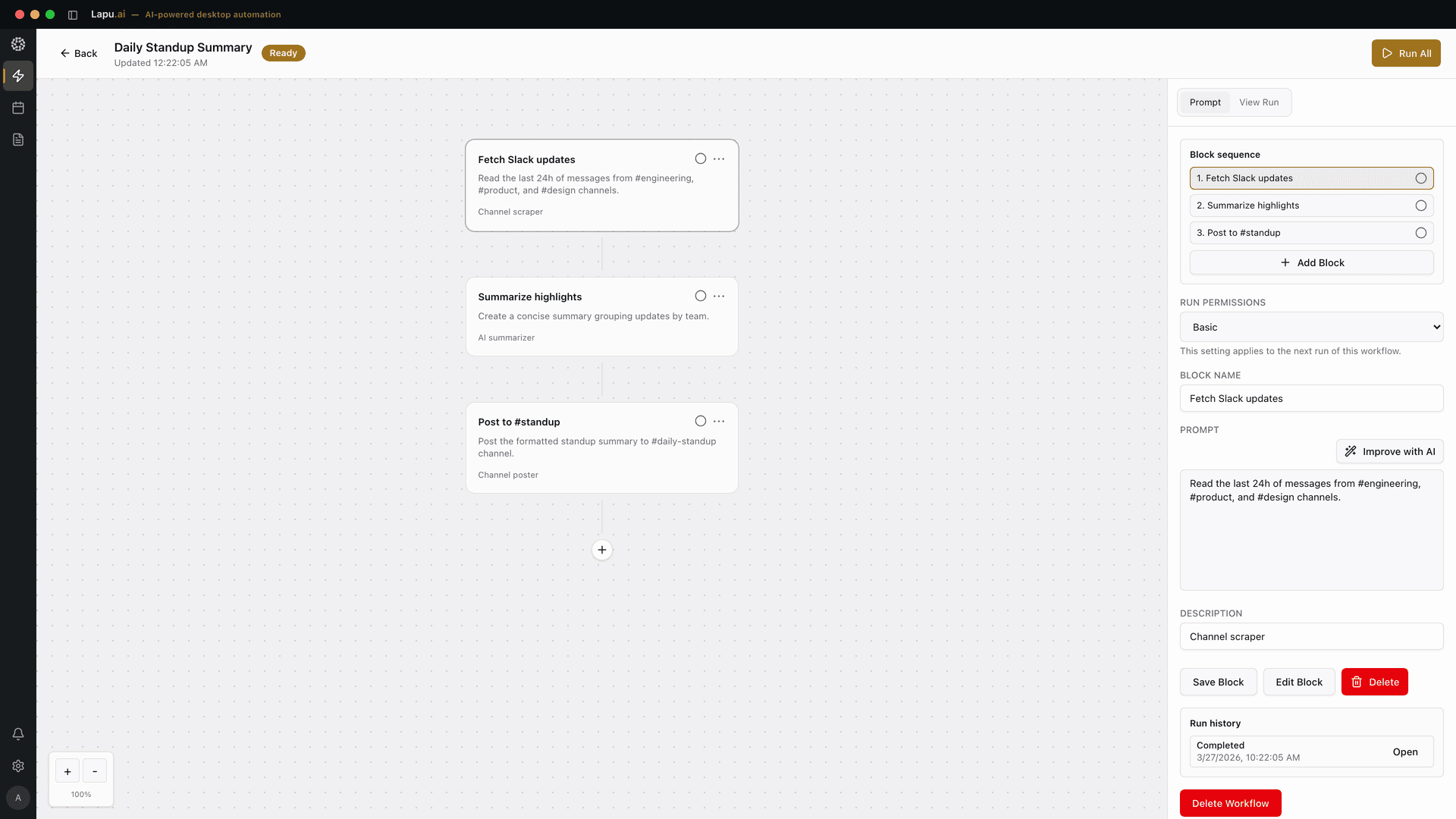
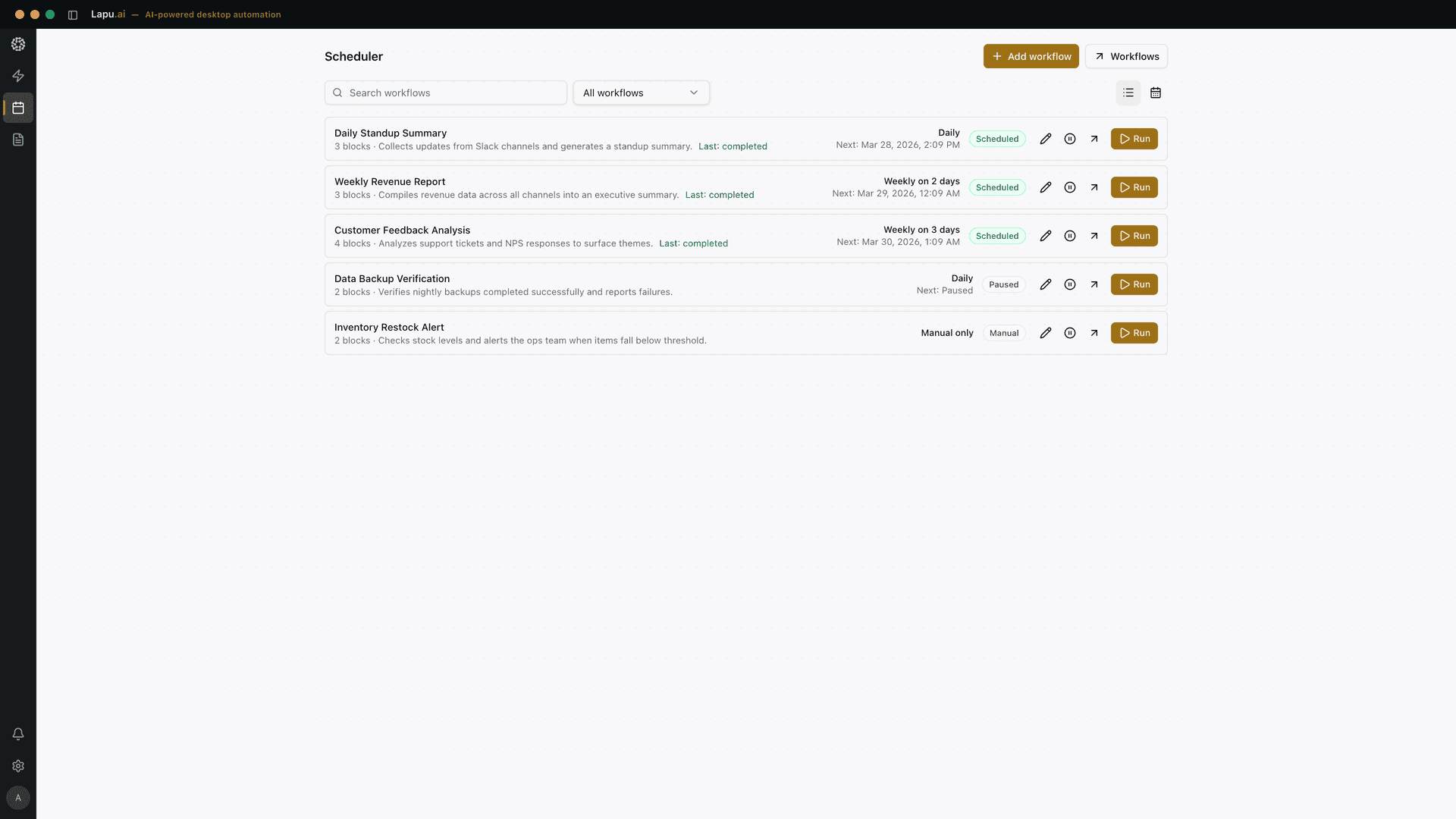
Lapu AI handles the repetitive work between you and outcomes. One desktop agent, zero tab-switching. Available now on macOS and Windows.
- 1-click uninstall
- Cancel anytime
- Files never leave your computer
Free to start. Cancel in 1 click. Files stay on your machine.