
AI Agent That Runs Terminal Commands
An AI agent without shell access is half a tool. The shell is where developers and ops actually live, and a useful agent has to operate there with the same care a human would.
Reviewed
- 1-click uninstall
- Cancel anytime
- Files never leave your computer
Highlights
Real shell execution
Bash, zsh, and PowerShell commands run on your machine. The agent does not simulate output — it captures actual stdout and stderr.
Per-action permission
Every shell invocation requires explicit user approval. You see the command before it runs and can edit or deny it.
Output-aware reasoning
After a command, the agent reasons about the output and decides what to do next. Errors trigger debugging steps; success advances the workflow.
Cross-platform
The same agent loop runs on macOS (zsh, bash) and Windows (PowerShell, cmd). Skills written on one platform port to the other where the underlying commands exist.
How shell execution works
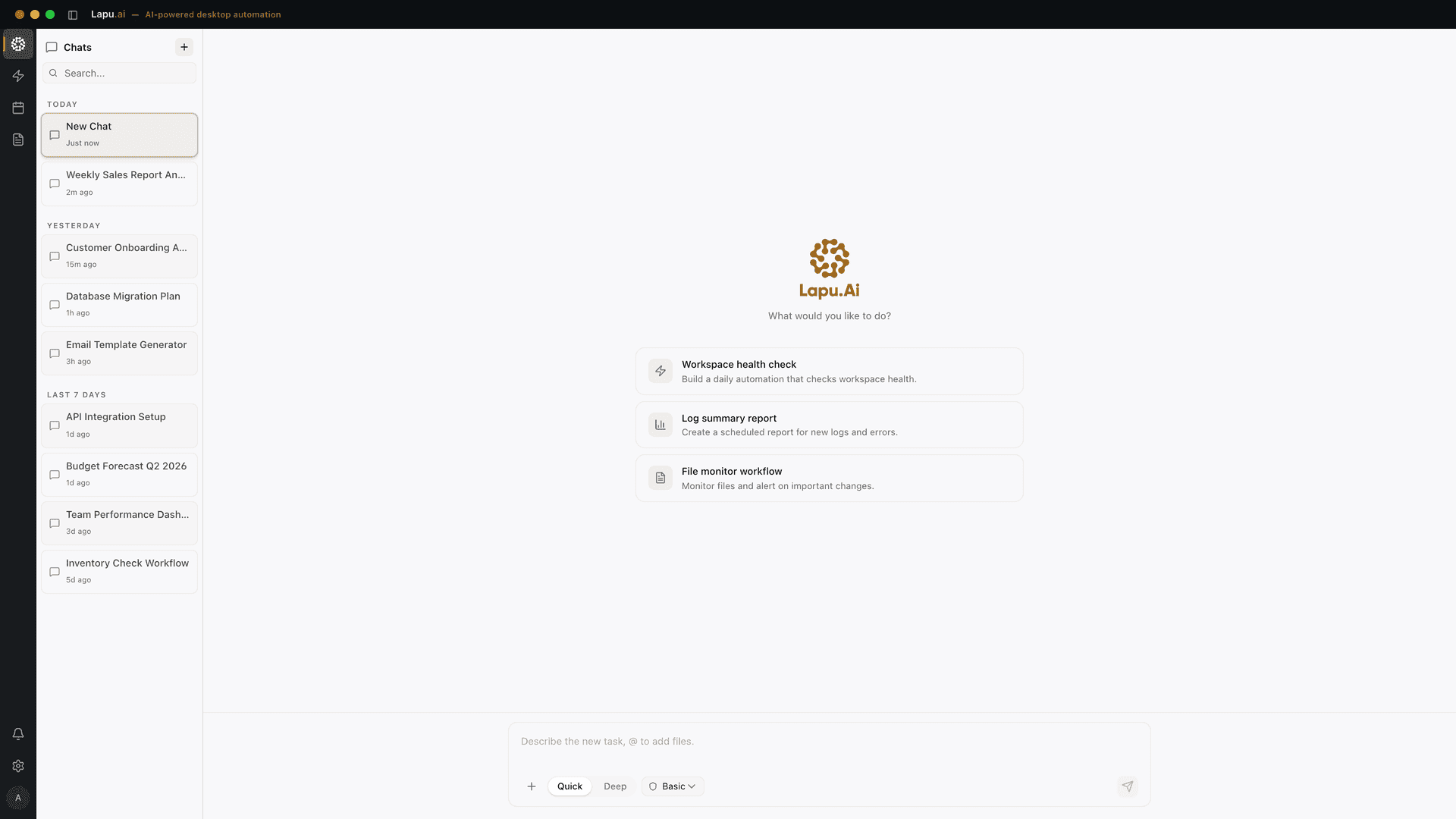
When a step requires a command, Lapu AI shows the command, the working directory, and the rationale. You approve or edit it. The command runs locally, and the agent receives the captured output. If the command fails, the agent attempts to debug — reading error messages, trying alternative invocations, or asking you for clarification — instead of pretending to succeed.
What this enables
Anything you do at the shell, the agent can do with your approval. Run a test suite, kick off a build, search a codebase with grep, fetch and parse JSON with curl and jq, manage virtual environments, install packages. Combined with the file tools and desktop automation, the shell is the workhorse for technical workflows.
Try Lapu AI for free
Free tier with no credit card. macOS and Windows — see the app before you install.
- 1-click uninstall
- Cancel anytime
- Files never leave your computer
Frequently asked questions
- Can the agent run commands without my approval?
- No. Every shell command surfaces a per-action approval prompt before executing. You see the command and can deny or modify it.
- What shells are supported?
- On macOS, zsh and bash. On Windows, PowerShell and the Command Prompt. The agent picks the appropriate shell based on the platform and the command.
- Can it run sudo commands?
- Sudo prompts for the user password, which Lapu AI does not provide automatically. You can approve a command and enter your password manually if appropriate.
- Does it read environment variables?
- Commands inherit the environment of the shell session the agent runs them in. Be mindful of secrets in environment variables when scoping what the agent can run.
- Is there a sandbox?
- Commands run in your real shell so they have the same effect as if you typed them. The safety layer is the per-action approval prompt, not a sandbox. Plan permissions accordingly.
Related
AI Agent That Reads and Edits Files
An AI agent that reads, edits, and writes files on macOS and Windows. Lapu AI ships local file tools with per-action approvals and an audit trail.
Desktop AI Agent for Developers
A desktop AI agent for developers. Lapu AI runs locally with shell, grep, file edit, and desktop automation on macOS and Windows.
Desktop AI Agent for Operations Teams
A desktop AI agent for ops, IT, and BizOps. Lapu AI automates desktop work across files, shell, and apps — with permission gates and reusable skills.
Local Desktop AI Agent
A local-first desktop AI agent for macOS and Windows. Your files stay on your machine; Lapu AI uses permission-based local tools with frontier AI.
Compare against alternatives
Automate the work between you and outcomes
Lapu AI handles the repetitive work between you and outcomes. One desktop agent, zero tab-switching. Available now on macOS and Windows.
- 1-click uninstall
- Cancel anytime
- Files never leave your computer
Free to start. Cancel in 1 click. Files stay on your machine.